
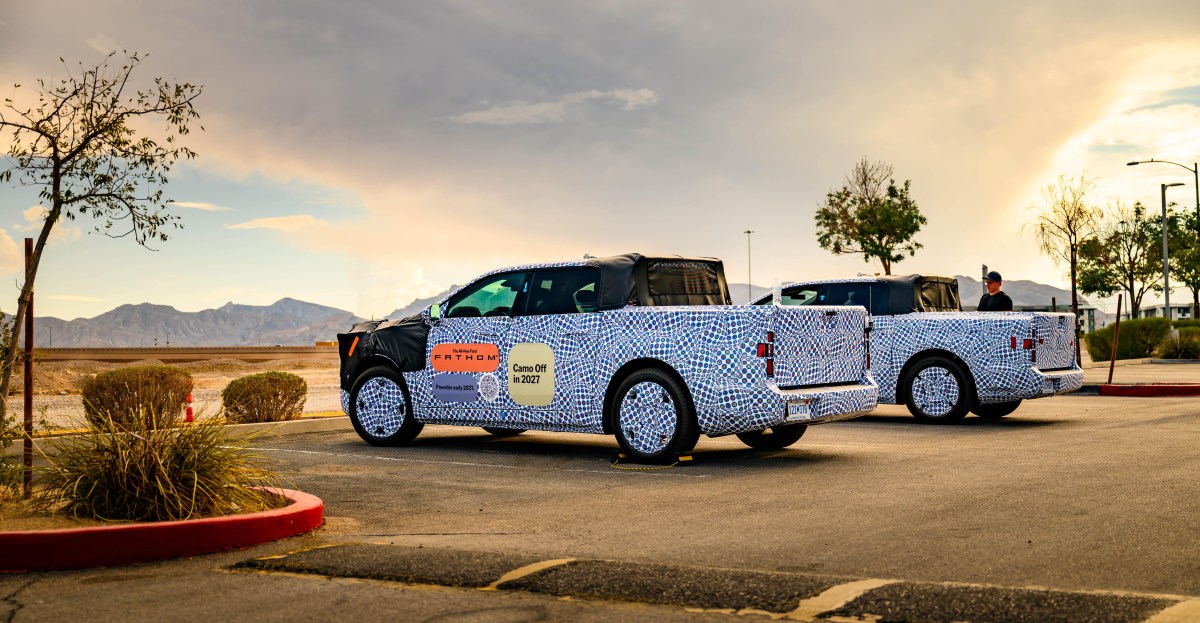
We’re still a few months away from the official reveal of the Ford Fathom, the automaker’s first next-generation electric vehicle. While we wait, Ford has been whetting our appetite with news about the sub-$30,000 pickup — including today’s announcement about the Fathom’s bidirectional charging capabilities.With an increasing number of EVs coming out with bidirectional vehicle-to-home (V2H) or vehicle-to-load (V2L) charging capabilities, Ford is trying to position the Fathom as a key entrant — and one that simplifies the system by making it an everyday reality rather than a $10,000 luxury perk. Unlike the discontinued F-150 Lightning, which required a massive, expensive external DC-to-AC wall inverter, the Fathom packs the inverter directly into its onboard “E-box” to pump out over 10 kW of AC power natively.The Fathom’s built-in inverter converts its battery power into standard household electricity to run appliances, back up a home during an outage, or feed energy back into the grid.The Ford Fathom’s E-box supplies up to 10kW of power. Taking advantage of these features will require additional hardware, though Ford aims to make it significantly cheaper than current options. To send power back to the grid, owners will need the Ford Home Power Station. Ford is targeting a 50 percent discount compared to the existing $1,310 Ford Charge Station Pro. For whole-home backup power during a blackout, owners must pair that station with a backup panel. While that combination typically runs around $5,205, Ford is aiming for an estimated $3,123 — a roughly 40 percent reduction — though finalized pricing for both packages is still pending.The Fathom, a $28,000 electric pickup truck, will be the first vehicle on Ford’s new Universal Electric Vehicle Platform, an innovative new system designed to maximize aerodynamic range while also reducing production costs so Ford can make a profitable EV. For over a year, the company has been hyping it as its “Model T moment” that will revolutionize nearly everything at the 123-year-old company.Another barrier to V2H or V2L charging is red tape from public utilities. Ford’s solution was to team up with five of North America’s biggest power companies — Pacific Gas and Electric (PG&E); American Electric Power (AEP); BC Hydro; Consumers Energy; and Exelon — which collectively cover millions of customers in the US and Canada. Ford theorized that whatever rules they agree on will likely become the standard everyone else follows. They agreed to cut the paperwork for basic storm backup, use common plugs and software, and make grid programs automatic.Cutting the cost of the Ford Home Power Station and Backup Panel is certainly helpful, but homeowners will still face additional costs related to permitting, electrician labor, and heavy-gauge wiring. These could conspire to keep these bidirectional charging features out of reach for some customers.Still, Ford is intent on keeping the costs low for its new electric truck. With supply chain constraints and trade upheaval, that will remain a central challenge for the automaker as it gets closer to one of the most important vehicle debuts in Ford’s history.Images by FordFollow topics and authors from this story to see more like this in your personalized homepage feed and to receive email updates.Andrew J. Hawkins
Ford’s sub-$30K electric truck puts the home backup inverter right inside the vehicle
Full Article
Original Source
Read the full article at Theverge →KhanList aggregates and links to publicly available news content. We do not host full articles from third-party sources. Always verify important information with original sources.