
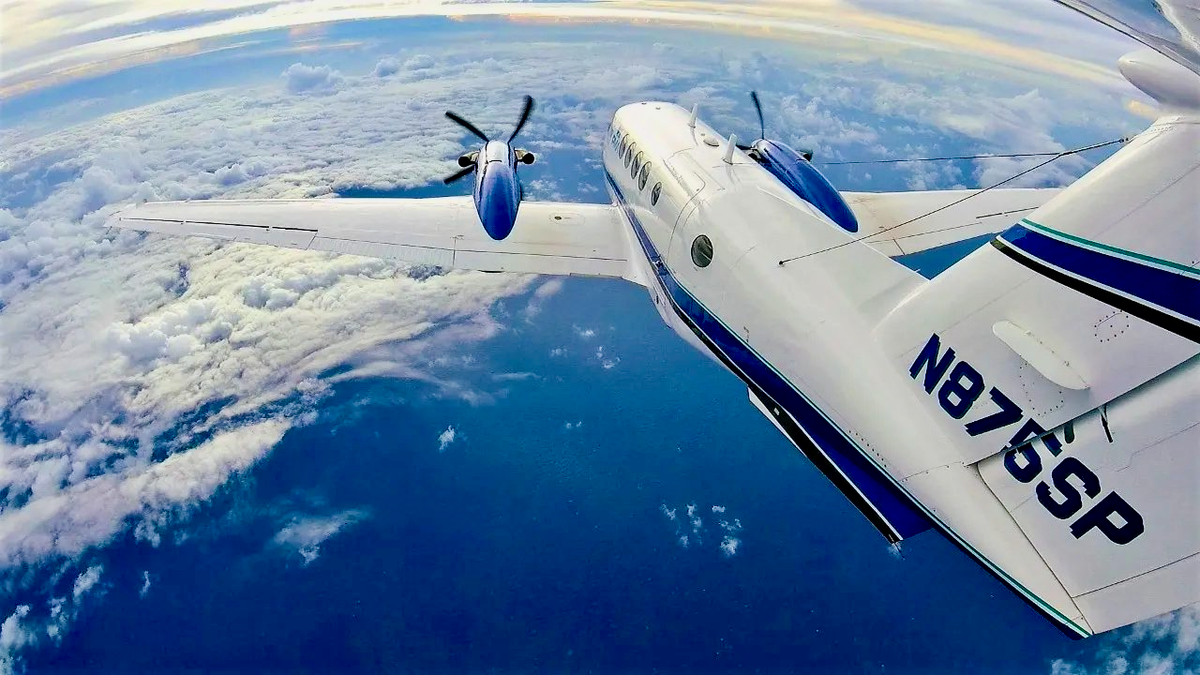
Published Nov 16, 2026, 1:00 PM EST Aaron is an aviation enthusiast and world traveler with a deep interest in aerospace history and technology. He has traveled around the world numerous times, often incorporating visits to aviation museums and historic aircraft collections into his journeys. A native of New Zealand, he is an expert in aviation and maintains a broad interest in a variety of other subjects. In October and November 2026, I flew with Pacific Missionary Aviation (PMA) on a commercial scheduled passenger flight from Palau to Yap. Having been invited to the co-pilot's seat in the Beechcraft Super King Air 200 (B200), I got to know and interview the volunteer pilot, Amos Collins. Collins has worked with the organization for decades and lives on Yap Island. During the flight, through the aircraft's headphones, he explained to me the airline and its charity role in providing services to remote islands in the Pacific. Knowing me to be a freelance aviation journalist for Simple Flying, he invited me on a mission to the minor outlying island of Ulithi to see firsthand the work the airline does to supply remote islands that would otherwise lack air services. The central purpose of PMA's Christian mission is to assist residents on remote Pacific islands, including medical evacuation, logistical support, and passenger service. PMA's Efforts To Serve Remote Pacific Islands Credit: Aaron Spray Pacific Missionary Aviation is a small aviation organization operating in the Pacific Micronesian countries of Palau and the Federated States of Micronesia (FSM). In FSM, they primarily serve the island state of Yap and its outlying islands with aircraft. Collins explained, "The founder of PMA, Edmund Kalau, had served as a pilot with the Luftwaffe in WWII and was a Missionary from a German organization called Liebenzell Mission. He was a missionary in Yap for about 15 years, from about 1955 till 1970. He explained, "During that time, he saw a tremendous need for medical evacuations from the outer islands. And knowing there was a runway in Ulithi and Woleai from WWII, he had a vision to start a flight medical service." He raised his own funds to buy an airplane, and he found a pilot to come serve. At first, he asked the German Mission to run it, but they didn’t know anything about airplanes, so they said no. Kalau felt so strongly about it that he split off from them and started PMA. In 1974, the first airplane arrived in Yap with Edmund Kalau and Maurice Pickard. Today, it operates a fleet of mostly Beechcraft aircraft to provide services to minor islands with airstrips and vessels to reach atolls and islands with no airstrips. United Airlines connects some of the main islands with its famous Island Hopper, while small national airlines connect various minor islands. Even so, many small islands with usable airstrips are left without a regular flight connection. Donation Of Two Super King Air 200s Credit: Aaron Spray In 2018, United Airlines dropped its flight between Palau and Yap; this left a void that PMA felt it should fill for the islanders. Without a flight connection, it would be more difficult for residents on the islands to travel back and forth and for Yap to receive the few tourists it attracts. Amos Collins told me he spent time researching what the best option would be. At the time, PMA's largest aircraft were Beechcraft Queen Airs, but these were not suitable for the mission. PMA determined that Beechcraft Super King Air 200s were the most suitable for the role. After some searching, Collins found used King Air 200s for sale for the relatively low price of $1 million. These had been in service for the charity organization, Samaritan's Purse, in Africa. Collins told me he started messaging Franklin Graham, the CEO of Samaritan's Purse. Graham is the son of Billy Graham, the well-known evangelist. Collins expressed his desire to purchase them, but acknowledged PMA would only have the money if it secured a grant it was anticipating. The conversation and back-and-forth messaging is a fabulous tale, but it is not possible to detail it here. The result of the messages between Collins and Graham was Graham declaring, "You don’t need a grant; our God is RICH!" Graham then announced that Samaritan's Purse would be selling the two Super King Airs for $1 each, and that it would overhaul and retrofit the aircraft before delivery and pay for the pilots to be trained on them. Having established a connection with PMA, Samaritan's Purse continued to make many more contributions. Covering The Costs Of Outer Islands Credit: Aaron Spray The pilots flying for PMA are volunteers who do not take a wage from the organization. Collins told me that his church in Washington State donates money to the organization with a note that its preferred use is to support him and his family. Pilots flying for PMA are expected to sign up for three years on a volunteer basis and to secure their own donors. I was told one of the pilots I met, Mark, is able to sustain himself as a retired US Air Force pilot and had worked with FedEx. But even with the donations and volunteer pilots, the aircraft are expensive to operate, especially in the challenging logistical environment of the remote Pacific. To help cover the expenses, the operation in Palau offers 40-minute sightseeing flights for $200 per person (minimum three people) and $160 per person for 25 minutes (minimum three people). PMA's aircraft (per PMA) Registration Role Primary operational base Beechcraft B200 King Air N468SP Passenger/cargo, MEDEVAC, longer-range island connections Yap Beechcraft B200 King Air N875SP Passenger/cargo, MEDEVAC, longer-range island connections Yap Beechcraft 65-B80 Queen Air N44MA Short-field passenger/cargo and island support Palau Beechcraft 65-B80 Queen Air N46MA Short-field passenger/cargo and island support Palau Cessna TU206G Turbo Stationair N181PK Light utility, sightseeing Palau Collins told me one of the main ways PMA generates revenue is with the weekly flights between Yap and Palau. These flights carry seven to nine passengers and cost $400 per person (plus $100 PPEF on flights to Palau). This allows PMA to offer flights at $100 per person to the outer island of Ulithi, $120 to Fais, and around $400 per person to far-flung Woleai. The rates for non-residents are around $20 extra. Linking Outer Islands Credit: Aaron Spray PMA operates weekly flights (advertised flexibly as 'on demand') to the outer islands of Ulithi and Fais and charter flights to Woleai. The day I flew, PMA was using its second King Air on a charter flight to Woleai. The combined population of the outer islands is around 4,000 (around 7,000 people live on the main Yap island). The Ulithi Atoll is home to around 850 residents, Fais is home to around 300, and Woleai is around 1,000. Other islands lack landing strips. I drove to the airport with Collins. At the PMA hangar, near where the USAF is set to expand the airport to accommodate fighter jets, locals from the outer islands living in Yap had assembled to send their mail, supplies, and wares back to their home islands. The cost of freight is $1 per pound (0.45 kg), which adds to the expenses of goods for sale on these remote islands. The day I flew there, there were only two passengers going to Ulithi, and this enabled PMA to carry a considerable amount of rice for the island (see picture above). PMA has a scheme whereby it flies the rice to the islands free of the otherwise considerable freight charge whenever there is unused payload capacity. The rice is modestly marked up, with the proceeds then used to purchase emergency beacons for island fishermen. The return flight from the Ulithi Atoll was mostly local passengers going to Yap and had little to no cargo. How PMA Offers Free Emergency Services Credit: Aaron Spray Collins said originally the plan was "to just have a plane to sit and wait to fly free medical evacuations. But the Government of Yap said, 'If you have an airplane, you might as well also provide transportation services. And they basically told him that either he flies commercially or won’t fly at all.'" After that, PMA became a commercial operation, but "has always provided FREE medical evacuations from the outer islands to Yap." He explained that to this day, if someone is critically sick, they will radio the hospital, which confirms how critical it is, and then, if critical, "they call us and we go. No cost to the state or individual." Collins explained that on their flights, if a patient needs to board, the medic will issue them a D-Form, which is their free ticket to board the plane. Collins explained, "Commercial flights help pay for our fuel, insurance, parts, and allows us to also offer those services free to the locals." He said they also offer sea searches for the cost of fuel only. "If someone is lost at sea, the government will dispatch us to go search, and we send them a bill for the cost of fuel." Flying Doctor Services & Search And Rescue Credit: Aaron Spray One of the main ways PMA can contribute to the islands is by being a first responder assisting search and rescue efforts when fishermen are reported lost at sea. The airline is also able to conduct medical evacuations for residents of other outer islands who need to attend the larger hospital on the main island of Yap. Not all of these missions are emergencies. One of the more notable pieces of equipment I saw is an aviation stretcher kept inside PMA's hangar. PMA also flies doctors and nurses out to the outer islands where they can conduct some simple medical operations for the locals on the islands. This is somewhat similar to the famous Obris Flying Eye Doctor or to other flying doctor concepts, but as a fairly modest affair. It can be noted that PMA is continuing to fulfill its mission and serve the islands even as competition between the United States and China heats up. For years, Yap has been a remote and largely forgotten location, but now the US has approved funds to expand Yap Airport's apron as part of its Agile Combat Employment doctrine (ACE) to disperse aviation assets from Guam. When I flew through Yap, the work had not yet begun, but the island is becoming relevant in geostrategic terms.
Flying With The Tiny Airline Where Paying Passengers Help Fund Life-Saving Medical Flights
Full Article
Original Source
Read the full article at Simpleflying →KhanList aggregates and links to publicly available news content. We do not host full articles from third-party sources. Always verify important information with original sources.