
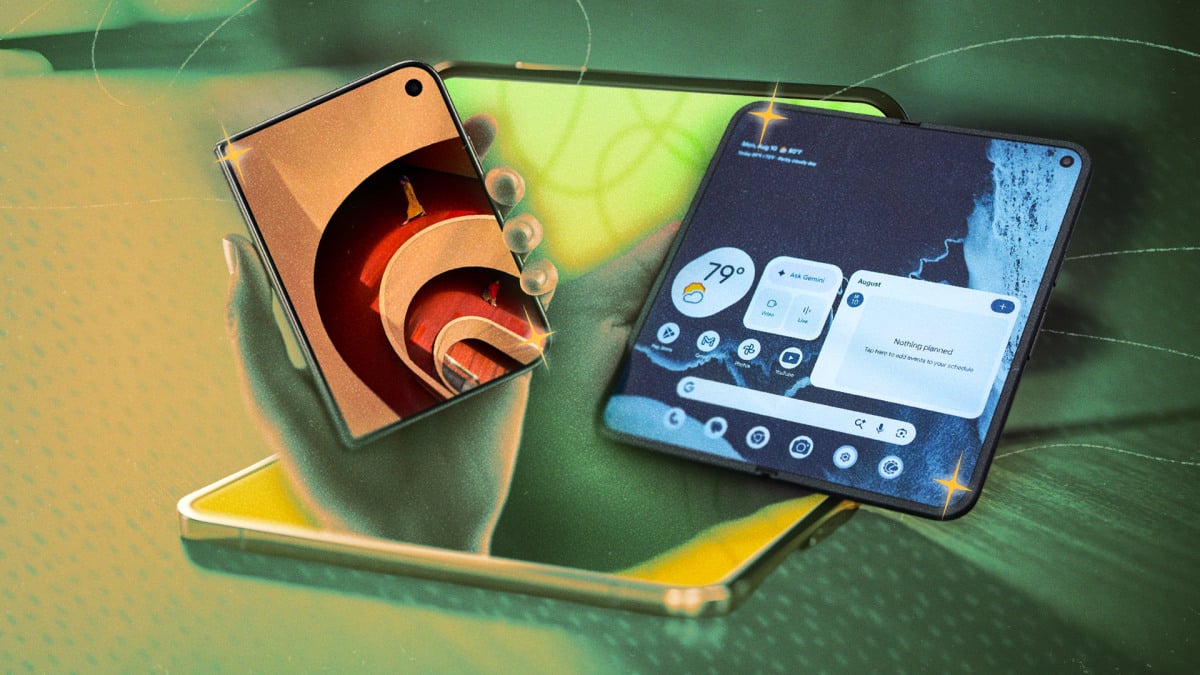
We may earn a commission from links on this page. The iPhone Duo might be the highest profile foldable phone to date, but it’s by no means the first. Personally, I’ve had my eye on the Google variant, the Pixel 11 Pro Fold—and recently I finally took the plunge. I thought I’d done my research to know how different having a foldable phone would be, but I still had a bit to learn. Here are some of the things I wish I’ve learned along the way after making the jump to foldables.The aspect ratio matters a lotOne of the most notable aspects of the iPhone Duo is how wide its screen is, even while closed. And there’s a good reason for that: The larger screen while open has exactly the same 1.41:1 aspect ratio as the smaller screen while closed. This has a ripple effect on how every app you use looks and feels—and whether you like Apple’s approach is largely a matter of personal preference.Compare with my Pixel 11 Pro Fold, which features an extremely tall 2.17:1 aspect ratio when closed, but a nearly square 1:04:1 aspect ratio when open. On the outer screen, apps are a little less wide than on my old phone, but there’s plenty of space for reading books or articles on the inner screen. I like the tall, thin display personally because it feels easier to reach buttons with my thumb, and the wider display is better for reading. However, this approach can occasionally result in some odd app layouts. Not every app is designed for tablets, especially on Android, and shifting the aspect ratio between the inner and outer display sometimes means re-rendering or even restarting an app entirely to load properly.The iPhone Duo has a more consistent aspect ratio and general feel between the inner and outer display, but it comes at the cost of a really wide phone. Neither approach is better or worse on its own, but it might be worth going to a local store to get your hands on the phone you’re thinking about before buying.The inside screen scratches more easilyFor years, the screens on most smartphones have been made of increasingly tough and scratch-resistant glass. So tough that you might not even need a screen protector anymore. On a foldable phone, that can be true of the outside display, but it’s very much not when it comes to the inner, foldable display.Screens might be foldable, but the strong, durable glass that makes your phone so scratch-resistant isn’t. No matter what foldable phone you use, the covering on the inner display will be more flexible, and thus softer. Apple uses a nano-texture polymer film that can be replaced, but the film on most foldable phones cannot. That means if they get damaged or scratched, those marks will be there for the life of your phone.If you (like me) haven’t considered a screen protector in a while, it might be time to try one again, at least for the inner display. It’s also worth keeping in mind how rough you plan to be with your phone. Construction sites or factories might not be the best home for a foldable phone you plan to open a lot, but an office job should be a bit safer.The case situation can be weirdSimilar to the screen protector issue, cases can be more of a headache. Most rigid cases will come in two pieces, and the piece that covers the outer display can be shockingly minimal—barely more than a frame, for some of the cases I looked at. A poorly made case can be brittle or pop off more easily, so it’s more important to get a high-quality one.If you like to use your phone case as your wallet, it’s also important to be wary of cases that aren’t specifically designed for your model of phone (and maybe some that are). A lot of wallet cases are built to unfold to reveal your phone’s screen on one side, and your cards and ID on the other. But depending on how your foldable phone unfolds, it could be awkward to reach the inner screen.The hinge also introduces more spaces for dust and debris to get into your phone. Despite the extra moving parts and gaps, most foldable phones still offer the now-standard IP68 dust and water resistance rating. That mainly applies to what can get inside and damage the components inside your phone. It’s still possible for hair and dirt to get gummed up in any pinchable spaces, so look out for any case that might provide even more nooks for dust to collect in. What do you think so far? Give all your apps' settings a second lookI’ve set up most of my apps how I like them by now, but when I first got my foldable phone, I had to revisit some settings I thought I was done messing with. One of the most notable examples was my ebook apps: I was previously using a single-column, medium-font layout, but it looked ridiculous on the inner display. After switching to a two-column layout, it not only felt more natural, but a lot like reading a regular book.Similarly, there were some uses for my calendar app that got a whole lot more useful. I’ve never really been able to use anything other than either the one-day or Schedule view if I want to make out anything, but on the inner screen, I can finally look at my week at a glance. But that meant tweaking some things—like showing reminders, which fit naturally amid my events in Schedule view, but become a cluttered mess when I saw 14 different reminders to take my meds at once in the Week view.Most apps do a decent job of automatically adjusting to different screen sizes, but I found a few outliers that I had to figure out myself. As an example, Google Docs would default to a view with extremely tiny text when I first started using it. It took me a bit to figure out that this was due to a “Print layout” toggle in the document’s settings. This is, for some reason, enabled by default when opening a document on the larger inner screen. It can take some time to learn the eccentricities of all your apps, but it’s worth poking around when you can.Don’t forget about the outer screenI know, it sounds so obvious, right? The outer screen is the one you’ll use most often, so how could you forget about it? But when you unfold the inner screen, the outer one is still useful in some surprising ways that I hadn’t even considered until I went poking around in some of my apps.One of the most adorable examples is the Made You Look feature in the Pixel’s Camera app. When unfolded, you can take a picture using the rear camera and see a preview like normal, while the outer screen shows silly animations to capture the attention of a baby or toddler that you want to look into the camera. Admittedly, this is an older feature, but it’s a clever one. For adults, you can also use the outer display to get a selfie preview while using the rear-facing camera.The outer screen is also just better for some things. YouTube is one of the few apps that has a unique layout designed for a partially folded screen, with the video playing on the tilted-up portion of the screen, and video controls on the bottom portion. However, in my experience, it was a lot nicer to watch a YouTube video by just propping up the outer screen by unfolding the phone a bit, like a kickstand. My Pixel even detected when YouTube was in full-screen mode on the outer display and would be more forgiving of unfolding the phone without switching to the inner screen. The phone anticipated I might just want to prop up the smaller screen, which I thought was a nice touch.
Five Things I Wish I'd Known Before Getting a Foldable Phone
Full Article
Original Source
Read the full article at Lifehacker →KhanList aggregates and links to publicly available news content. We do not host full articles from third-party sources. Always verify important information with original sources.