
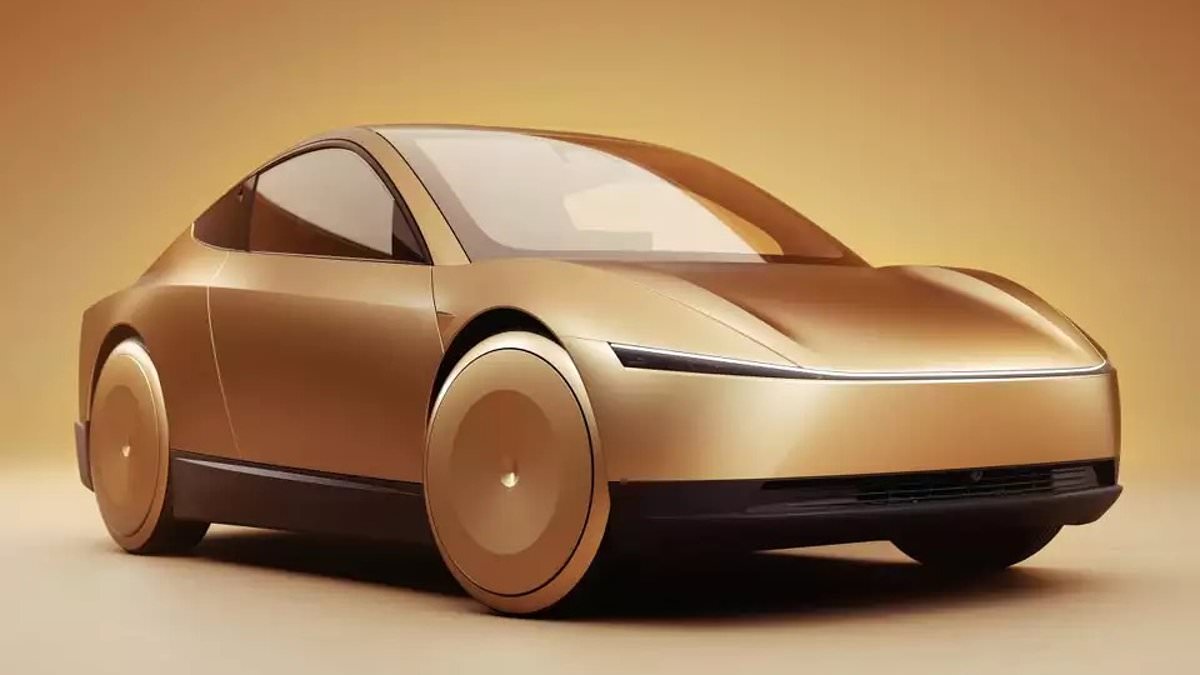
Elon Musk's vision of a future where humans let their cars do all the driving has taken a big leap forward as Tesla launches its bizarre steering wheel-free Cybercab on the streets of Austin, Texas.The sleek, gold-colored two-seater looks more like a futuristic concept car than a vehicle you would hail for a ride.And there is one particularly striking difference: The vehicle has no steering wheel, no pedals and no side or rearview mirrors.Tesla began offering Cybercab rides in limited areas of Austin on September 3, allowing members of the public to book the futuristic vehicles through its Robotaxi app.The move represents a major milestone for Musk, who has spent years promising that Tesla would become a powerhouse in autonomous driving.But it also highlights just how far the company still has to go before his vision of millions of driverless cars becomes reality.The Cybercab is intended to eventually become the centerpiece of Tesla's robotaxi network. Unlike the company's existing Robotaxi service, which uses modified Model Y vehicles and has sometimes included a human safety monitor, the purpose-built Cybercab has been designed from the outset for autonomous driving.Tesla says the cars navigate using cameras and neural networks rather than technologies such as lidar, which uses lasers to build three-dimensional maps of the surrounding environment. The Cybercab was first unveiled by Musk at a glitzy event in California in October 2024 Tesla began offering Cybercab rides in limited areas of Austin on Thursday, allowing members of the public to book the futuristic vehicles through its Robotaxi appThe company has promoted that approach as a way of keeping costs down.The Cybercab was first unveiled by Musk at a glitzy event in California in October 2024, when he painted a picture of a future in which autonomous Teslas could operate as driverless taxis while their owners were not using them.At the time, Musk said the vehicle would cost less than $30,000 when it eventually went on sale. That day has not yet arrived.Production of the Cybercab began in April, but Musk has warned that initial production would be 'very slow'. Tesla has installed manufacturing capacity for more than 125,000 Cybercabs a year, but only a tiny fraction of that number is currently on the road.Texas records showed Tesla had registered 45 Cybercabs for autonomous ride-hailing by Thursday, forming part of a wider Texas autonomous fleet of 420 vehicles.By comparison, Waymo, widely regarded as the US leader in driverless ride-hailing, had 988 autonomous vehicles registered in Texas.The gap is significant because Musk has previously made some extraordinarily ambitious predictions about the technology.He had said Tesla would have autonomous ride-hailing available to half of the US by the end of 2025 and envisioned millions of robotaxis operating by the end of 2026. Those targets have not materialized. There were plenty of Tesla enthusiasts and investors in Austin eager to document the arrival, posting photographs and videos of themselves riding in the new vehicles Production of the Cybercab began in April, but Musk has warned that initial production would be 'very slow'Tesla launched its Austin robotaxi pilot in June 2025 and has since expanded the service to a handful of other cities in Texas and Florida.Real-world experiences have also exposed some growing pains.The were reports of long waits when testing Tesla's service in Dallas and Houston, with some rides ending around a 15-minute walk from the requested destination despite being within the advertised service area.The latest Cybercab rollout could therefore prove an important test of whether Tesla can turn its ambitious promises into a reliable service that ordinary consumers actually want to use.There is another hurdle: regulation. Federal safety rules generally require conventional human controls, meaning vehicles without steering wheels and pedals face restrictions on how they can be deployed and sold.The National Highway Traffic Safety Administration said it was in contact with Tesla and was evaluating the Cybercab rollout.California presents an even bigger obstacle for Tesla. The company does not currently have permits to operate a robotaxi service there or test driverless vehicles without a safety driver who can take over.Tesla, meanwhile, has not yet said exactly when Austin passengers will begin paying fares for Cybercab rides. Executives have indicated that dynamic pricing is planned, meaning prices could rise when demand is high. Regulation is another hurdle to the Cybercab's rollout. Federal safety rules generally require conventional human controls, meaning vehicles without steering wheels and pedals face restrictions on how they can be deployed and soldFor some Austin residents watching the futuristic cars appear on their streets, however, the reaction has been considerably less enthusiastic.One commenter on Reddit's Austin community summed up their feelings bluntly: 'I’d rather walk.'Another simply wrote: 'Hard pass.'Others took aim at the Cybercab's unusual styling, with one describing it as one of the ugliest vehicles they had ever seen and comparing its appearance to a cheap concept car from the late 1990s.But there were also plenty of Tesla enthusiasts and investors in Austin eager to document the arrival, posting photographs and videos of themselves riding in the new vehicles.For Musk, the stakes are enormous.Tesla's electric-vehicle business faces intensifying competition, particularly from Chinese manufacturers, while investors have increasingly viewed artificial intelligence and autonomous driving as crucial to the company's future.The Cybercab is therefore more than an unusual new taxi.It is Musk's latest attempt to convince consumers - and investors - that Tesla's biggest future may not be selling cars for people to drive at all.
Elon Musk unveils bizarre new Tesla robotaxi with NO steering wheel or pedals as driverless cars clog American streets
Full Article
Original Source
Read the full article at Dailymail →KhanList aggregates and links to publicly available news content. We do not host full articles from third-party sources. Always verify important information with original sources.