
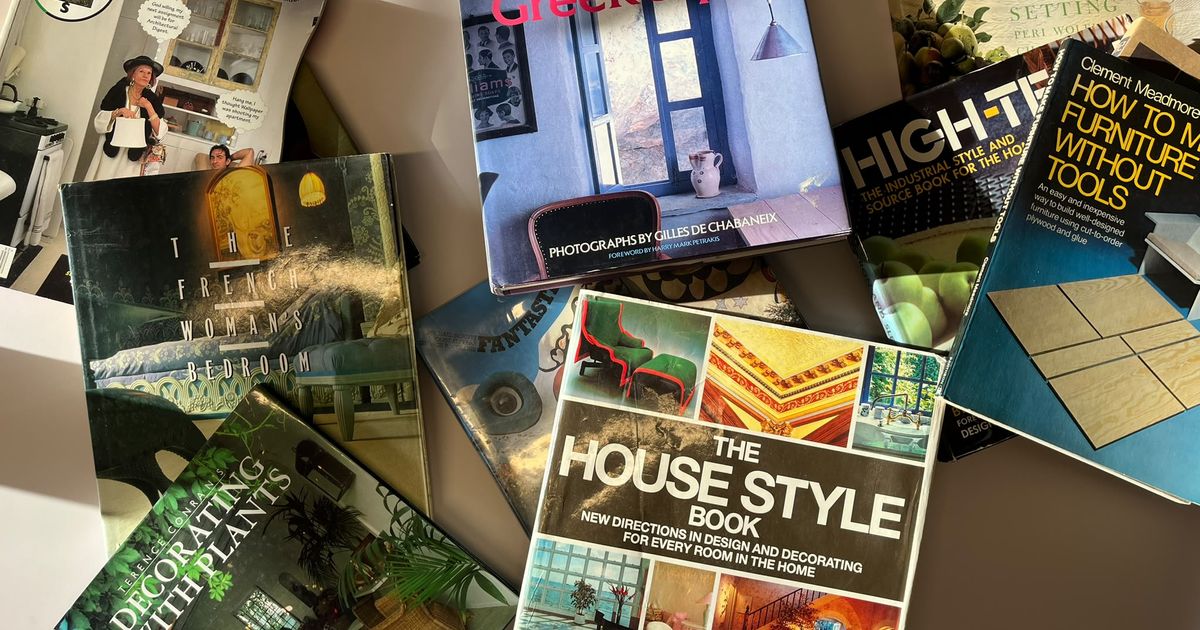
Photo: Courtesy of the publisher David Michon is the founder and editor of For Scale, a Substack and print magazine dedicated to “the supreme potential of interior décor.” It’s been described as “the design world’s most opinionated newsletter,” “subversive,” “vital,” and “joyfully weird.” He tells us about his latest collaboration, a pop-up bookshop dedicated to design books. During that February blizzard in New York City, I was foolishly walking between meetings to kill time and tried to find some spiritual and meteorological respite with a pitstop in the McNally Jackson bookstore on Prince Street. Instead, it induced a sort of rage. Its “interior design” section felt like a collection of 150 megasimilar monographs and books with the word “curated” in the title. Nobody who cares about décor, absolutely nobody, has a bookshelf that looks like that. Real décor bookshelves have range and very blurry edges. There are books about quilts and Medieval tablescapes and cultural theories about taste and magazines and something on ikebana and a DVD of Whit Stillman’s Metropolitan. So when For Scale was plotting some kind of collaboration with Santa & Cole (makers of the crucial bookshelf lamp the Bib Luz), I wanted to see a décor shelf I was more familiar with. Hence, a weeklong interiors bookshop, which we’re hosting at Park at Kims in Nolita. We asked our favorite interiors people — including Rosa Park (Francis Gallery), Kelly Wright (Yuns), Trang Tran (Salon 94), Andu Masebo, Levi Di Marco, Landslide Books, Italo Book Club, Peter Staples (Blue Green Works), Sophie Lou Jacobsen — to share their favorite titles. And we’ve sourced affordable copies of their choices. The man to help us find them was Geoff Snack, the founder of Wrong Answer, a book shop inside the USM showroom in Soho. We had a chat about what’s on our (wacky, custom USM) shelves, and the state of décor books and magazines past and present. From left: The custom USM bookshelf for the pop-up bookstore. Photo: Ellie PattersonPhoto: Ellie Patterson From top: The custom USM bookshelf for the pop-up bookstore. Photo: Ellie PattersonPhoto: Ellie Patterson David: Books are, of course, the ultimate resource for For Scale. It’s fucking sacrilegious to me when people have these endless shelves of books or tidy coffee table displays and they are treated as just décor. Uncracked spines, pristine pages. This is not my vibe. But in your search for these books, is your fantasy to find ones that are like new? Or what is some sexy-cool wear you’ve found, in books or in ephemera? Geoff: I’m of two minds. I personally like a bit of wear on old books or magazines. I want them to feel old. I want to see evidence of life, and I truly love the patina. But there’s definitely “good patina” and “bad patina.” Parts of a dust jacket missing due to tape or just large tears is bad patina in my eyes. A little bit of grit on the edges of the pages and minor yellowing is good patina. After years of selling, I try to source books that only have a bit of good patina or none at all because I know a lot of my customers want pristine copies, which is completely rational and reasonable. So I try to source a bit of both. When you first told me about this project, one of the big insights was that it’s really tough to find good, inexpensive interiors books. They do very well at my shop. Why do you think people outside of the trade are attracted to these? What do these books do for them? David: Speaking personally, it’s an ultimate fantasy to imagine your home as a place that is wildly amazing and such an expression of personal taste — it’s the ultimate. Or is it just a fun mind experiment of “possible selves?” Can you tell me more about the 1980s issues of Ottagono that Formas chose for the pop-up? Someone has already requested that I hold those for them, though that is against my unwritten rules for the shop. I’d never heard of that magazine before. Had you? From left: Issues of Ottagano available at the sale. Photo: Courtesy of the publisherPhoto: Courtesy of the publisher From top: Issues of Ottagano available at the sale. Photo: Courtesy of the publisherPhoto: Courtesy of the publisher From left: Photo: Courtesy of the publisherPhoto: Courtesy of the publisher From top: Photo: Courtesy of the publisherPhoto: Courtesy of the publisher Geoff: Ottagono is great. I love Italian design and magazines but I never think to go after Ottagono issues. I should. I get the feeling that magazines are more free, in a sense. They don’t need to be definitive or even correct which makes them a much more honest reflection of what is happening. The Italians published some of the best magazines — Domus, Casa, and of course, Archigram’s and Sottsass’s zines. I feel like all of that was an attempt to capture and document activity in a movement that was rapidly evolving. David: And a magazine always sort of aims to capture its little moment issue-by-issue. So it really feels like a snapshot. No wonder many excellent décor books of decades past are actually Architectural Digest or New York Times collations. From left: Issues of NEST, the legendary interiors magazine, at the sale. Photo: Courtesy of the publisherPhoto: Courtesy of the publisher From top: Issues of NEST, the legendary interiors magazine, at the sale. Photo: Courtesy of the publisherPhoto: Courtesy of the publisher Geoff: As someone reporting on the cutting edge of what’s happening in design on your Substack and in your printed zines, do you think about how your writing will be perceived as time goes on? Does that impact how you work? David: Well – there’s a sort of vibe where people tell me, “Oh, people don’t read.” And I think it’s partly because we’ve let all the words be so fucking boring. I just don’t think that we’re consuming opinion in a sweet, fluid, beginning-middle-end way anymore. It’s sidebars and tangents, and sometimes you’re listing and sometimes you’ve got a block of text and you are using little tools to try and mimic the pace and intonation of speech. Geoff: I completely agree with your sentiment that people actually love reading and want to read, but writing on design and art can often be too academic or dry. David: But the form helps. Shorter pieces. If the Substack were scaled up to a book, it would be rather experimental in tone. We are, in fact, planning a book, which we’ve told you about, but we’ll keep the details private for now — so I guess we’ll see. That reminds me: Do mags sell as well for you versus books? Geoff: Whenever I offer magazines, they typically fly. Especially when there’s a specific space that’s featured, or just really cool furniture that doesn’t appear elsewhere. Even the ads can be a selling point. They were so clever and often even felt experimental. Specifically in publications like Domus, Casa, and Studio International. David: Ads! In the print mag we do them in a specific way, and actually they get tons of positive feedback. It’s wild. Okay, but on mags versus books: I wonder if books have lost a little charisma? There is something so impossibly good about High-Tech, co-authored by the goddess Suzanne Slesin. It’s on everyone’s shelf, I think. Because it’s so forensic, and so practical, and so multidimensional — it has sources and shop owners and people’s places and little sidebar histories. No book dares to write about an aesthetic in this way anymore. It’s always a series of interiors. Maybe it’s because the “practical” stuff might change too quickly. Geoff: This is precisely why I love Suzanne Slesin. Her book is more searching-and-sorting and less curating, if that makes sense. The same sentiment goes for surveys like an all-time favorite of mine, Underground Interiors. There’s certainly an element of curation there and Slesin has an undeniably great and prescient eye, but I believe that their searching for these books pushes authors to the outer reaches. From left: Photo: Courtesy of the publisherPhoto: Courtesy of the publisher From top: Photo: Courtesy of the publisherPhoto: Courtesy of the publisher David: I also feel quite strongly that there was a different quality to interiors photography in the past. Like in the Paige Rense era of Architectural Digest, which was 1975 to 2010, where she had a thing for nighttime photography (which you NEVER see anymore!), and who also never sent editors or stylists to shoots, who ubiquitously fiddled around. We have that book she edited in the sale, the 1979 hardcover of Architectural Digest International Interiors: A Selection of Distinguished Interior Design From Four Continents – a mouthful! – which is one of your contributions. Paige loved this photographer Jaime Ardiles-Arce, whose stuff still feels incredibly cool. Much cooler than the majority of what’s happening now. Do you feel the difference too? Photo: Courtesy of the publisher Geoff: I absolutely do! Things feel much more regimented now. Perhaps that is because it took so much longer for design trends to spread and become defined pre-Internet. Put another way: It took longer for these trends to be figured out and “optimized.” Now, it feels like all these publications and (many) decorators are rapidly optimizing for what is on-trend, which kind of kills what’s interesting about decorating. The book, edited by Jacqueline Kennedy-Onassis. Photo: Courtesy of the publisher David: Maybe there’s a reaction to this, now? There are definitely little sparks of a new-gen of interiors photography that is less related to the hegemonic neutral you see in most magazines and more seen as an extension of the specific mood or intention of a project. Like, how a project is captured visually is case-by-case. I know that Width Over Ears does this. I’m also so curious to get inside The French Woman’s Bedroom. How voyeuristic! Again, I feel like that’s a tone we’re sort of missing now. Every book seems to be about the author these days, how they “curate,” how they arrange, how they choose — it’s rarely just editorial. Every author must be a personality first. Geoff: I totally agree we’re missing that. Would love to see a completely anonymous interiors magazine. I guess Nest got close to that since very little is known about its brilliant founder. And it really kept the focus on its subjects. I’m glad you added those to our list. David: Don’t give away good ideas! The “One Week of Very Good Books on Interiors” pop-up by For Scale and Santa & Cole (at Park at Kims) closes Friday, November 13 at 6pm. From left: Books in the For Scale popup. Photo: Courtesy of the publisherPhoto: Courtesy of the publisher From top: Books in the For Scale popup. Photo: Courtesy of the publisherPhoto: Courtesy of the publisher From left: Photo: Courtesy of the publisherPhoto: Courtesy of the publisher From top: Photo: Courtesy of the publisherPhoto: Courtesy of the publisher Décor Books You’ll Actually Want to Read Your product is saved! You’ll receive emails when your saved products go on sale. Manage preferences.
Décor Books You’ll Actually Want to Read
Full Article
Original Source
Read the full article at Curbed →KhanList aggregates and links to publicly available news content. We do not host full articles from third-party sources. Always verify important information with original sources.