
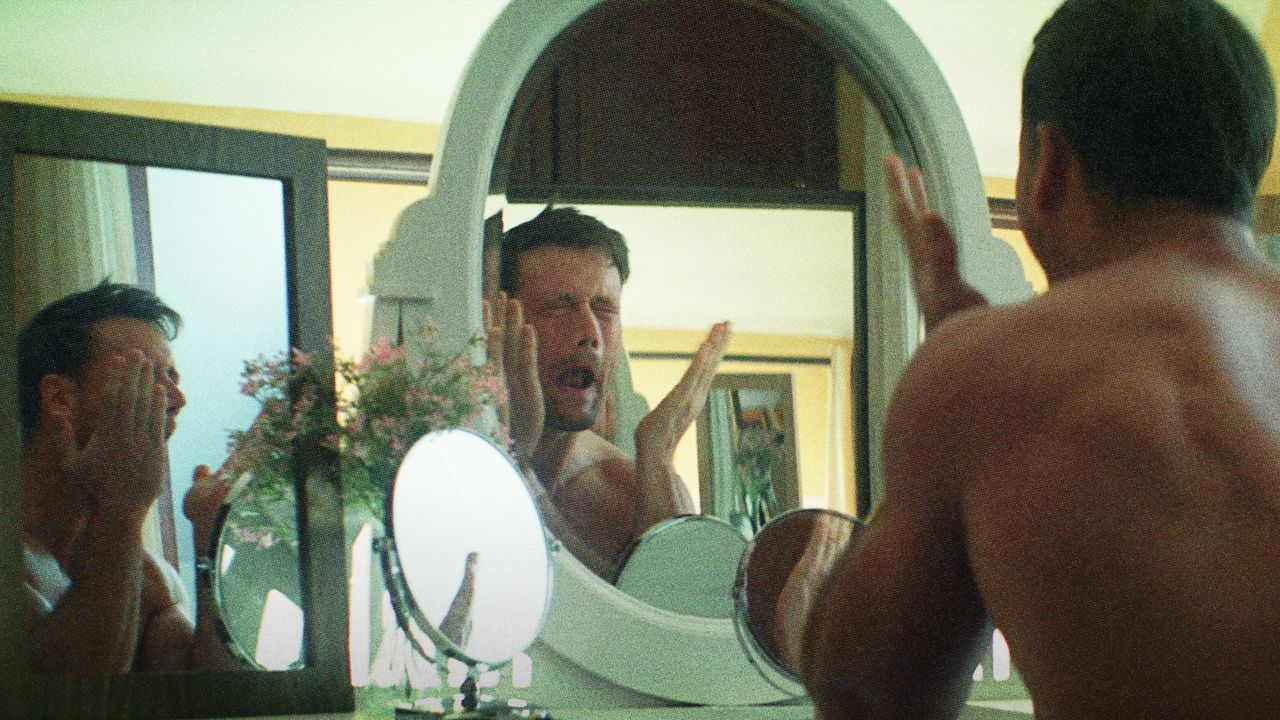
Chasing physical perfection is a hobby now. This year, the community of men obsessed with climbing the ranks of society via square jawlines and hunter eyes, became a subject of widespread fascination. Once a term known in niche internet forums in the early 2010s, the concept of “looksmaxxing” has gone mainstream. These days, even the casual scrollers among us have probably heard of techniques like bonesmashing and mewing.But beyond a few self-appointed figureheads of the movement, the question of who is buying into these extreme self-improvement measures has loomed large. In Get Huge: Looksmaxxing to Death documentarian Stacey Lee gives viewers a deeper look into the lives of some of the looksmaxxing community’s more controversial figures. The three-part Hulu docuseries, out now, follows bodybuilding and biohacking influencer Dr. Tony Huge (whose real name is Anthony Hughes), controversial fitness personality, Connor Murphy, and a handful of other men.Set largely in Thailand, the series tells the story of how these influencers decamped abroad and continued to post near daily videos of their body modification techniques. Lee also confronts the disturbing pattern of deaths among Huge’s inner circle, some of which have gone unsolved. Ultimately the series raises larger questions about the cultural, gender-driven motivations to push the limits of their bodies. GQ spoke with Lee about her nearly two-year immersion into a small corner of this community, the blurred lines between online persona and reality, and what it all reveals about a generation of young men who are seemingly searching for identity, connection, and purpose through increasingly unhealthy outlets.What are you most excited for viewers to learn from this docuseries?These internet influencers create so much content, and there's a performance of masculinity that takes place within it. The topic is incredibly polarizing, but also very nuanced. We wanted to capture this world in a way that was more dimensional than what YouTube feeds allow, puncturing the veneer of performance to show who these people are beyond their online personas. I want audiences to see a more multifaceted view of this world and decide for themselves how they feel about these characters based on what they're seeing.What was your introduction to the looksmaxxing community?Looksmaxxing wasn't even a term when we started this project [in 2024]. We initially entered the bodybuilding, biohacking, and masculinity influencer community, which was still very fringe at the time. Tony had started making content nearly a decade ago, using shock value and radical transparency to build his brand. He was willing to do things on camera that others wouldn't, challenging social taboos. Ten years later, we're seeing a new generation of influencers who grew up watching Tony, [biohacking YouTuber Leo and Longevity], and Connor and are now using similar methods. But the algorithm has shifted the goalposts significantly since 2016, pushing the content into a much more extreme and nihilistic space.Would you consider Tony the godfather of the looksmaxxing movement?I wouldn't necessarily say he was the godfather of looksmaxxing, but he was certainly influential in the biohacking and bodybuilding space. Connor Murphy was probably more directly connected to the origins of looksmaxxing, and Clavicular has referenced him as an inspiration. Tony was part of that same world, but represented a different generation.Would this movement have happened if Tony hadn't done what he was doing online?Tony was a larger-than-life figure, but it was also a broader cultural moment. Around 2016, we were seeing the first Trump presidency, the post-Me Too movement, and the rise of Red Pill philosophy. There were several figures galvanizing these ideas, and Tony was among them.I think what you're also referring to is this idea of legacy, right? He created something he believed was his unique gift to the world, but there's a sense that the next generation doesn't recognize him or understand his influence. That disconnect seems to drive some of his pursuit of the next big thing, which, in this instance, is looksmaxxing.Were you drawn into Tony's appeal while filming him?Look, Tony is incredibly charismatic and easygoing. Honestly, filming with him was a really respectful process. I think at times it was really discombobulating because he's always smiling in these videos, and he's presenting as this happy-go-lucky kind of guy, but then you're stopped in your tracks because he's doing and saying things that run against that.The only other reference I'm thinking of is Andrew Tate, who presents in this very sinister way and has a darkness to him that's front and center. Tony doesn't present that way. For us, it was important to show that and to dimensionalize him. In his eyes, he didn't care if he was a hero or a villain. He just wanted to get his story out there. My approach was that I wanted to humanize him, but it wasn't about excusing what was happening.It's important in this day and age to approach controversial subjects with an element of humanity while still maintaining journalistic independence. In this world, the boundaries are really slippery because people are performing so much. You really have to have your guard up about what's real and what's not. I don't think it's my job to tell audiences what to think of Tony. It's my job to provide a fuller understanding of who he is and allow them to make up their own minds. Discernment was something that was really important for us to communicate: What you see is not always what you get.The women in the series have their own voices and boundaries, even though Tony is at the center of the dynamic. Can you talk about that?You see it in episodes one and two. [Editor's note: Tony lives with his wife and a group of other women he refers to as his girlfriends.] There's a very specific mentality rooted in Red Pill philosophy, where the role of a man is to control these women and provide for them, but also to assert himself. He's the leader, and they must follow. I think one of the things Tony is always battling is that he presents in such a nice way and isn't aggressive like [his friend and fellow biohacking influencer] Leo was, but there's still this desire to control the women. The women are very strong, opinionated women.From conversations with Tony during the making of this documentary, I know a lot of the women didn't realize they were coming into a harem. They thought they were his one and only true love, and then they've entered this environment and suddenly they're in competition with one another.That competition is part of the dynamic of how the harem works. The way Tony puts it is that if they're in competition with one another, they try harder to vie for his attention, love, and affection. That's an incredibly complicated way of pitting women against each other, and somewhat dehumanizing.What are your thoughts on this new generation of men seeing their bodies less as something to inhabit and more as something they can engineer into an idealized version of themselves?What I want to be really careful of is that these aren't a bunch of outrageous, crazy people doing crazy things from the start. It actually begins in a real human place, a place all of us can relate to. I want to be the best version of myself. Yeah, of course I do. That's very relatable.What happens within this is that some of the needs, in Elon [Muscular, one of Tony Huge’s mentees and a content creator]'s case, a sense of belonging, a father figure, all of those kinds of things that he's craving, aren't solved by taking one pill. These are really deep societal issues that are complex and need to be approached with a multidimensional complexity.Therein lies a lot of the challenges with this world, because the extreme and the attention keep pushing those goalposts further. You get a bigger jawline, a bigger penis, bigger muscles, and you're still not feeling happy. I think it creates this kind of trap that some men can get stuck within, because the original solution was never going to solve that problem to begin with.How are you hoping to shield your [9-year-old] son from all of this negative online commentary?Honestly, it was really important for me to make this. A lot of my prior work has centered on women and diverse perspectives, and it's such an honor and privilege to do that kind of work. But I also recognize I was existing in a bit of an echo chamber, so doing this project took me well outside my comfort zone.I use this example with kids: When they're scared at night, you shine a light in the room. You look under the bed, you shine a light into it, and it makes the thing that's inside your head less scary. There was a little bit of that in making this documentary, of really looking at it and understanding it, witnessing how people come in, why they stay, and why they also can't leave, and using those things as what I need to teach my son. I need to teach him discernment. I need to teach him the difference between a YouTube influencer who's performing and one who's actually giving genuine, real tips.In this day and age, where clipping culture and soundbites matter, there's no room for context. We're in a post-truth era, and no one's taking the time to provide context, human dimension, or other perspectives. I want my son to understand how the internet and influencer culture work so he can make his own decisions with more critical thought than what's often taught in the public space.Will you ever show your son the docuseries?Yeah, of course. I never wanted to make something that was just another echo chamber. I want this documentary to reach people deep in the heart of the masculinity influencer space. I want them to see it. Everyone's going to have a different reaction, but most importantly, people are talking, and that's what I care about. I need the conversation, the depth of the conversation. That's what this is designed to have.Have we hit a breaking point with looksmaxxing?It's interesting because that question has come up a few times. There does appear to be a turning of the tides. Even within Tony's own universe, his sense of relevancy has shifted. He went from being the most masculine man he could be to wearing eyeliner. It's all become a lot more fluid and therefore a lot more interesting.I think there's a time we're living through where the power structures that have existed for the last decade are starting to break down. People aren't feeling connected to them anymore, or they certainly aren't serving their needs.I hope we're at a time of reckoning and change, where people are recognizing that this isn't working. There's so much more awareness about the issues men are facing, and there are specific influencers who are the opposite kind, who are speaking about this stuff more. There are some incredible voices in this space starting to counter the other perspectives out there.
Get Huge’s Director on How Looksmaxxing Is a “Trap” for Men
Full Article
Original Source
Read the full article at Gq →KhanList aggregates and links to publicly available news content. We do not host full articles from third-party sources. Always verify important information with original sources.