
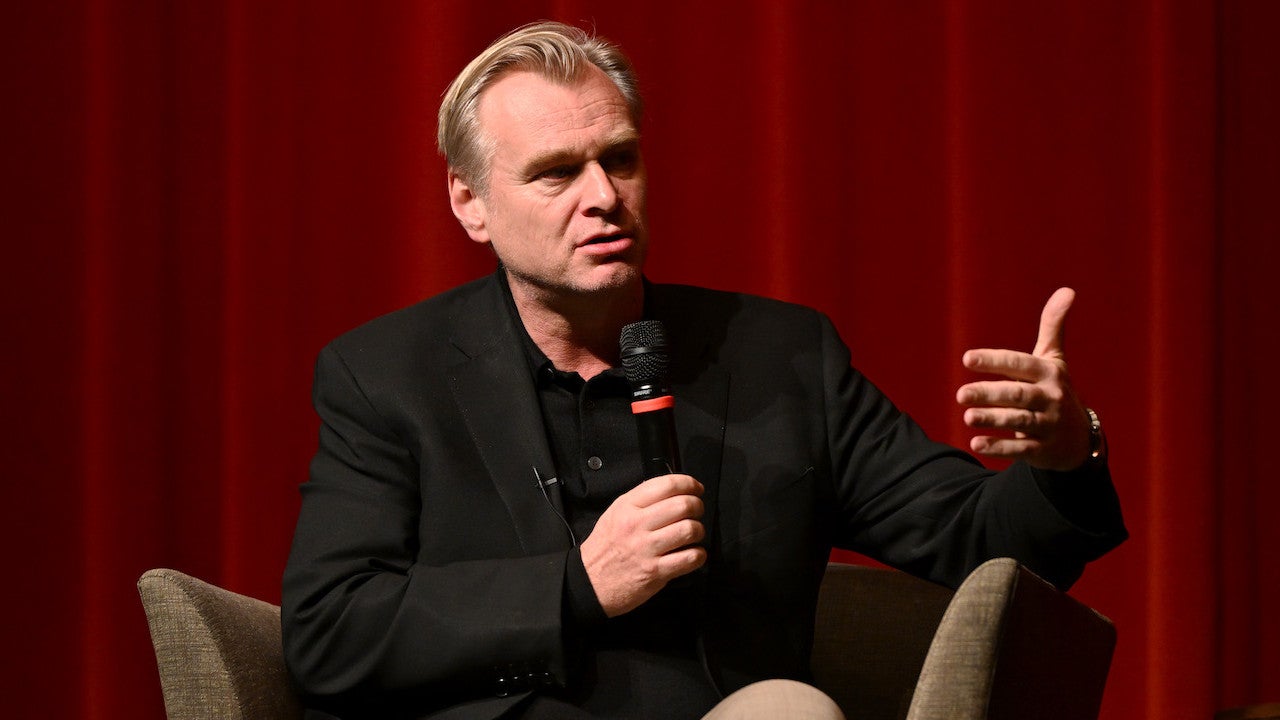
While Christopher Nolan applauded the Directors Guild of America (DGA) and Alliance of Motion Picture and Television Producers (AMPTP) for coming to the table and negotiating “excellent language and guardrails” against artificial intelligence in film and TV production, the “Odyssey” director teased that the next hurdle in the fight against AI falls squarely on the studios’ shoulders.“We’re very focused at the guild about holding the studios to account for protecting their copyrights. We can’t do that,” the filmmaker, who’s been president of the DGA since fall 2025, said on the “Hollywood Insiders” podcast Saturday. “With very few exceptions in the guild, we are not the copyright holders of the films that we’ve worked on. It’s down to the studios to do that.” “AI is too big a catchall term,” he posited. “It’s describing too many things. It’s being used by companies to absolve themselves of responsibility. They want to portray it as this Frankenstein’s monster that can get out of control and could change the world without them having any accountability for it. We have to strongly resist that.” He continued: “There’s already legislation in place that protects people, protects creators, etc. And the fact that they these companies hide behind fair use provisions, for example. I think longer term that won’t hold up in court. There have already been some significant judgments against it.” Nolan added that for his film “The Odyssey,” he was heartened by Universal’s inclusion “for the first time” of boilerplate language in the credits stating that the film cannot be ingested, scraped or used as training data for generative AI models, a point of progress for the push for greater protections in Hollywood. “I was very pleased to see that the boilerplate at the end of ‘The Odyssey’ contains, for the first time, a message saying that this film cannot be ingested and used as training data. And this is a principle,” he said, drawing a comparison to the rights around sampling songs as a musician. “This is something that was dealt with decades ago, and people fully understand that yes, you can’t just take something, stick it into your machine, and then claim that that’s fair use if you’re selling it on, even in thinly disguised form. “So the more those principles get drilled down on — and this has to go through the courts. It’s going to take a long time. I have no doubt that we’re going to get there … For us, it’s a constant push towards litigation and legislation. It’s like how can we make sure that our work is not stolen and thinly disguised, repackaged, sold back to us. And that fight’s never going away. It’ll be an ongoing thing. But I see that as one of the main areas that everybody working in film needs to be protected. And it’s really about not allowing people to steal your work and repurpose it.” The “Hollywood Insiders” podcast is hosted by film producer and former president of the Academy of Motion Picture Arts and Sciences Hawk Koch. It is produced by the The Motion Picture & Television Fund (MPTF).
Christopher Nolan Previews DGA’s Next Phase of AI Protections: ‘It’s Down to the Studios’
Full Article
Original Source
Read the full article at Thewrap →KhanList aggregates and links to publicly available news content. We do not host full articles from third-party sources. Always verify important information with original sources.