
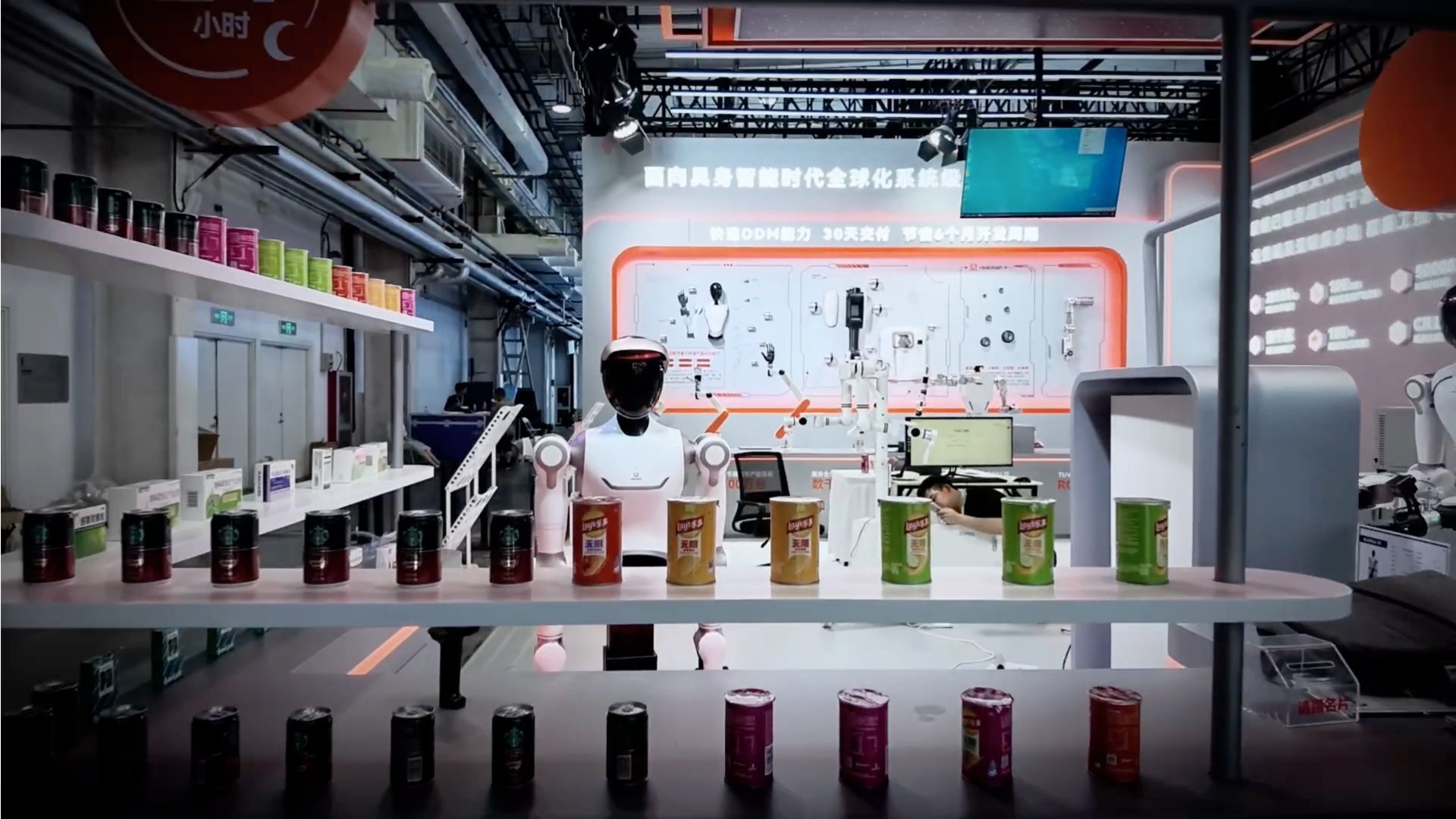
China-based RealMan Robotics plans to deploy nearly 1,000 RealBOT robots across its network in 2026, using the resulting data to improve the robots’ ability to perform tasks across different environments. At the 2026 World Robot Conference (WRC) in Beijing, the company showcased robots performing tasks including medicine handling, power-room inspections, food preparation and remote equipment commissioning. The demonstrations are powered by its Global Link Network (GLN), which enables operators to remotely control robots across long distances while collecting data from real-world operations. In May, Figure AI completed a 200-hour autonomous livestream, with Figure 03 robots processing nearly 250,000 packages without hardware failures. Robots begin working RealMan Robotics is pushing humanoid and robotic systems beyond controlled demonstrations and toward practical, continuous deployment, unveiling its GLN real-world deployment initiative at the 2026 WRC in Beijing. According to the Beijing-based firm, the initiative highlights a broader shift in robotics: from developing capable machines in laboratories to creating systems that can reliably perform useful work in homes, factories, pharmacies and other real-world environments. At WRC 2026, RealMan demonstrated its RealBOT robots performing tasks including medicine retrieval and restocking at a smart pharmacy, inspections in a power distribution room, pastry-making alongside human chefs, and remote operation at the company’s embodied-intelligence factory in Changzhou. These demonstrations are designed to show how robots can operate in environments where physical conditions and tasks are less predictable than in laboratory settings. A key technology underpinning the initiative is RealMan’s GLN remote-operation network. The system allows human operators to control robots remotely, with the company claiming millisecond-level latency even across thousands of miles. This could allow specialized human skills to be delivered remotely through robotic systems, potentially creating a new model for distributed robotic labor. More importantly, remote operations generate real-world interaction data. Each task provides information about perception, manipulation, and decision-making in physical environments, helping create a feedback loop through which robots can improve their ability to handle different tasks and conditions. Smarter robot workers Reliability is another important component of large-scale deployment. RealMan received CR L3 certification from the Shanghai Robot Industry Technology Research Institute at WRC 2026. The company says its lightweight humanoid robotic arms have achieved a mean time between failures (MTBF) of 50,000 hours, providing a foundation for long-duration commercial operation. The company is also advancing robotic perception through a partnership with tactile-sensing specialist PaXini. Their demonstration combines RealMan’s RM75 seven-degree-of-freedom robotic arm with multidimensional force and tactile sensing, a six-axis force sensor, and joint torque sensors. Such technology could improve robots’ ability to detect contact forces and handle objects more precisely. In industrial applications, this may help reduce collisions, improve assembly quality and minimize failures while making human-robot collaboration safer. RealMan says it plans to deploy nearly 1,000 RealBOT robots across real-world environments in 2026 through the GLN network. If achieved, the deployment could provide a significant stream of operational data while testing robotic systems at a scale beyond conventional demonstrations. The initiative reflects an increasingly important direction for robotics: combining reliable hardware, advanced sensing, remote human control, and real-world data to create machines capable of performing useful work continuously rather than simply showcasing isolated capabilities.Get the latest in engineering, tech, space & science - delivered daily to your inbox.Jijo is an automotive and business journalist based in India. Armed with a BA in History (Honors) from St. Stephen's College, Delhi University, and a PG diploma in Journalism from the Indian Institute of Mass Communication, Delhi, he has worked for news agencies, national newspapers, and automotive magazines. In his spare time, he likes to go off-roading, engage in political discourse, travel, and teach languages.
Chinese firm to send 1,000 robots into real workplaces to cook, inspect and dispense meds
Full Article
Original Source
Read the full article at Interestingengineering →KhanList aggregates and links to publicly available news content. We do not host full articles from third-party sources. Always verify important information with original sources.