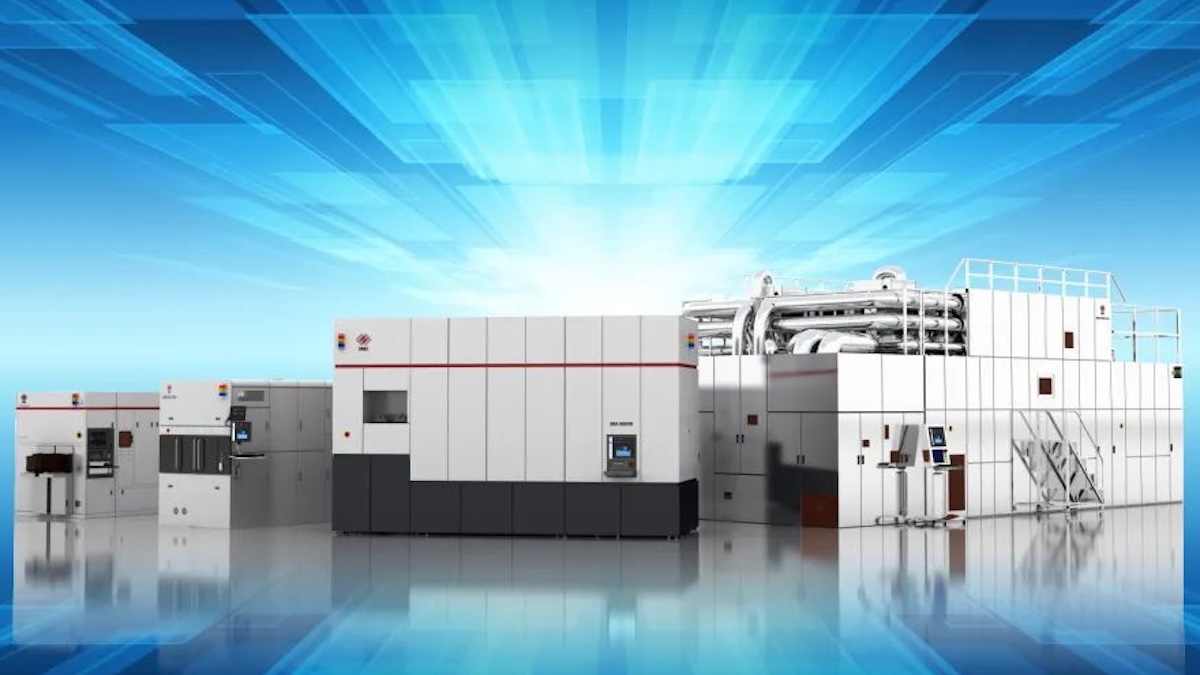
Media reports published earlier this week about China’s plan to start making its own immersion deep ultraviolet (DUV) lithography machines have caused a sharp sell-off of European chip equipment stocks. But Chinese pundits say the situation remains very far from a point where China’s DUV machines coukd compete with ASML’s. The Information reported Monday that a state-backed manufacturer, whose identity has not been disclosed due to the sensitivity of the matter, has begun mass producing the homegrown machines. Production will be limited initially, with about five units expected this year and roughly 20 more in 2027, for delivery to leading chipmakers including Semiconductor Manufacturing International Corp (SMIC), Hua Hong Semiconductor and ChangXin Memory Technologies. The report said the breakthrough could eventually challenge ASML’s position in China, but cautioned that the system still lags in performance and reliability and requires further testing before mass production. Reuters reported Tuesday that the Chinese state-owned firm mass-producing the machines is Shanghai Aishengna Electronic Technology Group. Public information shows that Aishengna was founded in August 2023 with registered capital of 7 billion yuan (about US$1 billion), backed by two state-owned shareholders, Shanghai Electric Holding and a Shanghai International Trust subsidiary. The secretive firm has no website and has disclosed little about its operations, but Reuters reported it has absorbed teams from Shanghai Yuliangsheng, which began testing a DUV prototype last year, and from Shanghai Micro Electronics Equipment (SMEE). ASML shares fell 13% over the first three trading days this week. BE Semiconductor Industries declined 16.3% and Infineon Technologies slipped 15.5% over the same period. The three stocks rebounded on Thursday after JP Morgan analysts called the selloff disproportionate to what the report had indicated, though their shares have yet to return to last Friday’s level. Without confirming whether China is producing its own immersion DUV machines, the Global Times, a unit of the People’s Daily, said in an editorial on Tuesday that the significant fall in chip equipment suppliers’ shares showed that “Western investors’ blind faith in the effectiveness of blockades has been shaken, and the US-led decoupling strategy has lost much of its momentum.” “Western technology companies like ASML understand that once China achieves a genuine breakthrough, their market share will face a direct hit,” it said. “Therefore, the stock price fluctuations triggered by this unconfirmed report were not merely emotional knee-jerk reactions, but also a realistic risk assessment by the industry.” “One day, the technologies once used to constrain China’s development will simply become ordinary components of its independent industrial system. For China, the task now is simply to stay focused, keep doing the work, and not be distracted by the external buzz.” With state media calling for not being distracted by the “external buzz,” Chinese commentators have stayed silent so far this week, with only a few stock market bloggers saying that shares of Chinese chip-making equipment suppliers may gain support. Last September, the Financial Times reported that SMIC, China’s leading chipmaker, was testing a DUV immersion lithography machine made by Yuliangsheng. The machine is understood to be targeting 28-nanometer chip production, and Yuliangsheng had planned to deploy it on production lines by 2027. In October, Brandon Weichert, a senior national security editor at The National Interest, wrote that a Chinese firm had reportedly sought technical support from ASML after failing to reassemble a DUV machine following an internal teardown carried out for alleged reverse engineering. Some people may be confused by different Western media reports, but Chinese analysts have already explained that Yuliangsheng, SMEE and Aishengna are actually sharing the same team of engineers, who are developing a machine similar to SMEE’s SSA800, which has not yet been officially launched. Yuliangsheng was founded in 2022 and is jointly owned by SiCarrier and the state-backed Chuangkewei (Shanghai) Technology. Last year, SMEE underwent a restructuring that moved its immersion DUV lithography technologies and engineers into Yuliangsheng, while it kept its extreme ultraviolet (EUV) lithography project. Yuliangsheng’s team is now housed within Aishengna and continues developing the SSA800, though the machine could be renamed to avoid ownership disputes if Yuliangsheng or Aishengna eventually goes public. SSX800 is roughly equivalent to ASML’s TWINSCAN NXT:1950i, a tool the Dutch company launched in 2008 for making 28 nm chips. Media reports said about 70% of the SSA800’s components are made in China, listing several of its suppliers: Non-objective lens (zinc selenide and laser lens) by Nanjing Wavelength Opto-Electronic Science and Technology 300 millimeter large-aperture lens by MLOPTIC Corp Exposure system by the Changchun Institute of Optics, Fine Mechanics and Physics Dual-stage system by Beijing U-Precision Temperature control system by Beijing Naura Electronics The machine still needs to import many parts – including a 193 nm excimer laser mirror, Zeiss lenses, a vacuum chamber, synchronization control algorithm software and argon fluoride (ArF) immersion light sources – or source them from secondary markets. In fact, Chinese chipmakers are still allowed to import ASML’s NXT:1980i machines. SMIC is reportedly using such equipment, along with multiple-patterning techniques, to produce 7 nm chips for Huawei Technologies despite US sanctions. “China’s self-developed 28 nm DUV lithography machine still lags about four generations behind ASML’s products, with performance roughly equivalent to the Dutch company’s lithography tool from 15 years ago,” a Liaoning-based columnist writes. “But at least China has achieved a key breakthrough from zero to one in the mature process node segment.” The columnist says China plans to invest heavily in three areas, including high-power DUV light sources, high-precision 193 nm optical lenses and synchronization control algorithms. ‘Stay rational’ In April, US lawmakers introduced the Multilateral Alignment of Technology Controls on Hardware (MATCH) Act, which aims to stop ASML from shipping all immersion DUV machines to China. Since then, Chinese media and commentators have turned low profile when discussing the progress of domestic chipmaking equipment. They have even taken the initiative to deny an online media report claiming that the SSA800 had been officially launched and achieved a 90% yield. ICSmart, a Chinese outlet that focuses on the chip and technology sectors, said in a May 10 commentary that it was groundless to say that “SMEE officially announced mass production of the SSA800 in January 2026 and exhibited the machine at an industry show in March.” “It is true that the SSA800 machine can process 150 wafers an hour, but it is far-fetched to say its mass production yield is stable in the range of 90% to 95%,” ICSmart said. Citing a source at a domestic wafer foundry, ICSmart said the SSA800 series had not yet entered a commercial wafer fab in China and appeared still to be undergoing testing at the Shanghai Integrated Circuit Research and Development Center (ICRD), which provides wafer-level testing, parameter analysis and reliability verification for integrated circuits. It questioned how the machine could be deployed for mass production, let alone achieve a high yield. The opinion piece said many Chinese people want to hear news of domestic equipment breaking through in advanced process technology, but the stronger that desire grows, the more important it is for people to stay rational. It warned that false or self-congratulatory reports undermine the public’s ability to judge real progress and the seriousness of the incremental work being done across the supply chain. Read: US lawmakers seek to block China’s DUV lithography access Follow Jeff Pao on Twitter at @jeffpao3
China’s DUV lithography still lags ASML by four generations
Full Article
Original Source
Read the full article at Asiatimes →KhanList aggregates and links to publicly available news content. We do not host full articles from third-party sources. Always verify important information with original sources.