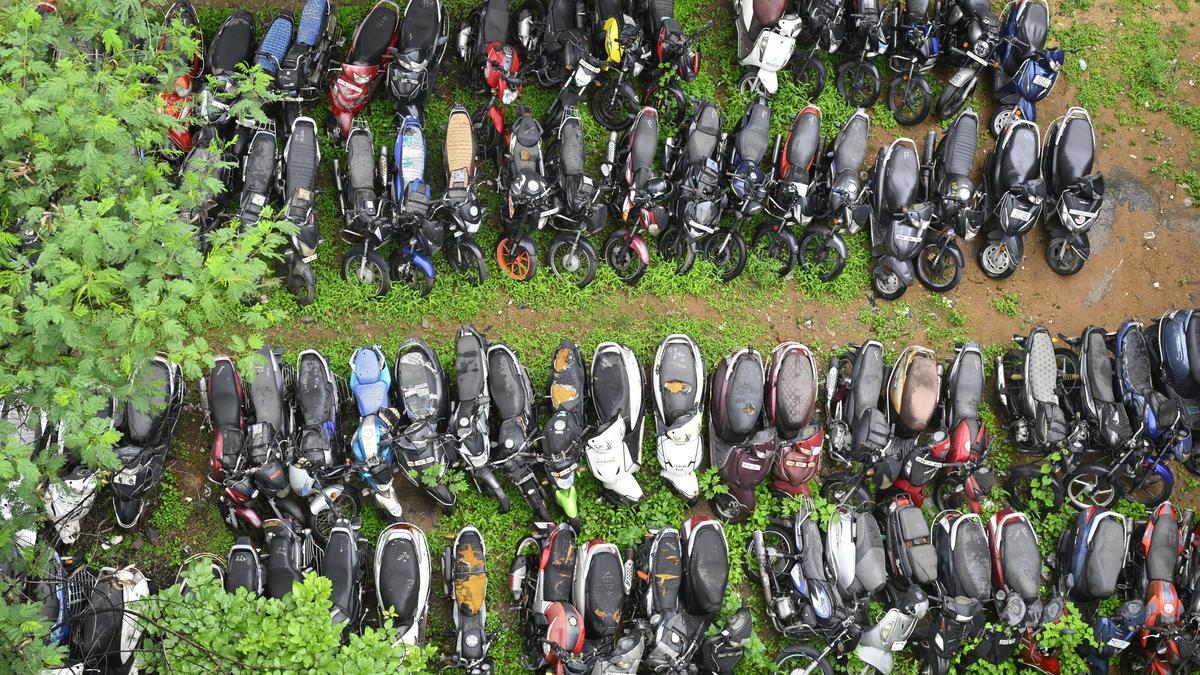
Every time an e-challan arrived on his phone, Praveen Kumar Reddy feared the worst. The notices carried the registration number of his family’s motorcycle that had vanished nearly a decade earlier, even though the traffic violations were being committed hundreds of kilometres away in Hyderabad. What began as a puzzling notice soon turned into a nightmare. If someone was using the motorcycle to rack up fines, what would happen if it was involved in a serious crime?For Praveen’s family in Koilakuntla in Andhra Pradesh’s Nandyal district, the black Hero Glamour was their first motorcycle. Bought in 2013 by his farmer father, C. Venkateswara Reddy, it was part of the family’s daily life before disappearing without a trace three years later.“That bike was my initiation into motorcycling,” says Praveen, who dropped out of school to join the family’s agriculture business.The motorcycle was stolen in 2016 from outside a hostel in Hyderabad’s Moosapet, where Praveen’s elder brother, Vinod Kumar, was staying while pursuing chartered accountancy. Embarrassed at losing it, he kept the theft to himself for nearly five months.By the time he informed the family, they had given up hope of recovering it. No police complaint was lodged.Nearly a decade later, the motorcycle returned to their lives through a stream of traffic violation notices from Hyderabad.The first e-challan, for riding without a helmet and triple riding, was issued on September 14 last year after the motorcycle was recorded at Musthabad X Road in Siddipet. The family dismissed it as an error.Three months later, another notice arrived from Gandhi Nagar. More followed on February 9, February 24 and April 8. By June, the challans had become relentless. Several were issued within days around Musheerabad and Chikkadpally for wrong-side driving, while others came from NMDC Road in Asif Nagar for helmetless riding.The family’s long-lost motorcycle appeared to be criss-crossing Hyderabad while they, 322 kilometres away in Koilakuntla, watched the challans mount. In all, the vehicle bearing registration number AP 21 AV 2498 accumulated 20 unpaid traffic challans amounting to ₹15,665.“I went to our local police station after the notices started arriving. They advised me to write to the Hyderabad Traffic Police. Many people told us that if the motorcycle was involved in a fatal accident or a serious offence, we could end up facing much bigger problems,” Praveen says.His father then wrote to the police, explaining that although the family had not lodged a theft complaint in 2016, the motorcycle had remained out of their possession ever since and they could not be held responsible for offences committed using it.The letter proved to be the breakthrough.On July 1, Hyderabad police traced the motorcycle after analysing the complaint and traffic records. Chikkadpally police intercepted the vehicle. The rider claimed he had bought it from another person who had promised to hand over the documents later. Police are now investigating how the stolen motorcycle changed hands over the past decade.A growing patternFor Hyderabad Police, the family’s ordeal was part of a growing pattern.Since March 24 this year, Hyderabad Traffic Police have registered 40 FIRs based on complaints from vehicle owners who received e-challans for offences they never committed. More than 10 such cases surfaced in June alone while over 300 complaints are under scrutiny. Police are also preparing to launch an online portal for motorists to report wrongful challans and suspected cloned registrations.A similar complaint came from the office of the Tirumala Tirupati Devasthanams (TTD). A Toyota Innova registered in the name of the TTD executive officer in Tirupati began attracting traffic challans from Hyderabad despite never entering the city.After four e-challans were issued, P.Ramu, general manager (Transport), TTD, approached Hyderabad Traffic Police on July 27. Investigators traced the cloned registration number to a Tata Safari in Hyderabad and acted against the person responsible.The experience of retired schoolteacher Ningappa Gogolla of Narayanpet district was no different. Every few weeks, a new e-challan for violations in Hyderabad landed on his phone. His Honda Activa scooter was allegedly caught for being driven on the wrong side near Meraj Cafe, then without a helmet at Putlibowli Crossroads. More notices followed from Zoo Park, Bahadurpura, MG Road, Gowliguda Chaman and Tank Bund — except Gogolla had never made any of those trips.The septuagenarian, who lives on Subhash Road in Narayanpet, nearly 160 kilometres from Hyderabad, says the scooter he bought in 2019 has rarely travelled beyond his hometown. “I thought it was some mistake. I had never taken my two-wheeler to Hyderabad,” Gogolla recalled. As the challans mounted, so did his anxiety. It was only after he approached the Regional Transport Office, which alerted Hyderabad Traffic Police, that investigators uncovered the truth.Police traced a Honda Activa in Hyderabad bearing Gogolla’s registration number. The rider, 35-year-old businessman Zaker Jeelani, allegedly admitted he had bought the scooter from a friend, removed its original number plate and fitted Gogolla’s registration number. Police seized the vehicle and registered a case.For Gogolla, the discovery ended months of confusion. For investigators, it was another reminder that cloned number plates can leave innocent vehicle owners answering for traffic violations, and potentially far more serious crimes, committed by complete strangers.According to an officer involved in the enforcement drive, offenders are no longer merely removing number plates or using decorative fonts. Many are cloning genuine registrations or making subtle alterations that are difficult to detect. In some cases, a single digit or letter is modified to resemble another; in others, an identical registration is fitted to a different vehicle.“Some numbers with a ‘3’ can be altered to resemble an ‘8’. Some people deliberately tamper with the plates to escape enforcement. Every complaint is manually verified by checking the registration details with the transport database, examining the chassis number and conducting field verification before a criminal case is registered,” the officer says.The misuse of fake registration plates extends well beyond escaping traffic challans. Investigators say such vehicles are increasingly being used to transport narcotics and commit other offences while concealing their identity.On July 1, the Excise State Task Force seized 102 kg of marijuana worth over ₹10 lakh from a car intercepted at Pedda Amberpet on the Outer Ring Road. Officials alleged that the accused, Rajesh Sirsat, 27, had replaced the vehicle’s original Odisha registration with a fake Maharashtra number plate to avoid suspicion while transporting the contraband from the Andhra-Odisha border to Pune. Investigators say the registration plates were changed to match the State through which the vehicle was travelling, making it harder for enforcement agencies to identify and track it. A woman searching for her bike in the vehicle pound of Jubilee Hills Traffic Police Station after it was seized for non-payment of challan. | Photo Credit: Nagara Gopal A resident of Mumbai’s Mulund West received Hyderabad traffic challans after his registration number was allegedly cloned and affixed to a Hyundai Creta in Upparpally.In separate cases, police found duplicate registrations being used on scooters in Borabanda and Eidi Bazar, while a doctor from Shaikpet received challans from Warangal despite his vehicle remaining parked at home. A Karnataka vehicle owner also complained after his registration number was allegedly copied.Investigators say such complaints are becoming increasingly common.Offenders, fraud caught on cameraHigh Security Registration Plates (HSRPs) were introduced by the Centre in the early 2000s to standardise vehicle registration and curb fake or tampered number plates. Made of aluminium, they incorporate security features such as a chromium-based hologram, a unique laser-etched serial number and non-removable snap locks, making them difficult to counterfeit or transfer between vehicles.Linked to a vehicle’s registration details, HSRPs also support surveillance systems such as Automatic Number Plate Recognition (ANPR) cameras. Hyderabad’s extensive network of ANPR cameras reads vehicle registration numbers in real time and compares them with transport databases.The system can flag suspicious situations where the same registration appears in different parts of the city, or where the registration belongs to a different make or model of vehicle. Investigators then trace and track the vehicle’s movement using CCTV footage before field officers intercept it.The city has also introduced handheld scanners capable of verifying a vehicle’s identity within seconds.Joel Davis, Joint Commissioner of Police (Traffic), Hyderabad, says the scanners allow officers to instantly determine whether a vehicle has been reported stolen or is using a forged registration plate.“Earlier we had to stop a vehicle and manually enter the registration number. Now we simply scan the plate and within five seconds, the system alerts the officer if it is a stolen vehicle or if the registration is forged. We are expanding the system to routine vehicle checks across the city,” he explains.Police say motorists caught using fake or cloned registration plates face more than traffic penalties. Depending on the circumstances, cases are registered under provisions of the Bharatiya Nyaya Sanhita relating to cheating or cheating by personation, along with relevant sections of the Motor Vehicles Act.The exact provisions invoked depend on how the fake registration plate was used. Legal experts say cloned registration plates are far more serious than ordinary traffic violations because they can derail criminal investigations.Pavan Kumar, a senior advocate specialising in criminal law, says cloned registration plates are intended to conceal a vehicle’s identity and mislead law enforcement agencies. Depending on the circumstances, offenders could face charges relating to cheating, forgery and the use of false documents in addition to provisions of the Motor Vehicles Act.Chand Ahmed, an advocate practising at Nampally Criminal Court, asserts that innocent vehicle owners often become the biggest victims as repeated e-challans and police inquiries are initially linked to their registration numbers.The implications do not end there.P. Mrinal Kumar, a manager with an insurance company, recalls a case in which the letter ‘C’ on a registration plate had been altered to resemble a ‘G’, causing the offence to be attributed to the genuine owner. Registration numbers, he says, often become the primary evidence in hit-and-run investigations because witnesses usually remember only the number plate.“The initial police documentation is generally prepared using the registration number noted at the scene and those same records are later relied upon in Motor Accident Claims Tribunal proceedings. Although the chassis and engine numbers can establish the true identity of a vehicle, those checks are often carried out only at a later stage. By then, charge sheets may already have been filed, making it harder for innocent owners to prove they were never involved,” he says.For Hyderabad police, fake number plates are no longer merely a traffic enforcement issue. Every cloned registration has the potential to shift suspicion from the guilty to the innocent, complicate investigations and undermine confidence in automated enforcement systems.Davis urges motorists who suspect misuse of their vehicle registration number to report it through the Hyderabad Traffic Police e-Challan portal (https://echallan.tspolice.gov.in), by e-mail (echallanhelpdesk.hyd@gmail.com) or via the department’s dedicated WhatsApp helpline (87126-61690). Police say complaints are verified before further action is initiated.
Driven by deception
Full Article
Original Source
Read the full article at Thehindu →KhanList aggregates and links to publicly available news content. We do not host full articles from third-party sources. Always verify important information with original sources.