
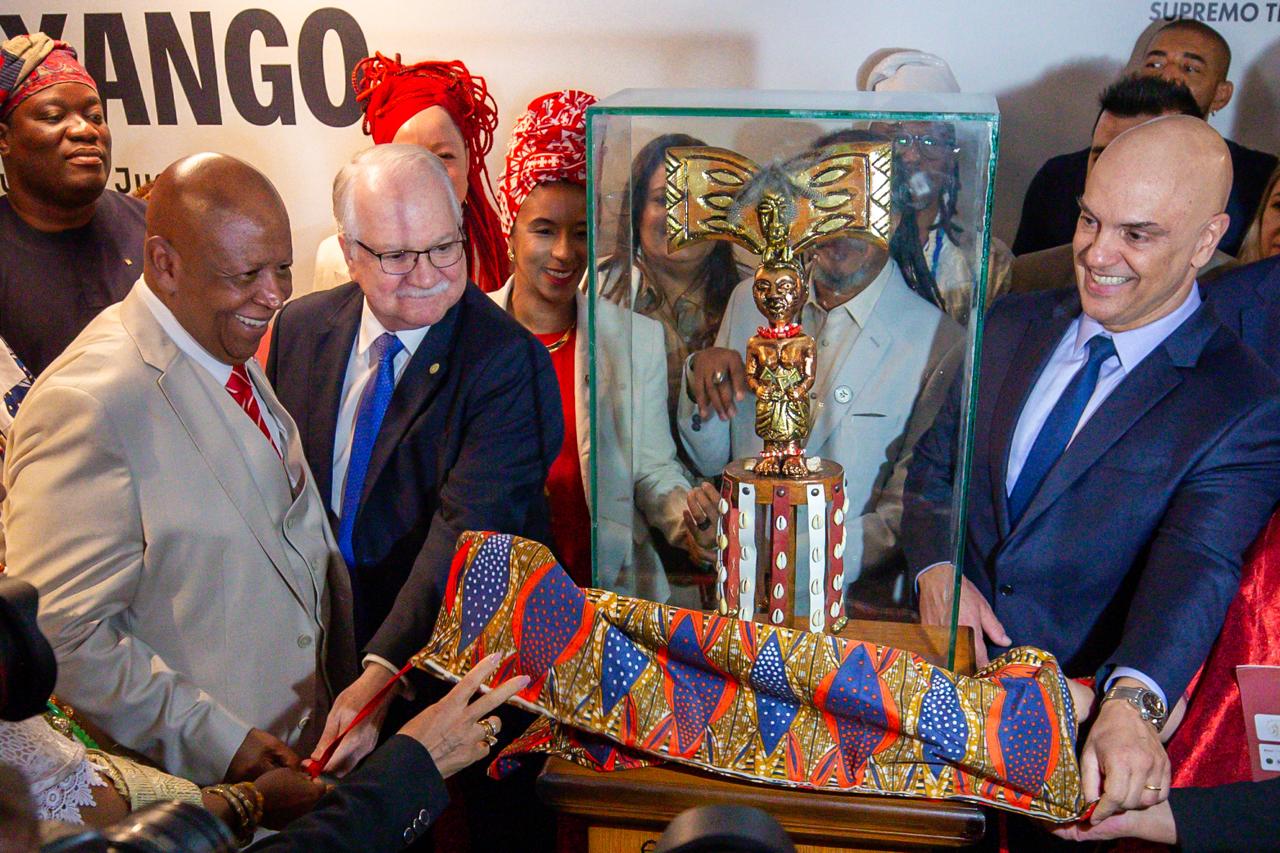
Black activists chose Nov. 20 to honor Zumbi dos Palmares in 1971. More than five decades later, it became a national holiday, which Brazil observes for the third time Friday.RIO DE JANEIRO (CN) — In Yoruba tradition, Shango, known in Brazil as Xangô, was a king of Oyo in what is now Nigeria. In Brazil, religions of African origin such as Candomblé and Umbanda worship him as the orisha of justice, thunder and fire. One of his symbols is the oxê, a double-bladed ax.On Tuesday, Brazil’s Supreme Court installed a sculpture of the Oxê de Xangô in its ceremonial hall, ahead of Black Consciousness Day. Brazil observes the day as a national holiday for the third time Friday.In 2024, Brazil’s Supreme Court ruled that religious symbols such as crucifixes can remain in public buildings when they reflect a Brazilian cultural tradition.That ruling gave Hédio Silva Júnior, a lawyer and founder of the Institute for the Defense of the Rights of Afro-Brazilian Religions, the idea to ask the court to display the Oxê. Silva Júnior said he brought together 12 religious leaders and submitted the request in February 2025.“The Oxê de Xangô embodies a duality, with two sides that can represent formal equality and substantive equality,” Silva Júnior said. He added that fighting discrimination requires both punishing those who discriminate and adopting policies that promote equality.Black activists also sought recognition on Brazil’s official calendar. Marcelo Dias, a former Rio de Janeiro state lawmaker and a member of the Unified Black Movement, said the movement campaigned for decades to make Nov. 20 a national holiday.“We questioned why Brazil had so many holidays tied to Judeo-Christian civilization,” Dias said.An estimated 4.9 million enslaved Africans arrived in Brazil during the transatlantic slave trade, according to the SlaveVoyages project. Brazil has the largest population of African descent outside Africa, according to the Ministry of Culture. In the 2022 census, 55.5% of the population identified as Black or pardo, a census category often translated as mixed race.In 1971, the Palmares Group in the southern city of Porto Alegre chose Nov. 20 to honor Zumbi dos Palmares, a leader of Quilombo dos Palmares, a network of communities founded by people who escaped slavery in colonial Brazil. The date marks the anniversary of his death. The network’s main settlement was in what is now the northeastern state of Alagoas.Dias traced the name Black Consciousness Day to “Wattstax,” a documentary about a 1972 music festival in Los Angeles where the Rev. Jesse Jackson spoke of “a day of black awareness.” The Unified Black Movement adopted the name in 1978, while Brazil was still under military rule.“At the time, the dictatorship was selling the world on the idea that Brazil was a racial democracy, that there was no racism,” Dias said.Activists also challenged the way Brazil told the story of abolition. The country had long commemorated the end of slavery on May 13, the anniversary of Princess Isabel’s signing of the Golden Law in 1888.Amilcar Araujo Pereira, a historian and professor at the Federal University of Rio de Janeiro’s School of Education, said about 90% of Brazil’s Black population was already free when Isabel signed the law.Pereira said choosing Nov. 20 shifted the focus of the commemoration from Isabel’s signing of the law to Black resistance and enslaved people’s fight for freedom.“Putting Zumbi forward as a symbol of Black leadership in the struggle that led to abolition was a key political strategy for the Black movement, one that made it possible for us to celebrate a national holiday today,” Pereira said.A decade after the Unified Black Movement adopted Nov. 20, Black activists pressed Brazil’s Constituent Assembly to protect their history.“One of the Black movement’s priorities was memory,” Silva Júnior said.He said activists pushed for schools to teach Black history, for protections for records and sites associated with historic quilombos and for recognition of quilombo communities’ right to their land. Brazil’s 1988 constitution included all three.It took another 35 years for Nov. 20 to become a national holiday. Alagoas made it a state holiday in 1995, and Rio de Janeiro followed in 2002.A 2011 federal law established National Zumbi and Black Consciousness Day. In December 2023, President Luiz Inácio Lula da Silva signed a bill making Nov. 20 a national holiday. Brazil observed the holiday nationwide for the first time in 2024.“It was a major achievement for us,” Dias said.The movement continues to call for reparations. During this year’s presidential campaign, the Unified Black Movement presented Lula with three priorities, Dias said.The movement sought more federal funding for Black culture and sanitation in favelas and outlying neighborhoods. It urged authorities to reduce police violence in those communities and focus investigations on the financial networks behind drug trafficking. It also sought greater Black representation in government and at state-owned companies, as well as the appointment of a Black woman to the Supreme Court.Pereira said displaying the Oxê in the Supreme Court’s ceremonial hall gives the court a chance to better reflect Brazil’s cultural diversity. He described the installation and the national holiday as steps forward in a fight against racism that is far from over.“As long as there is racism, there will be no justice in this country,” Pereira said, adapting a 2019 slogan from Brazil’s Black Coalition for Rights.Courthouse News reporter Marília Marasciulo is based in Brazil.Subscribe to our free newslettersOur weekly newsletter Closing Arguments offers the latest about ongoing trials, major litigation and rulings in courthouses around the U.S. and the world, while the monthly Under the Lights dishes the legal dirt from Hollywood, sports, Big Tech and the arts.Additional Reads
Brazil Supreme Court installs Yoruba symbol of justice ahead of Black Consciousness Day
Full Article
Original Source
Read the full article at Courthousenews →KhanList aggregates and links to publicly available news content. We do not host full articles from third-party sources. Always verify important information with original sources.