
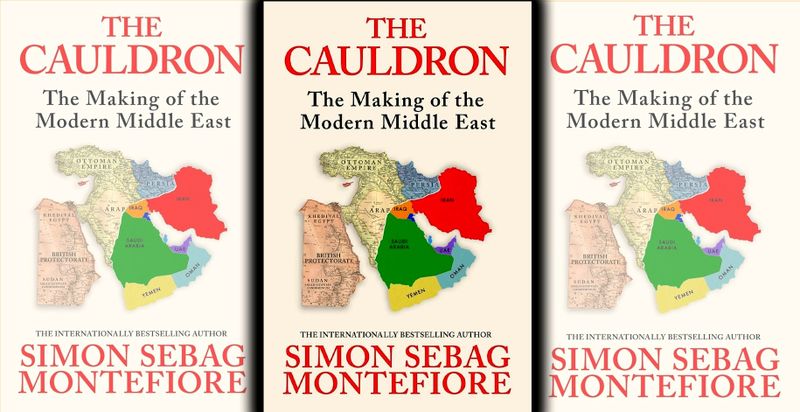
The majority of books written about the Middle East – and there have certainly been thousands upon thousands of them in many languages – focus on the story of one society or ethnic group. Or they examine conflict-ridden, bilateral relationships. Alternatively, they describe developments through the effects of a foreign power that is or has been engaged in the region. But Simon Sebag Montefiore’s newest book, The Cauldron, aims for something rather different. In his volume, the Americans, Russians, French, British and Italians and all their imperial ambitions are not the core for his work. Rather, Montefiore has aimed at treating the Middle East, together with the adjoining Maghreb nations, as an interconnected region in which the respective nations and ethnicities all have some degree of agency. (The alternative approach is a deep dive such as Mohsen Milani’s recent volume, Iran’s Rise and Rivalry with the US in the Middle East, which places Middle Eastern circumstances largely in the context of the contentious US-Iran and the Iran-Iraq relationships.)Montefiore is a well-respected British (and bestselling) historian. His earlier works focused on Russia and the Soviet Union, then more recently the saga of the city of Jerusalem over millennia, followed by a global history built around the impact of many different families, and even several works of fiction. (See our review of his previous book).Simon Sebag Montefiore, historian and author, attends the Cliveden Literary Festival at Cliveden House in Windsor, England, on 23 October 2021. (Photo: David Levenson / Getty Images) In this newest work, the author’s underlying thesis is that the entire region is significantly bound together by history, even as the societies within it are both linked and divided by rivalries and conflicts over religious traditions, multiple, sometimes overlapping ethnicities and intra-state tribal conflicts – as well as the influences of the rule by various conquerors.The author also notes the lingering impact on virtually all of these societies from centuries of Ottoman conquest and rule – an imperial regime that only disintegrated politically by the collapse of that empire at the end of World War 1.The task Montefiore set for himself has been seriously ambitious, even if the book weighs in with more than 400 pages, and even if it essentially starts at the beginning of the 20th century. Packed with all this detail and descriptions of the larger-than-life figures in it, his history can feel like a gallop through the region’s history as wars, insurrections, tribal feuds and foreign interventions all tumble forward, one after the other, relentlessly. Syria’s President Bashar al-Assad at the Signing of the comprehensive programme of strategic and long-term cooperation between Iran and Syria in Damascus on 3 May 2023. (Photo: Borna News / Matin Ghasemi / Aksonline ATPImages / Getty Images) Sometimes the plethora of details in the multiple threads of these stories may leave some readers breathless; but the author is such an accomplished storyteller that the reader enjoys (strange word, perhaps) the ride, regardless. In all of the death and destruction, Montefiore has been careful to apportion responsibility for the appalling mounds of victims and casualties sans excuses. (In his discussions of the Arab-Israeli conflicts, for example, his even-handedness might have been tested, but his judgements are likely to be unsettling to anyone – and their supporters – in those conflicts.) Many of the thumbnail portraits of the individuals he portrays go well beyond the usual public profiles of these people – exploring the fascinating interconnections between rulers, insurgents and tyrants who have populated the region. The reader gets backstage passes to private meetings where the hard realities of the region become clear – sometimes including when and where decisions to assassinate rivals are made.After reading this book one can draw several important observations about the region. The first is the overhang from centuries of Ottoman domination or suzerainty over most of the territory has not entirely dissipated – and the current leaders of Turkey seem to be hankering to revive some of that. Second is his conclusion that as the impacts of the European powers, Russia and America recede, the broader future of the region is likely to be determined at the hands of the three non-Arab societies and nations in the region: Turkey, Iran and Israel. Each of those nations have the military capabilities to substantially enforce their respective wills upon their neighbours – but, importantly, less so on the many non-state actors in the region.US President Jimmy Carter in the 1970s. (Photo: Hulton Archive / Getty Images) In Montefiore’s volume, the varied impacts of religion, the continuing fragilities or vulnerabilities of many of the states, the relative artificiality of many borders and the legitimacy or the lack of it on the part of so many of the rulers are all examined. He devotes significant attention to the evolution of social-political-religious movements, including Wahabism, Islamicism and Zionism, along with the importance of lingering historical memories – including the half-mythic, ancient glories of Egypt, Turkey and Iran, as well as an earlier Arabic world. Egyptian President Hosni Mubarak speaks to the media following talks with German Chancellor Angela Merkel at the Chancellery (Bundeskanzleramt) in Berlin on 4 March 2010. Mubarak was on a one-day official visit to Germany. (Photo: Sean Gallup / Getty Images) One minor quibble with Montefiore’s efforts might be his somewhat underplayed attention to the economic forces that have been important to the region. While petroleum and natural gas clearly underpin the successes, failures or futures of many of these nations, still more might have been made about how those products have shaped the region – and especially in their relationships with the rest of the globe.The massive scope of this book and the vividness of the story virtually cry out for a video series exploring the themes Montefiore has set out. In fact, it would be surprising if a video series were not already being storyboarded. It would be an immediate hit, in this reviewer’s view, with a huge audience.Given the current circumstances of the region and its ongoing, multiple conflicts, even bringing a book’s coverage up to mid-2026 runs the risk that major developments over the fate of Gaza, the conflicts between the US and Iran, between the Houthis and Saudi Arabia, and the political outcome in Israel’s upcoming election might require a major update in a year – or perhaps even a few months. In weighing the conflicts of the region, however, perhaps we should give the author a final say. As Montefiore concludes: The Cauldron may seem to argue that the Middle East is irredeemably more bloody and turbulent than anywhere else – it is certainly getting worse and the potential to proceed fast from ignition via flashover to apocalyptic pandemonium is ever-present – but it is worth putting this into the wider perspective world history. “This is not to say any of these cases are worse or better, nor to favour any victim over another: everyone counts. But during the period covered by The Cauldron, Europe has been much more lethal.” Perhaps that observation may be animated by a faint optimism, but we certainly can hope rational heads may prevail eventually across the region, despite the tugs and pulls of traditions, politics, economics or ethnicity. DM
BOOK REVIEW: Simon Sebag Montefiore’s ambitious attempt to make sense of the Middle East
Full Article
Original Source
Read the full article at Dailymaverick →KhanList aggregates and links to publicly available news content. We do not host full articles from third-party sources. Always verify important information with original sources.