
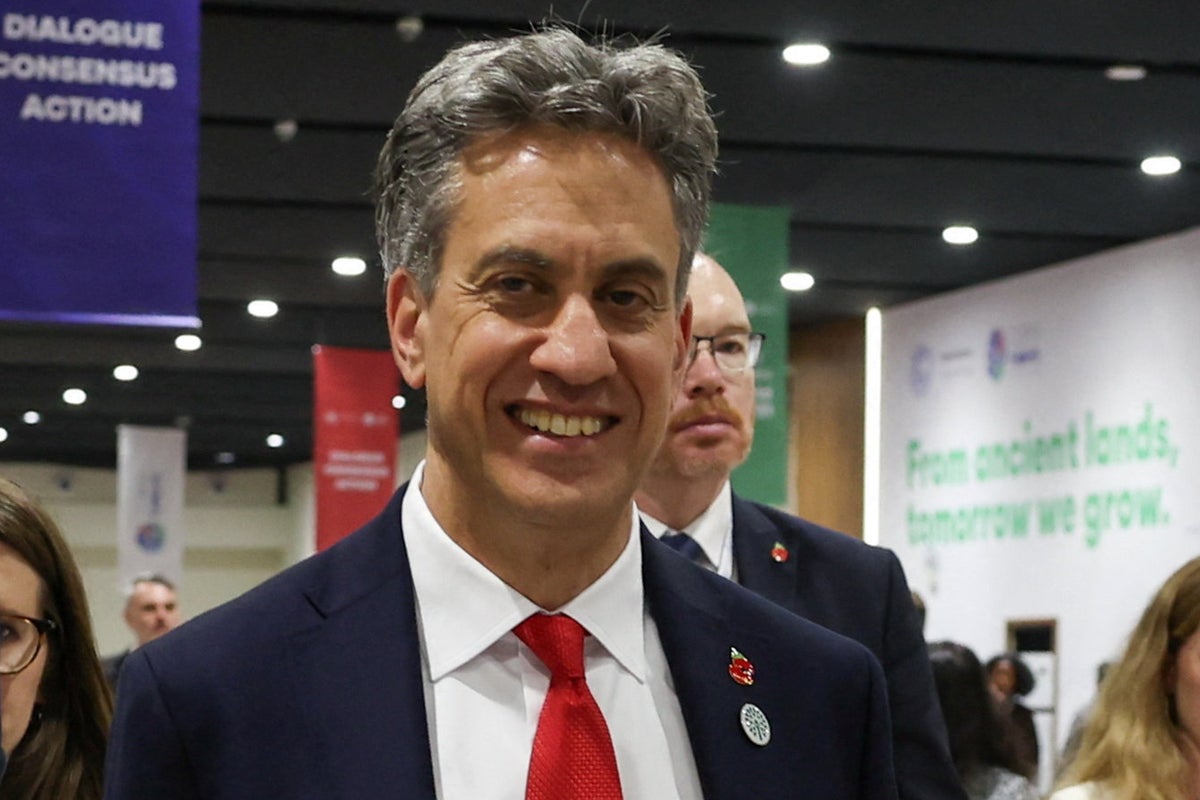
Billions of dollars in pledges for a high-profile forest protection fund from developing countries – and not just a small group of traditional donors with dwindling aid budgets – represents a ”powerful signal” of aid efforts to help the climate crisis, Foreign Secretary Ed Miliband has suggested. Mr Miliband made the comments to The Independent after a high profile event at Cop31 where countries reaffirmed commitments to the Tropical Forest Forever Facility (TFFF): a new forest finance initiative designed to pay tropical forest countries a recurring, performance-based amount per hectare of conserved standing forest.Launched by President Lula at Cop30 in Brazil last year, the fund has now been promised £400m from the UK, $500m (£380m) from the Netherlands, and nearly $100m from climate philanthropies. Norway has promised to fund up to 20 per cent of the facility's initial $10 billion capitalisation target, and it is to receive $1bn from Indonesia and $1bn from Brazil: two rainforest nations that are also developing countries, and therefore do not typically face the same expectations as wealthier Western nations to provide aidSpeaking to The Independent after a period of sweeping aid cuts from developed countries including the UK, Mr Miliband commended the fact that a broader group of nations was supporting the fund. “The breadth of support behind the TFFF is a powerful signal of the growing global momentum to protect forests, and a positive development in global efforts to fund the climate and nature crisis,” Mr Miliband said. “The UK is proud to be part of that effort, and the City of London has a crucial role to play in mobilising private capital at the scale we need.”His comments were echoed on the sidelines of the event by Hashim S. Djojohadikusum, Indonesia’s special presidential envoy for climate and energy, who told The Independent that he, too, believed that it was positive that developing countries are providing forest finance. Foreign Secretary Ed Miliband arrives at the high-profile forest protection event at Cop31 in Antalya (Nick Ferris)Indigenous leaders also attend the event (Nick Ferris)“This is a big moment because we have the developing world now coming up with money and showing that there is a new way of doing things,” he said. “We are glad that the TFFF again has prominence this year - and we are very happy, too, that the UK is now also getting involved.” Progress on forest finance contrasts with the deadlock in negotations over wider funding to help nations adapt to the climate crisis. Wealthy countries are cutting aid budgets, the US is entirely absent, and the official “Annex Two” list of climate finance donor nations remains unchanged since it was devised in 1992 - leaving out countries such as China, the UAE, South Korea and Singapore, which have all since become some of the world's richest nations.The world’s poorest and most climate vulnerable countries, meanwhile, are raising the alarm that climate challenges, particularly with this year’s ”super” El Niño, are only worsening, with hugely inadequate sums of money available to help them to adapt. Speaking at the same forest event, amid chanting from the numerous Brazilians in attendance, Brazil’s newly re-elected leader President Luiz Inácio Lula da Silva said that the “mistaken notion of the incompatibility of conservation and development belongs to the past”.With Brazil having last year recorded the lowest Amazon deforestation in four decades, President Lula added: “We need to recognise the value of the standing forest and the people that preserve it. And we need to stop degradation and we also need other restored degraded areas” Newly-reelected President Luiz Inácio Lula da Silva of Brazil gestures to crowds chanting 'Lula' at the Cop31 forest event (Nick Ferris)Elsewhere at Cop31, Prime Minister Matthew Wale of the Solomon Islands, an extremely climate-vulnerable island nation in the South Pacific, said that he also thought it was high time a broader group of nations should begin to stump up more aid for the climate crisis. “The G7 have profited on the back off the atmosphere and polluting it for the rest of us, and they must front [climate finance]. But of course the Brics and industrialising countries also must contribute,” Mr Wale told The Independent – adding that he also believes it is time to reopen the 1992 settlement on which countries should be classified as climate finance donors. “It’s an absurd logic that to become wealthy you must pollute the atmosphere for the rest of us. But it is what it is – and we encourage other countries to follow Indonesia and Brazil in providing money,” he said. Mr Wale’s comments came as the Solomon Islands announced that it has become the first country classified as a ‘small island developing state’ to pledge money to the $22bn Green Climate Fund, which is the world’s largest fund from which developing countries can apply for climate aid. With the country pledging some $400,000, Mr Wale said that he hoped the move would encourage other much wealthier and larger countries to follow suit. “The Pacific did not create this crisis, but we will not stand by and wait for others to act. We may be a small island nation with limited resources, but we are determined to show leadership,” he said. “Our message is clear:we have stepped forward, and now we call on the world's largest economies to do the same.” This article has been produced as part of The Independent’s Rethinking Global Aid project
Billions for forest fund a ‘powerful signal’ over climate aid, says Ed Miliband
Full Article
Original Source
Read the full article at Independent →KhanList aggregates and links to publicly available news content. We do not host full articles from third-party sources. Always verify important information with original sources.