
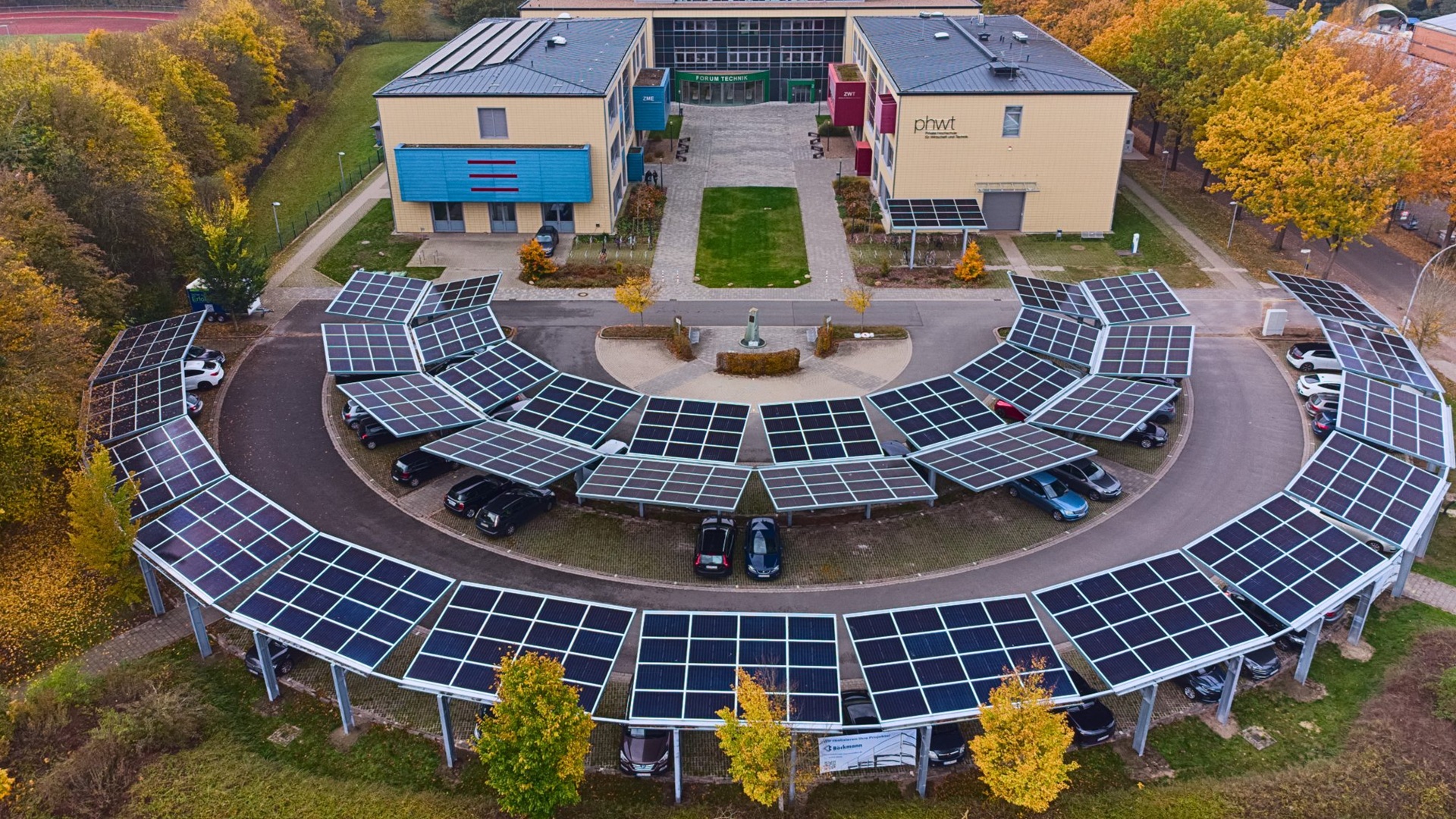
A German university has introduced a solar carport equipped with 237 kilowatts-peak (kWp) of photovoltaic capacity and a 200-kilowatt-hour (kWh) sodium-ion battery for excess energy storage. Located at the Diepholz campus of the Private University of Applied Sciences for Business and Technology (PHWT), the new installation was officially inaugurated on November 9. It has a total of 90 covered spaces and a battery system that uses sodium instead of lithium. The structure is home to the first sodium-ion battery storage system in the state of Lower Saxony, and the third in the country. It will reportedly allow the campus to store electricity for later use, especially during periods of high demand. PHWT representatives highlighted the facility’s most striking feature. “The existing parking lot is arranged in a semicircle with two rows of parking spaces,” they said. “The aim was to incorporate this unusual geometry into the roof design.” A massive solar twist To bring the unusual design to life, solar energy company PfefferKnecht came up with a custom metal structure that follows the parking area’s curved layout. Local engineering firm and longstanding university partner, Böckmann Maschinenbau, then erected the structure. According to PHWT, the carport’s roof covers roughly 12,378 square feet (1,150 square meters) and incorporates glass-glass photovoltaic modules. These panels provide around 230 kWp of installed solar capacity. The inauguration of the new solar carport.Credit: PHWT An additional bicycle shelter contributes another 7.3 kWp. The bicycle facility can accommodate 20 bikes. “A patented feature of the structure is that the individual photovoltaic modules also serve as a seamless, waterproof roof covering,” PHWT said. “This eliminates the need for an additional roofing membrane underneath.” The construction is also complemented by integrated LED lighting for the parking spaces. Moreover, the energy storage system consists of two sodium-ion battery cabinets supplied by Swiss green energy company Phenogy. Together, they offer 200 kWh of storage capacity and a charging and discharging power of 100 kW. The sodium-ion technology relies on widely available sodium-based materials and does not require lithium, graphite or cobalt. This makes the batteries less flammable and resistant to high and low temperatures. Completed in record time The system is expected to help the university become more energy independent and rely less on grid electricity. According to PHWT, stored electricity can cover peak demand periods, and potentially reduce energy costs. While the project’s development took nearly 18 months, the actual construction was completed within a 10-week window during the semester break. The effort was initiated by Dennis De, PhD, PHWT President Professor, and Andreas Knecht, PfefferKnecht’s Managing Director. PfefferKnecht planned and implemented the solar structures under its Lichtkraft brand. The entire construction process involved laying the foundations, erecting the steel frame, installing solar panels, and setting up the electrical systems. The new solar carport site complements an existing sustainable energy concept at the Diepholz campus,” PHWT officials said in a press statement. “The campus already uses an ice-based thermal energy storage system for heating and cooling.”PHWT hopes to become a leader in sustainable energy solutions beyond Lower Saxony. “The facility also highlights how innovation, sustainability, and industry collaboration can work together,” PHWT concluded.Get the latest in engineering, tech, space & science - delivered daily to your inbox.Based in Skopje, North Macedonia. Her work has appeared in Daily Mail, Mirror, Daily Star, Yahoo, NationalWorld, Newsweek, Press Gazette and others. She covers stories on batteries, wind energy, sustainable shipping and new discoveries. When she's not chasing the next big science story, she's traveling, exploring new cultures, or enjoying good food with even better wine.
Solar carport packs 237 kWp of power with 200-kWh sodium battery for campus parking
Full Article
Original Source
Read the full article at Interestingengineering →KhanList aggregates and links to publicly available news content. We do not host full articles from third-party sources. Always verify important information with original sources.