
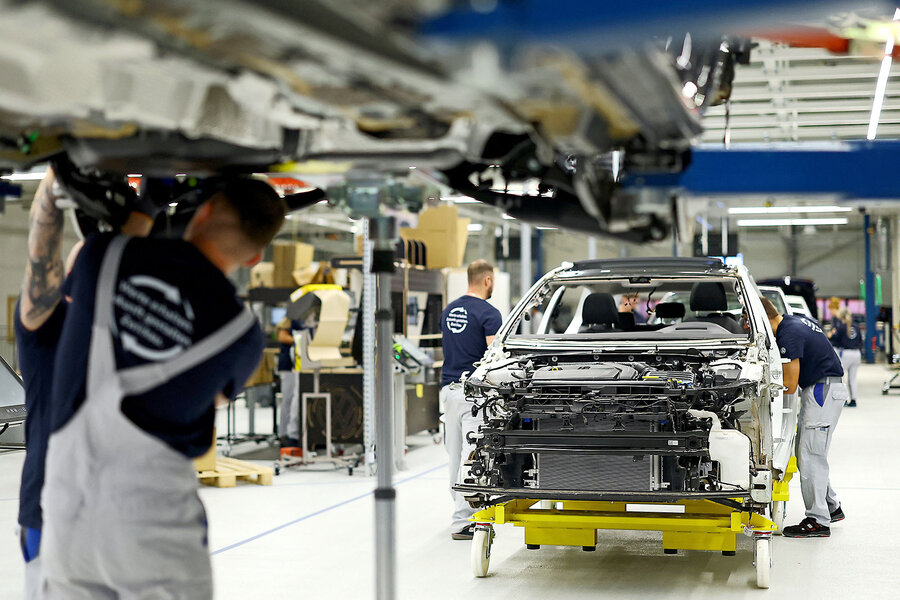
Berlin | Nov. 02, 2026, 4:35 p.m. ET | 4 min read For decades, “German engineering” was synonymous with arguably the world’s best cars: the symphonic hum of an exquisitely calibrated internal combustion engine, combined with the elegant appointments of a meticulously crafted autobahn experience.Today, experts say, the phrase is in danger of becoming synonymous with the potentially enormous costs of overconfidence, complacency, and an unwillingness to change.The German auto industry faces what many analysts agree is the most daunting crisis in its history. Just as Apple reinvented the telephone, Tesla has effectively reinvented the car, turning it from a vehicle to a computer on four wheels and revolutionizing how it is built, making the process faster, more innovative, and more efficient.The German industry has largely ignored the trend, while new Chinese automakers have built themselves almost from scratch precisely to deliver this “car of tomorrow.” The result has been a disaster, the scope of which is only now becoming apparent.As recently as 2020, 25% of the cars sold in China – the world’s largest auto market – were German. Today, that number is down to 12% as Chinese buyers increasingly turn to domestic models. Compounding the challenge, Chinese cars are exploding in Europe, with a 9% market share in the first half of this year – up from 0.6% five years ago. The greatest concern, however, is the difficulty of the path ahead. As Europe and China push toward a more-electric future, German automakers have fallen dramatically behind their Chinese competitors, whose electric cars are both cheaper and more technologically advanced. To catch up, Germany will need to completely reimagine its car industry at a time when its energy prices are high, production processes are outdated, and huge layoffs threaten a war with historically entrenched unions in a way that could kindle more working-class political anger. Benoit Tessier/ReutersPeople visit the booth for Chinese automaker BYD at the Paris Motor Show, Oct. 16, 2026. “This is a big transformation of the car industry, and for the established players it’s not easy,” says Stefan Bratzel, director of the Center of Automotive Management in Bergisch Gladbach, Germany. “But a big part was hubris. They thought they were defining the rules of the game, and they ignored the new tech trends.”Understanding the car of tomorrowThe auto industry is Germany’s largest and most influential sector, and manufacturing excellence has been deeply sown into the German identity from the days that Gottlieb Daimler and Karl Benz helped develop the first internal combustion engines in the late 1800s.In casting doubt on those treasured economic pillars, the current crisis has an added poignancy – feeling like a direct assault on German pride and tradition.When Tesla introduced the new manufacturing process called gigacasting, it allowed cars to be made faster, with less labor and fewer parts. All Chinese manufacturers now use some version of the process. By contrast, a top executive at one German carmaker initially called the process “crazy,” saying, “You can’t do that,” says Ferdi Dudenhöffer, director of the Center for Automotive Research in Bochum.The same mistake was repeated again and again, says Dr. Dudenhöffer. And not just by German automakers, but by the industries that supply them, too. German manufacturer Bosch has long been one of the top suppliers for high-end automotive technology. But it has not significantly invested in battery or semiconductor technology.In Dr. Dudenhöffer’s view, “Bosch has lost the whole auto industry.” The German auto industry “didn’t understand the car of tomorrow for a long time,” he adds. “The Chinese realized that very fast.”In the short term, Germany will almost certainly see layoffs, buyouts, and perhaps strikes. Matthias Balk/picture-alliance/dpa/APCar transport wagons with new vehicles from Volkswagen, BMW, and Audi stand on the tracks of a marshaling yard in Munich, May 11, 2026. German automakers are petitioning Berlin and the European Union to back off electric vehicle targets. Increased tariffs on Chinese cars are an option, too. Such moves could ease the effect of Germany’s automotive drag.“The big party is over”Some German automakers have begun to realize the size of the challenge ahead, though the solutions might not win praise in Germany.Volkswagen has concluded it cannot build a competitive car for the Chinese market in Germany, given the impediments here. So it is ramping up an “in China, for China” philosophy that aims to mimic Chinese carmakers’ advantages.“Employees know the situation is serious,” says Dr. Bratzel of the Center of Automotive Management, after visiting Volkswagen headquarters last week. “The big party is over.”Volkswagen already announced plans earlier this year to eliminate 100,000 jobs by the end of the decade. The automaker is set to begin negotiations with IG Metall, Germany’s largest union, in December. It has unilaterally terminated several collective bargaining agreements while proposing a freeze of all salaries until 2030. In a statement, IG Metall accused Volkswagen of a “breach of trust,” adding that the current path “will set in motion a process that paves the way for a massive confrontation involving all stages of escalation in the labor dispute.” Deepen your worldviewwith Monitor Highlights.Politics with respectGet political stories with respectful analysis.There‘s a world of new ideas in everyBooks newsletter.There‘s more to life, enrich yours withCulture & Learning weekly.Follow humanity‘s discoveries withScience & Nature stories in your inbox.Gain a spiritual perspectivefrom the stories in your inbox.Want to understand the deeper impact of critical events? Learn the Monitor‘s insight.Already a subscriber? Log in to hide ads. Dr. Bratzel is not sure Germany’s nascent attempt to recast its auto industry will be successful. But he knows the first step is for everyone to understand the significance of the changes ahead.“A big part of whether this will be successful is whether they can build up a partnership to work together,” he says. This level of institutional change “is going to be a battle.” ALREADY A SUBSCRIBER? LoginReal news can be honest, hopeful, credible, constructive.The Christian Science Monitor was founded in 1908 to lift the standard of journalism and uplift humanity. We aim to “speak the truth in love.” Our goal is not to tell you what to think, but to give you the essential knowledge and understanding to come to your own intelligent conclusions. Join us in this mission by subscribing.
As EV race heats up, Germany finds itself falling behind pack leaders
Full Article
Original Source
Read the full article at Csmonitor →KhanList aggregates and links to publicly available news content. We do not host full articles from third-party sources. Always verify important information with original sources.