
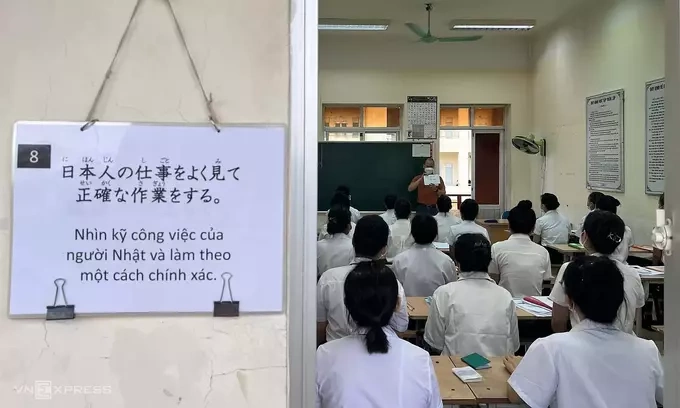
Vietnamese recruitment firms that once had seven or eight applicants for every Japan job order now send staff into villages and still find it hard to fill their quotas. Recruiters blame a weaker yen and more jobs at home, and many workers are turning to other markets, especially Taiwan, where the wait to depart is shorter.For almost a year, Pham Van Trong, human resources manager at a company that supplies workers to Japan and Taiwan, has traveled to rural and mountainous northern Vietnam twice a month to recruit young people for jobs abroad.Based in An Khanh, Hanoi, the company has sent workers to Japan for more than 10 years in food processing, mechanical engineering, automobiles, machine building, seafood and agriculture, and to Taiwan for electronics work. It asks local Women's Union and Youth Union officials to help find candidates, but they turn up only about 10% of the workers it needs."The villages are empty of young people because they've moved to the big cities to work in services, drive for ride-hailing apps or take factory jobs. Visit their homes and you only find old people and small children," he said.Japan is one of Vietnam's three traditional labor markets. Vietnamese were the largest group of foreign workers there as of October 2025, according to Japan's labor ministry.At the end of June, 176,865 Vietnamese were in Japan as technical interns, more than any other nationality, and another 176,915 as specified skilled workers, Immigration Services Agency figures show.Japan took nearly 28,500 Vietnamese workers in the first half of this year, the most of any market but down from 35,240 a year earlier, Vietnam's Ministry of Home Affairs data show. By the end of August, Taiwan had pulled ahead, 39,890 to 35,837.Trong's company takes more than 600 job orders a year from Japanese partners on average, but filling them has become very difficult, with its supply of candidates down about 60% from before.A decade ago, seven or eight applicants competed for each order. Now there are two per position, or the company accepts anyone who turns up.Its recruiters post in online groups and split up to search the provinces. The company has also relaxed its selection criteria to fill more places.In food processing and auto parts manufacturing, for example, workers used to need to be at least 1.65 meters tall and physically fit to cope with the work and winter weather. Now candidates who fall just short of the height and weight requirements still pass.The company provides transport and covers extra costs for trainees during preparation. Some candidates interview before the Lunar New Year, or Tet, and leave after the holiday, but quotas still go unfilled.Trong said several factors were behind the falling supply, among them more jobs at home. Unskilled construction workers, for example, can now earn around VND20 million ($770).But the main reason, he said, is the weaker yen. One yen used to fetch VND200-220 and now fetches about VND160-170, so every 10,000 yen ($64) is worth VND400,000-600,000 ($15-23) less once converted.Workers' total incomes are 1.2 to 1.5 times what they were 10 years ago, but what they can save and send home has not kept pace. On total incomes of VND30-40 million ($1,150-1,540) a month, workers used to send home VND20-25 million ($770-960), and their savings still hover around that level."With the yen sliding and savings not growing, workers will think twice," Trong said. Candidates attend a training class in Hanoi before leaving to work in Japan, 2023. Photo by VnExpress/Hong Chieu Long waits add to the pressure. A National Statistics Office survey found that the average migrant worker waits about six months between starting preparations and departing.Japan, with its strict requirements, takes about seven months of preparation, compared with about four for other destinations in Asia. The wait can leave workers without income, raising costs and the risk of debt, as more than half borrow to go abroad."Japanese is also a barrier for unskilled workers, because both the receiving and sending sides demand a high level. But whether it's Japan or any other market, the more of the language you know, the better," he said.Even for Taiwan, a less demanding market than Japan that draws workers because departure takes only one to two months, the company's supply of workers has fallen about 30%. It receives 300-400 electronics orders a year and meets about 60-70% of demand.Kim Thanh, who asked that her real name not be used, handles recruitment at a company that sends workers to Japan. She said its warehousing and food processing orders for this year are nearly filled, but three mechanical engineering orders for eight workers have gone unfilled since the start of the month.Thanh said generational differences in attitudes to work also make recruiting harder. Workers born in the 1980s and 1990s generally don't mind heavy work, while younger people weigh other things.Food processing and warehousing, known as "light work, high pay" jobs, tend to draw young applicants. Mechanical work such as semi-automatic welding or operating cutting machines is grueling, demands high skill and attracts few takers.Each order used to draw three or four applicants per place. Now there are one or two, and many workers are turning to other markets such as Europe and especially Taiwan, where the wait to depart is about two months and entry requirements are looser, even for those who don't speak the language well.Despite the shortage, companies find it hard to lower their standards because partners set mandatory requirements. In mechanical engineering, for instance, workers must be at least 1.68 meters tall to handle goods racks.Thanh's company offers staff bonuses for referrals, paid only after a recruit has left for Japan and worked there for a while, but candidates remain scarce.Sending companies sometimes turn to local brokers, and a trainee may pass through two or three layers of middlemen before reaching one. The sending company is usually the last link, training workers and handling the paperwork to send them to Japan.Thanh said Japan still offers advantages worth weighing despite its demanding recruitment and the weaker yen, including stable work and relatively good labor protections. On returning home, technical interns who complete a three-year contract can claim back part of the pension contributions they paid in Japan, known as nenkin, as a lump sum of VND100-150 million ($3,840-5,760), depending on the case.Japan is set to launch its Employment for Skill Development system in April 2027, gradually replacing the Technical Intern Training Program. Thanh said better working conditions and higher workforce standards will mean stricter recruitment criteria and even scarcer candidates, and sending companies will have to compete harder for workers to keep their orders."The closer we get to the end of the year, the harder it is to find anyone. Everyone wants to wait until after Tet," said Trong, who faces the same pressure. His orders still have about 60 places open, and he reckons he can fill only a third of them.
Vietnam, Japan's biggest source of foreign workers, struggles to recruit more
Full Article
Original Source
Read the full article at E →KhanList aggregates and links to publicly available news content. We do not host full articles from third-party sources. Always verify important information with original sources.