
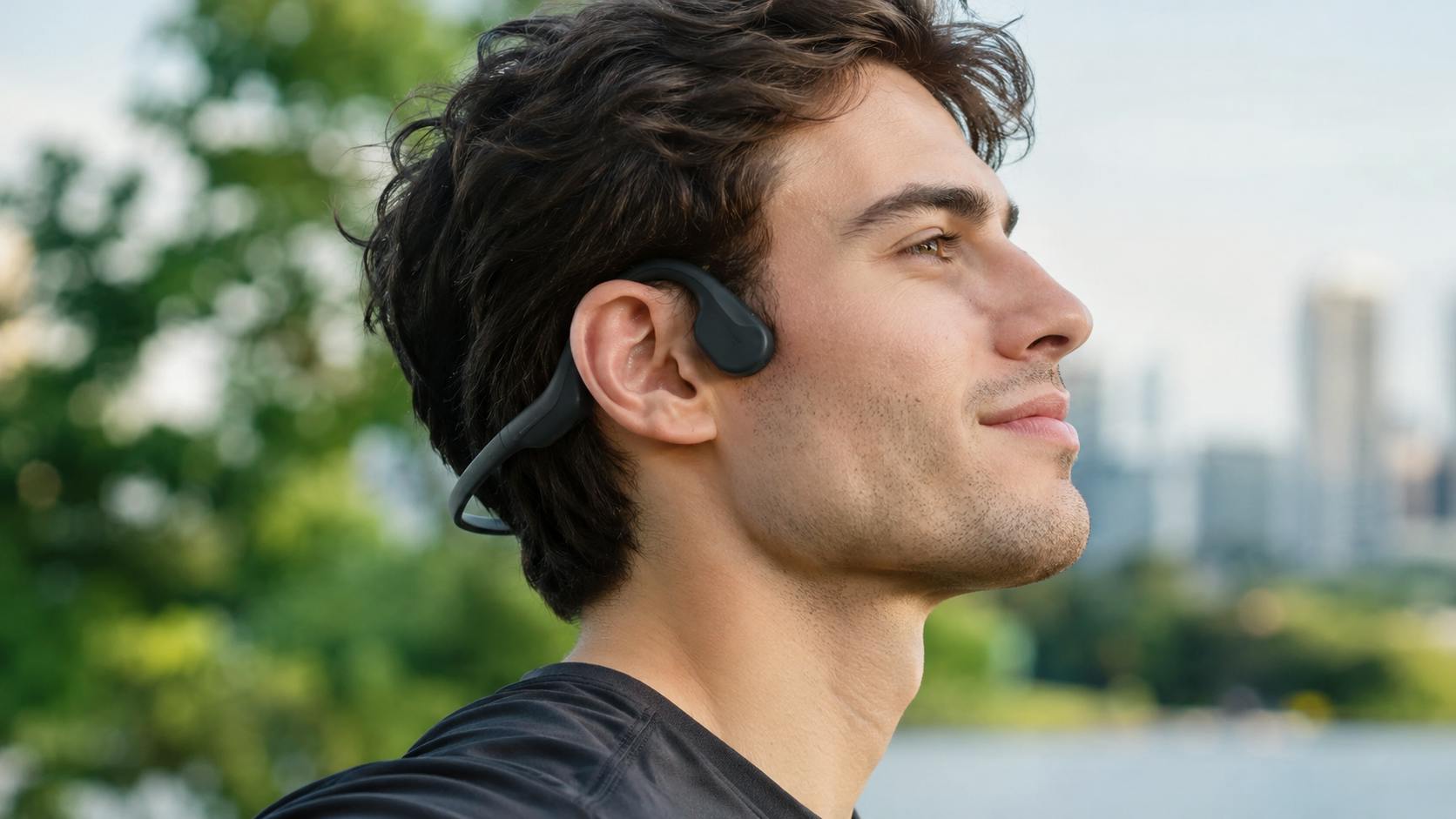
Most headphones function in a very simple manner: sound waves created by the headphones propagate through the air into the ear canal and into the inner ear. However, there are some headphones that have a non-traditional approach to producing sound for listening to music. These headphones can deliver sounds through vibrations to the head bones and tissues, thus enabling users to listen to music without inserting earbuds into the ear canals or using bulky headphones that cover them completely.Such headphones are called bone-conduction headphones, as they produce vibrations in addition to the conventional sounds created by speakers.It may appear strange, but the science behind this process is fairly simple. In fact, there is always some kind of bone conduction when a person speaks and hears his own voice. Vibrations generated by the act of speaking pass not only through the air but through the body, which explains why the voice that is recorded differs from the voice we hear when speaking.In addition, transmission of sounds via the head affects how music is being played. In order to explain why this happens, it is necessary to learn more about how these headphones function and how sound vibration turns into music.First, Understand How Traditional Headphones Deliver SoundBefore diving into the mechanics of bone conduction, it helps to establish exactly how normal headphones work. Understanding this baseline makes the technical jump to bone conduction much easier to follow.The Journey of Sound Through Your EarsHeadphones are designed based on the principle of air conduction and transmit sound into the inner ear in the following way. First, sound waves are produced from the headphones as a result of a diaphragm's rapid vibration. These waves move through the air inside the ear canal and eventually encounter the eardrum that starts vibrating.Then, three small bones in the middle ear, called malleus, incus and stapes, amplify the vibrations and pass them on to the cochlea. It is an incredibly small organ located in the inner ear, which has the shape of a snail and contains fluid. Moreover, it consists of a basilar membrane, which separates the liquid inside the cochlea. As the waves move through the liquid, the sensory hair cells convert mechanical energy to the electrical one. Finally, the signals reach the brain through the auditory nerve, which interprets them as sound. However, the eardrum is not the only place for vibrations to get to the cochlea.How Bone-Conduction Headphones Actually WorkWhereas miniature speakers have been traditionally used, modern consumer bone-conduction headphones make use of transducers that are electromechanical. This is because the main function of these transducers is to convert electrical audio signals to mechanical vibration. This is different from normal headphones since the transducer does not go inside or on the ears. They usually come into contact with the skin around the ear region.From Electrical Signals to Mechanical VibrationsHearing using a bone conduction device is quite distinct from the one used by earbuds. Once the audio signal sent from the computer to the headphones has been received, it gets converted into mechanical waves through the transducer inside. The transducer moves in sync with the skin of your face and the body tissues beneath it.This vibration travels through the biological parts of your head, without interacting with the outer and middle ear at all. Mechanical energy turns into motion in the cochlear region. From here, the entire process becomes just like any other form of hearing process, where the sensory hair cells detect the motion in the fluid and send signals to the brain through the auditory nerve.Does Sound Really Travel Through the Skull Bones?It is easy to picture bone conduction as one simple process involving the skull, but the reality of it is actually quite complicated. The process of transmission of sounds through the head includes more than one pathway operating at once.As described in the basic research on bone-conducted sounds and their physiology, there are a number of different ways that this is accomplished. Vibrations lead to movement of the fluid within the cochlea, called cochlear fluid inertia, which is one of the main factors that allow us to hear bone-conducted sounds. Also, the small bones of the middle ear react to the vibration of the skull (ossicle inertia). Moreover, the vibrations cause micro-movement of the walls of the cochlea. Surprisingly, vibrations of the skull also produce secondary sound pressure within the ear canal.Why Bone-Conduction Headphones Sound Different From Regular HeadphonesIf you have ever tried a pair of bone-conduction headphones, you immediately notice that they do not reproduce sound in exactly the same way as conventional earbuds. The audio often feels different in texture and weight. This variance comes down to the transducers, the physical vibration pathways and how human tissue filters different frequencies.Bass Doesn't Feel the SameBass sounds that have lower frequencies are critical in the listening experience of music in modern times. In the case of regular earphones, changes in air pressure are used effectively in stimulating the eardrum. In the case of bone conduction headphones that people can buy, the sound waves have to fight their way to the cochlea through a combination of skin, cartilage and bone tissues.Human tissue has a natural tendency to dampen certain mechanical frequencies, thus, the production of bass tones is noticeably less intense. The transducers have to vibrate more in order for bass tones to be produced, thus, there will be a noticeable buzzing and tickling effect on the cheekbones of the listener.Sound Leakage and Environmental NoiseSince the transducers are placed totally outside of the ear canal and operate by making vibrations outside of the head, part of the acoustic energy is bound to leak out into the air. As a result, there will be sound leakage, which means that people who happen to be sitting close to you can overhear the low-quality music leaking from the earphones. Additionally, the open-ear technology allows all kinds of background noises to get into your ears automatically.The Engineering Behind Bone-Conduction HeadphonesDesigning consumer bone-conduction wearables requires engineers to navigate a highly specific set of physical limitations. Building a traditional speaker is mostly about moving ai, building a bone-conduction transducer is about effectively transferring mechanical energy into the human body.Why Transducer Placement MattersThe issue of positioning the transducer is significantly more complicated than just finding a place where it will be able to vibrate. The exact position of the transducer, the force of its pressure on the skin and the coupling with the underlying tissue will determine the efficiency of vibrations reaching the inner ear.One particularly intriguing experiment conducted in 2023 on bone conduction hearing via bone conduction headsets revealed precisely this connection. It was found out that vibrating the area near the opening of the ear canal greatly increased bone conduction sensitivity by about 20 dB compared to the classical position of the transducer behind the ear (mastoid bone) with the highest sensitivity increase of up to 40 dB on certain frequencies.The Challenge of Balancing Comfort and Audio QualityEngineers always find themselves in the midst of a tug-of-war when it comes to trade-offs. The vibration can be enhanced in the transducer, which may result in improved bass and volume, however, very soon, it will result in skin fatigue for the user. A more tight headband provides better mechanical coupling and sound transmission, but it results in a headache due to the pressure exerted on the head.Why Do Bone-Conduction Headphones Leave Your Ears Open?The most defining visual characteristic of these headphones is that they leave the ear entirely unobstructed. By resting on the temporal bone or cheekbone, they do not physically block the ear canal in any way.Understanding the Open-Ear DesignThe open ear technology allows normal transfer of environmental sound through the air to your eardrum despite you listening to a podcast or music. It addresses the issue of situational awareness that is faced by a particular user segment. Bicyclists would be able to hear any coming traffic, office workers can listen to music and still be aware of their colleagues and even runners can have spatial awareness around them.But most importantly, it needs to be realized that having an open ear feature does not mean that it automatically provides you with safety. Listening to loud playback using bone conduction technology may mentally distract the listeners and loud environmental sound would also be enough to mask the audio you are listening to. What's more, no consumer bone conduction headsets provide any kind of passive noise cancellation.Are Bone-Conduction Headphones Better for Everyone?It is a mistake to view consumer bone-conduction technology as a direct upgrade or replacement for conventional headphones. Instead, both technologies solve fundamentally different listening problems.Where Bone Conduction Makes SenseThey are perfect for those people who have trouble wearing regular ear buds because of discomfort or the tendency for them to fall out. They are great options for outdoor sportsmen, urban travelers and anyone else who wants to have their own music soundtrack while staying engaged with reality.Where Traditional Headphones Still Have an AdvantageIf you’re someone who requires high-fidelity sound quality, then the concept of bone conduction won’t work for you. Over-the-ear or in-the-ear headphones have a far more superior performance when it comes to deep bass, wide soundstage and an immersive experience. The one purpose for which bone conduction headphones can’t fulfill their purpose is to cancel the noise of an airplane or noisy café.The Bigger Picture: Bone Conduction Is More Than Just Another Headphone TechnologyIn addition to traditional methods of listening to music, the technology of bone conduction is opening new classes of wearable devices for consumers. This is because the bone-conduction system does not occlude the ear canal and it is increasingly becoming an integral part of augmented reality (AR) smart glasses and spatial computing visors.While using AR glasses, you need your digital data to be laid over the real one. Bone conduction transducers integrated into the arm of smart glasses can provide you with directions, responses of your virtual assistant and even chime notifications without isolating you from your environment. In tactical, outdoors and sports communications, it allows team members to coordinate themselves through voice communication while remaining fully acoustically aware of their environment.Final Thoughts: Hearing Is More Complicated Than We ThinkUltimately, the emergence of bone conduction technology demonstrates an interesting biological phenomenon - the fact that sound doesn’t always have to pass through the ear canal to be audible. This kind of headphones shows how versatile the human auditory system can be in its ability to convert mechanical vibrations via different physical paths into our beloved music.Although their distinctive transfer method restricts the capabilities of the headphones in terms of bass reproduction and noise isolation, it provides a truly unique combination of digital sound and physical perception. In case our brain can easily process the sound via vibrations transmitted through the skull, what other physical paths could be used by future wearables to change our digital experiences?
Music Through Your Cheekbones: How Bone-Conduction Headphones Work and Why They Sound Different
Full Article
Original Source
Read the full article at Hackernoon →KhanList aggregates and links to publicly available news content. We do not host full articles from third-party sources. Always verify important information with original sources.