
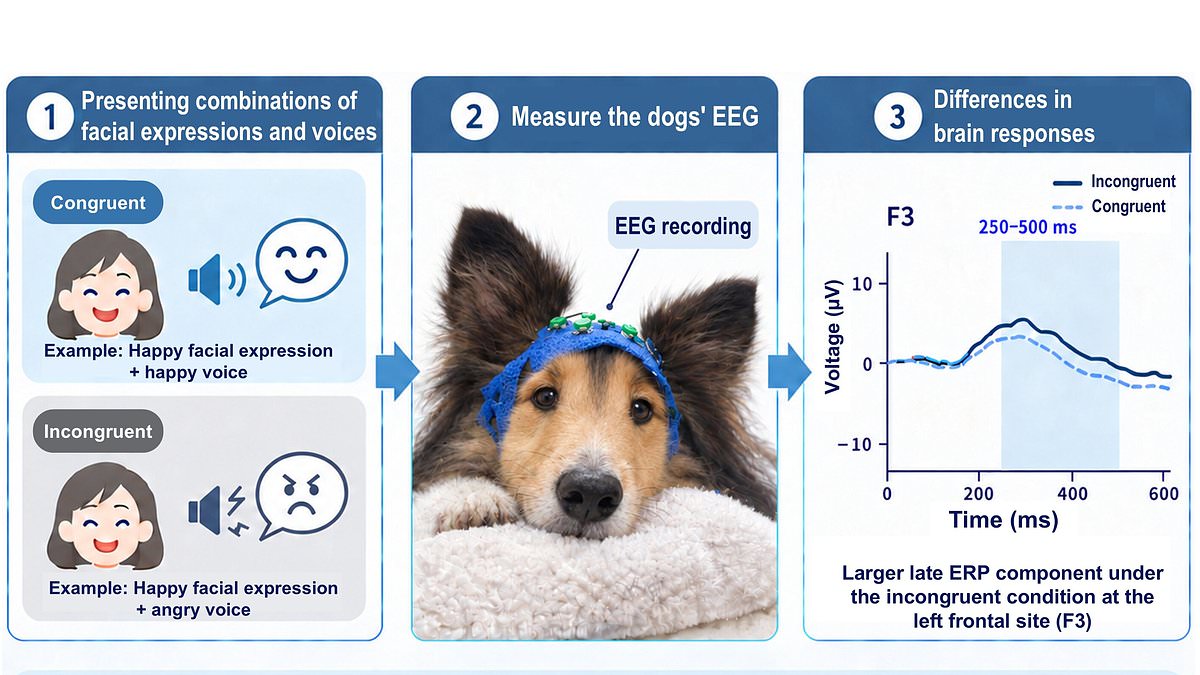
Published: 06:42 EST, 16 November 2026 | Updated: 06:45 EST, 16 November 2026 Many dog owners like to think they've got a special connection with their pet. But a new study has warned that if you have a pup, you may unknowingly be sending them mixed signals. Scientists used brain scanning technology to investigate how dogs respond to emotional cues from their owners.The results revealed that when these cues are conflicting, it can send the dog's brain into overdrive. For example, when the owners spoke to their pets with a happy face but an angry voice, the scientists detected a spike in electrical activity.'These preliminary findings suggest that dogs may show neural sensitivity to incongruent audiovisual emotional cues from their owners, potentially reflecting increased attentional, integrative or expectancy–violation processes,' said lead author Dr Takatomi Kubo, from the Nara Institute of Science and Technology. Scientists used brain scanning technology to investigate how dogs respond to emotional cues from their owners. The results revealed that when these cues are conflicting, it can send the dog's brain into overdrivePrevious studies have shown that dogs are keenly tuned into our emotions. For example, research shows that dogs adjust their behaviour, heart rate, and even brain activity depending on the emotional expressions they encounter in humans. However, until now, how dogs process conflicting cues has remained a mystery. To get to the bottom of it, the researchers enlisted three pet dogs, who were given special electroencephalography (EEG) caps to track their brain activity.Each dog watched clips combining photos of its owner looking happy or angry with recordings of the owner's voice, also expressing one of these emotions.As the dogs watched the clips, the researchers studied their 'event–related potentials' (ERPs) – marked, localised changes in electrical activity that can be tied to a specific event. The results, published in Scientific Reports, revealed that when the emotional cues didn't match, the ERPs were larger in the dogs than when the cues lined up. The researchers note that only three dogs were involved in the study, and hope to carry out further research on a larger scale to verify the findings. Previous studies have shown that dogs are keenly tuned into our emotions. For example, research shows that dogs adjust their behaviour, heart rate, and even brain activity depending on the emotional expressions they encounter in humans (stock image)'Our study provides a way to investigate how dogs process conflicting cues using noninvasive brain recordings,' Dr Kubo said.'With further validation, our approach could help researchers understand how human communication affects dogs in everyday care and training.'The research comes shortly after a study revealed that many cat owners are probably reading the signals from their pets wrong.Scientists from the University of Sao Paulo gave cats an unsolvable task involving their favourite food, both with and without their owner present.When they were there, the cats meowed much more frequently, often standing still and staring directly at them.But when their owner was absent, the cats tended to stare silently at the door.The findings suggest that cats use meowing as a way to communicate their needs and get what they want from humans, rather than necessarily as a sign of affection.WHAT ARE THE TEN COMMONLY HELD MYTHS ABOUT DOGS?It is easy to believe that dogs like what we like, but this is not always strictly true. Here are ten things which people should remember when trying to understand their pets, according to animal behaviour experts Dr Melissa Starling and Dr Paul McGreevy, from the University of Sydney.1. Dogs don't like to share 2. Not all dogs like to be hugged or patted 3. A barking dog is not always an aggressive dog 4. Dogs do not like other dogs entering their territory/home5. Dogs like to be active and don't need as much relaxation time as humans 6. Not all dogs are overly friendly, some are shyer to begin with 7. A dog that appears friendly can soon become aggressive 8. Dogs need open space and new areas to explore. Playing in the garden won't always suffice 9. Sometimes a dog isn't misbehaving, it simply does not understand what to do or what you want 10. Subtle facial signals often preempt barking or snapping when a dog is unhappy
Are you sending your dog mixed signals? Study reveals how talking to your pet with a happy face and an angry voice sends their brain into overdrive
Full Article
Original Source
Read the full article at Dailymail →KhanList aggregates and links to publicly available news content. We do not host full articles from third-party sources. Always verify important information with original sources.