
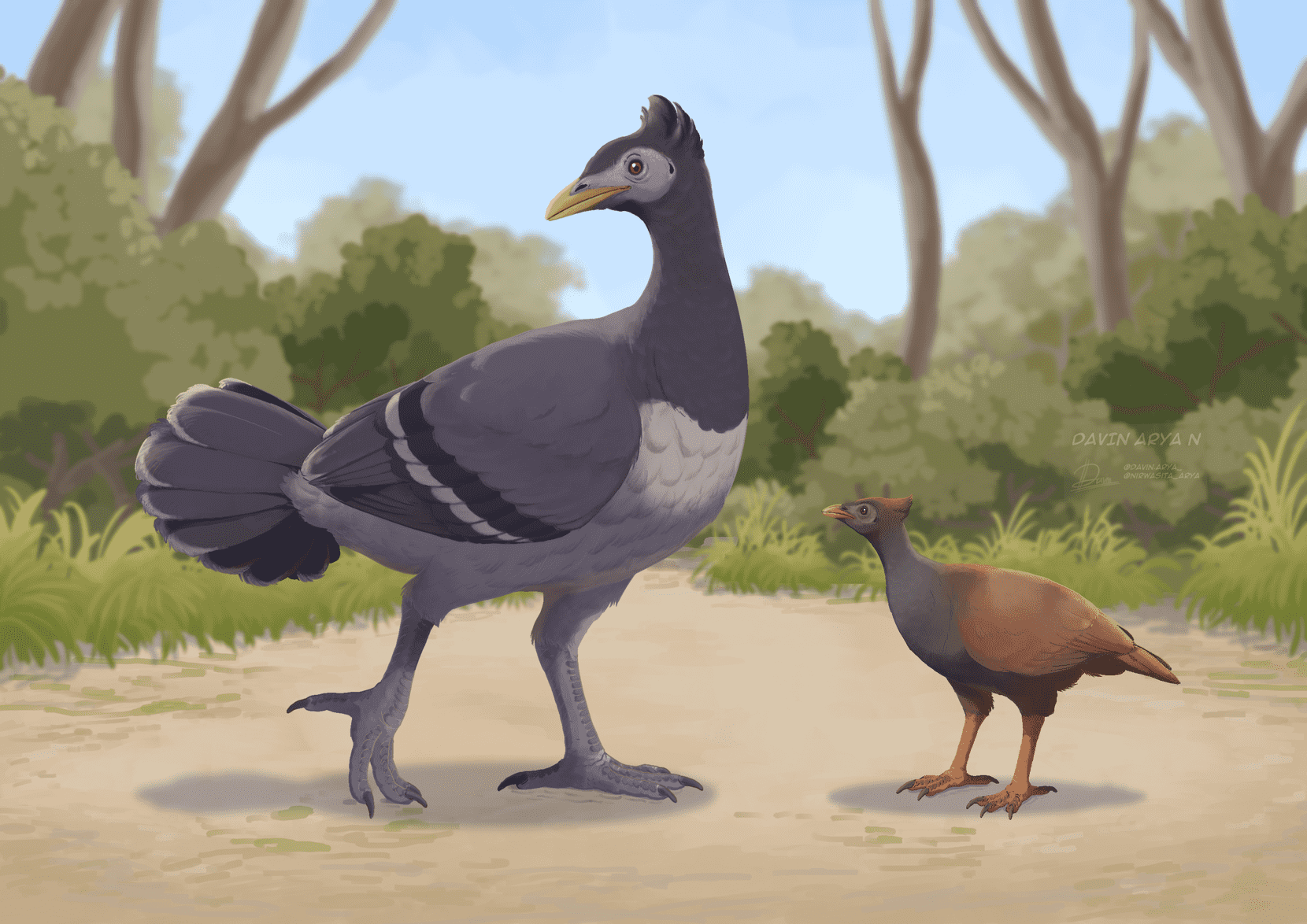
Archaeologists excavating Liang Bua cave on the Indonesian island of Flores have identified a new species of extinct giant bird that roamed the region some 150,000 years ago, according to a recent study. The giant bird was a kind of megapode — large, chicken-like birds that today live in the broader Australasian region. These birds nest in the ground and incubate their eggs using environmental heat rather than body heat. “Megapodes are common across many Indonesian islands, but this is the first fossil megapode from Indonesia,” Hanneke Meijer, the study’s lead author and a paleontologist at the University Museum of Bergen, Norway, told Mongabay by email. “It shows that Indonesia also had large megapodes in the past that were similar in size to large extinct Australian megapodes.” The newly recognized species, named Megapodius rokusi, was identified from a fossilized right foot bone excavated from cave sediment layers dated to between 190,000-120,000 years ago. The researchers named the species in honor of the late Indonesian zooarchaeologist Rokus Due Awe, who played a seminal role in analyzing animal fossil remains at Liang Bua and was the first researcher to identify the hominin fossils later classified as early human species Homo floresiensis. According to the authors, M. rokusi represents the first megapode species named after an Indonesian scientist. Researchers estimated that M. rokusi weighed approximately 3.9 kilograms (8.6 pounds), making it the largest species within the genus Megapodius described to date, according to the paper. There are 12 living species of Megapodius today. The only living megapode species on Flores island is the orange-footed scrubfowl (M. reinwardt), which weighs between 0.5 and 1.2 kilograms (1.1 to 2.6 pounds). The specimen is also the first fossil megapode described from Wallacea, the biologically distinct zone between Southeast Asia and Australia, the authors write. “Wallacea is an area that is known for its unique birds and high biodiversity, but we know very little about the history of the birds in this region,” Meijer said. “This new finding shows that prehistoric Wallacea had many extinct species that are as interesting, or even more interesting than the ones that are alive today.” However, Meijer added that since the discovery rests on a single bone from a foot, several questions remain. These include questions of whether or not the bird could fly, when the bird went extinct and if it possibly overlapped with M. reinwardt, she said. Bird fossils across Southeast Asia have historically been neglected in favor of mammal remains even though they are present in many sites, Meijer added, “I am very happy that I get to look at the bird bones from several sites in Southeast Asia and can slowly add more data about the history of birds in this region.” Banner image: Reconstruction of Megapodius rokusi, left, next to M. reinwardt, right, based on the newly described fossil. Illustration by Davin Arya Nirwasita, Indonesia. Image courtesy of Meijer et al., 2026 (CC BY 4.0). Credits Topics
Fossil of extinct giant bird discovered in Flores cave, Indonesia
Full Article
Original Source
Read the full article at News →KhanList aggregates and links to publicly available news content. We do not host full articles from third-party sources. Always verify important information with original sources.