
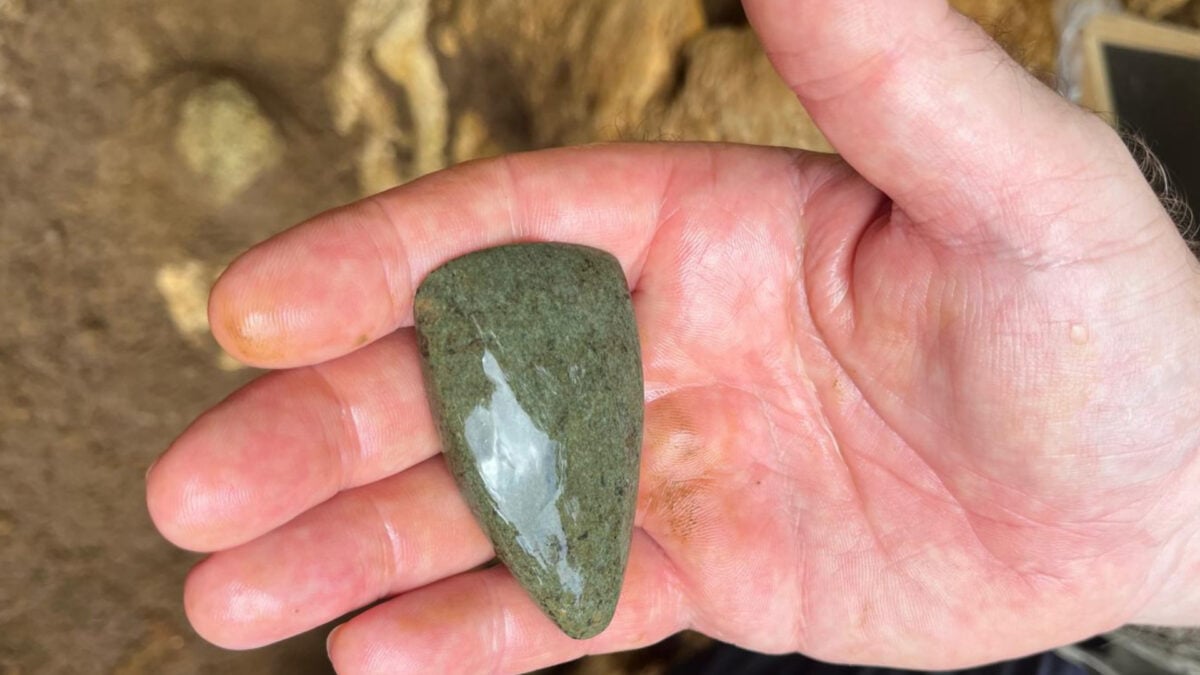
When it comes to unexpected discoveries, archaeology consistently delivers. Seriously—stuff can pop up literally anywhere. Lovely spa resorts in Italy are no exception. Since 2024, scientists have been investigating an archaeological site located within Terme di Sorano, a spa resort in Tuscany, Italy. So far, the team has dated human activity at the site to roughly the fifth millennium BCE, and the region likely hosted a thermal spring back then. Although analysis is still in progress, this site may represent the only known use of hot springs for health or ritualistic purposes in the Neolithic. The most recent round of discoveries supports this interpretation, as the researchers retrieved a perfectly polished greenstone axe likely used for rituals. The excavations were led by Stefano Giuntoli, an independent archaeologist. Collaborators included experts from the University of Florence, the University of Basilicata, and the Superintendency for Archaeology, Fine Arts, and Landscape (ABAP) for Siena, Grosseto, and Arezzo. The latest findings were detailed in a press release (translation provided to Gizmodo by Davide Denci, Terme di Sorano’s marketing head and scientific team member). An occupational hazard Unexpected discoveries often appear in unexpected places. According to the statement, Giuntoli was staying at Terme di Sorano when he noticed a large cavity opening above a historical thermal pool at the resort. He shared his observations with Luciano Calvani, the board chairman of the resort’s management company. As it turned out, Calvani had also been interested in the ancient structures at the spa complex. The archaeological site at Terme di Sorano. © Davide Denci/Terme di Sorano It was from there that shared curiosity evolved into a fully fledged archaeological project. Starting in 2024, experts measured and excavated the cavity, which covered about 3,444 square feet (320 square meters) at a depth of about 12 feet (3.6 meters). When they dug further into the cavity, they uncovered a roundish structure made of travertine and tuff filled with smaller stones, as well as an ancient aquifer—telling signs of human occupation. Radiocarbon dating placed the site’s age at between 4495 and 4335 BCE. A Neolithic spa and resort? As the excavations continued, the team found numerous stone and ceramic artifacts. However, the artifacts were sparsely scattered throughout the site, suggesting that the area wasn’t a permanent settlement but served a specific purpose, according to the statement. Some of the ceramics had decorative elements. All the artifacts had one thing in common: signs of alteration caused by thermal fluctuations. The greenstone axe as it was discovered at the site. © Davide Denci/Terme di Sorano The standout discovery was a small greenstone axe, which lab analyses identified as eclogite traced back to the Western Alps. Given the date ranges for human occupation at the site, the relic is about 6,000 years old. Although the material itself was widely used at the time to craft similar artifacts, this particular axe showed no signs of use and “retains its original cutting edge in perfectly intact condition,” the team explained. Some theories, and more Again, the researchers are still piecing together the evidence, but there are some promising leads. For one, axes of this kind have been documented in funerary contexts for high-ranking males, as well as other ritualistic settings in the Neolithic. Springs, waterfalls, and marshes may have been perceived as “boundaries” between different worlds. In other words, this natural hot spring may have been a sacred spot for Neolithic communities. If so, the polished axe was probably a power or religious symbol for its owner. In any case, it’s clear that the spa has yet to give up all its archaeological secrets. Researchers will continue to work at the site while analyzing photographs and 3D reconstructions of the artifacts. It’s also a fascinating reminder that the traces of the past can be hidden anywhere for those curious and observant enough to notice.
Archaeologists Just Found a Flawless 6,000-Year-Old Greenstone Axe in the Weirdest Place
Full Article
Original Source
Read the full article at Gizmodo →KhanList aggregates and links to publicly available news content. We do not host full articles from third-party sources. Always verify important information with original sources.