
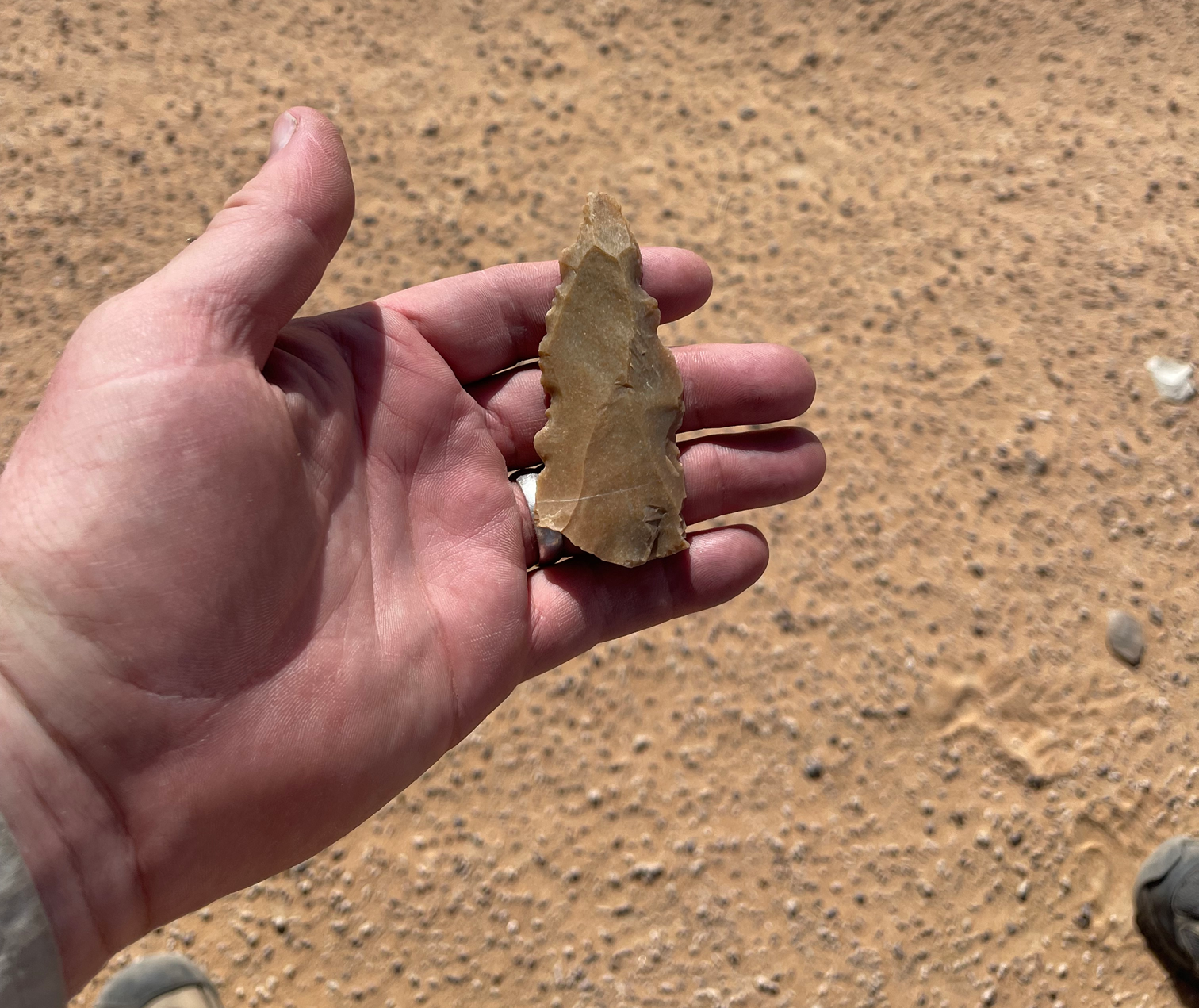
A new study suggests people hunted and processed game near a large, lush, freshwater lake in what is now southern Saudi Arabia, challenging the assumption that humans just passed through the region November 17, 2026 8:10 a.m. A stone point unearthed at the Uruq Aljelibah site Chris Clarkson Today, southern Saudi Arabia is a hot, dry desert, with sand dunes as far as the eye can see. But 125,000 years ago, it was home to a lush, freshwater lake that supported animals like hippopotamuses, buffalo, ostriches, camels, gazelles and oryx. A new study, published November 12 in the journal Science, suggests that ancient humans took advantage of this rich biodiversity—and may even have created poisoned weapons to take down their prey. Researchers conducted excavations at a Middle Paleolithic site known as Uruq Aljelibah, which means “sand dunes of a watering hole.” It’s located in the Empty Quarter, or Rub' al-Khali, a vast desert region spanning southern Saudi Arabia, as well as parts of Yemen, Oman and the United Arab Emirates. The evidence suggests the site was once home to a 131-square-mile lake that measured nearly 100 feet deep and was surrounded by palms, reeds, trees, shrubs and other plants, per a statement. While investigating the site, archaeologists discovered more than 500 fossilized animal remains and more than 5,500 stone tools and artifacts, including stone points they think may have been dipped in poison to paralyze or kill big game. The weapons were clustered near animal bones, which suggests the lakeshore was used for hunting and processing game. They also showed damage consistent with striking large animals, and some still had microscopic traces of animal tissue near their tips. Several also had chemical biomarkers associated with the arrow-poison tree (Acokanthera schimperi), a plant that contains cardiac glycosides, naturally occurring compounds that can affect heart rate. The researchers also found hints of resin and fibers at the bases of the stone points, which suggests they were “hafted”—composite weapons made from multiple materials, rather than simple handheld tools. “Hafting is often inferred indirectly, based on size and shape of stone tools, for instance,” study co-author Huw Groucutt, an archaeologist at the University of Malta, tells Haaretz’s Ruth Schuster. “What we have done is find direct evidence in the form of residues showing how the tools were hafted and used, at a scale that is rarely applied in archaeology, and certainly not at sites like this, open air sites in arid regions.” The scientists also discovered evidence of cutting, scraping and fiber processing, which suggests the people living here were exploiting plant resources for food, tools and binding materials. “Early humans were far more technologically sophisticated than the surviving archaeological record often suggests,” lead author Chris Clarkson, an archaeologist at Griffith University, tells Gizmodo’s Gayoung Lee. “We’re only beginning to understand just how complex their lives were.” It’s rare for archaeologists to find stone tools and animal bones at the same site on the Arabian Peninsula. This one, however, has “thousands of artifacts on an old lakeshore alongside hippo, buffalo and ostrich, and some of the flakes fit back together, so the tools were made on the spot,” Jeffrey Rose, an archaeologist at the University of Algarve who was not involved with the research, tells Live Science’s Charles Q. Choi. “It’s valuable new data.” The site itself has been dated to 125,000 years ago; however, researchers haven’t definitively dated the stone points. That’s because they found all of the stone artifacts on the surface, not in layers of sediment that can be dated. They also don’t know whether the poison was effective, or how it was prepared. Did you know? Animal carvings Last year, researchers in northern Saudi Arabia’s Nefud Desert discovered 130 life-size engravings of animals likely dating to between 11,400 and 12,800 years ago. The animals depicted include camels, ibex, wild donkeys, gazelles and aurochs, an extinct ancestor of cattle. But if the stone points are confirmed to be 125,000 years old, they would be the oldest poisoned hunting weapons ever identified by a considerable margin. The oldest discovered so far date to around 60,000 years ago. The archaeologists did not find any human remains at the site, though they suspect it was inhabited by Homo sapiens. Located between Africa and the rest of Asia, the Arabian Peninsula likely served as an important migration corridor for modern humans, especially during wetter climactic periods. The new study suggests ancient humans weren’t “just passing through,” Clarkson tells Live Science. They were settling in and exploiting green areas “in quite sophisticated ways, using a range of technologies and resources.” You Might Also Like Get the latest stories in your inbox every weekday. More about: Archaeology Deserts History Human Evolution Middle East
Ancient Humans May Have Hunted Hippos With Poisoned Spear Tips on the Arabian Peninsula 125,000 Years Ago
Full Article
Original Source
Read the full article at Smithsonianmag →KhanList aggregates and links to publicly available news content. We do not host full articles from third-party sources. Always verify important information with original sources.