
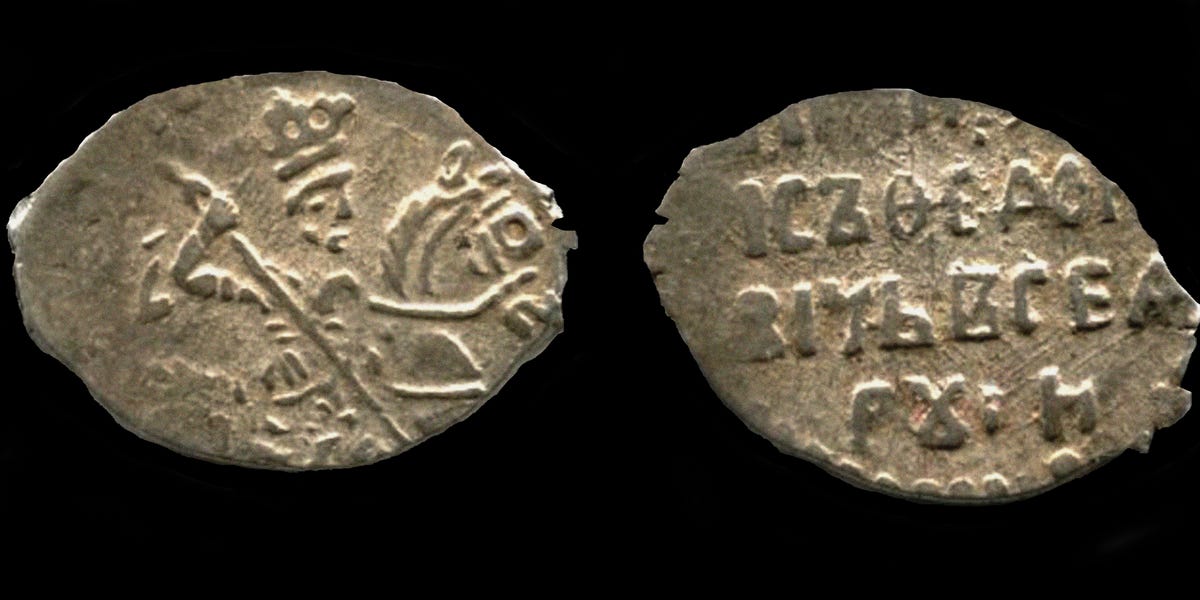
3 min readHere’s what you’ll learn when you read this story:Archaeologists discovered a ceramic jug buried in the medieval center of the Russian city of Kolomna. Inside the jug sat 2,600 silver coins, mostly minted under the reign of two Moscow-based Grand Princes. Experts said the fully intact hoard includes examples of coins from around 1400 C.E. that have never been seen before.Someone in medieval Kolomna, Russia, buried over 2,600 silver coins in a small ceramic jug and never came back for them.Archaeologists working in the medieval center of Kolomna, the region’s second city behind Moscow during the medieval period, discovered what they described as a “small, elegant, slip-painted ceramic jug buried in a shallow pit” near the city’s historic Kremlin, according to a translated statement from the Russian Academy of Sciences’ Institute of Archaeology.The real discovery was inside the jug.The team pulled out more than 2,600 silver “denga” coins, the largest intact coin assemblage from the first half of the 15th century ever discovered in Russia. What excites the experts more than the actual value of the silver coins—which experts from the institute surmise would have been enough to purchase two homes in town plus a herd of horses—is that the collection is just that: a collection.“The substantial size of the excavated hoard offers hope that this unique assemblage of coins reflects, in minute detail, the composition of the currency in circulation within the Kolomna appanage of the Grand Duchy of Moscow at the time the hoard was concealed,” the institute wrote, adding that numismatists can better reconstruct which coins circulated together at any one time when a complete hoard appears.Most of the coins were issued by either Grand Prince Vasily I Dmitrievich, who reigned from 1389 to 1425, or his son, Grand Prince Vasily II Vasilyevich—he was nicknamed either Vasily the Blind or Vasily the Dark, depending on the translation—who reigned from 1425 to 1462. The hoard is mainly composed of coins minted by the Grand Prince, with few coins from other regional princes. That’s consistent with Kolomna’s long-established status as part of the Grand Prince’s own domain, and it offers a rare economic snapshot of how thoroughly Moscow’s coinage dominated its second city.Numismatists said that many of the coins were minted during the later stages of Vasily I’s reign. These coins feature a flying bird image, some of which are extremely rare. In the 15th century, coins were struck using hand-cut dies, with each die showing a slight variation from others, whether on the coin’s artwork or lettering. Studies of the coins can pinpoint individual dies and thereby reconstruct the pattern of their production. Coins from the newly discovered hoard show features from dies that have never been seen before. So far, the team has discovered coins of more than 350 previously unknown varieties within the hoard.Additionally, experts found an impressive amount of locally minted coins, making it easier to reconstruct the technological sequences of dies and offering a detailed window into coin production in Kolomna over at least a 15-year span. The hoard also likely contains the final imprint of Kolomna coins featuring a bird design.The immense value of the silver hoard suggests the owner was a wealthy member of the upper class, possibly a high-ranking official serving the Grand Prince, or potentially a successful merchant.The hoard’s most recent coins were minted by Vasily II in the second half of the 1420s, making this the likely timing of the hoard’s abandonment. With an epidemic wave descending on the region between 1425 and 1427, the owner may have succumbed to sickness, with nobody aware of the secret location of the riches. But now, after six centuries, it’s been found.Tim Newcomb is a journalist based in the Pacific Northwest. He covers stadiums, sneakers, gear, infrastructure, and more for a variety of publications, including Popular Mechanics. His favorite interviews have included sit-downs with Roger Federer in Switzerland, Kobe Bryant in Los Angeles, and Tinker Hatfield in Portland.
Archaeologists Found a Fortune in Silver Left Behind by a 15th-Century Plague
Full Article
Original Source
Read the full article at Popularmechanics →KhanList aggregates and links to publicly available news content. We do not host full articles from third-party sources. Always verify important information with original sources.