
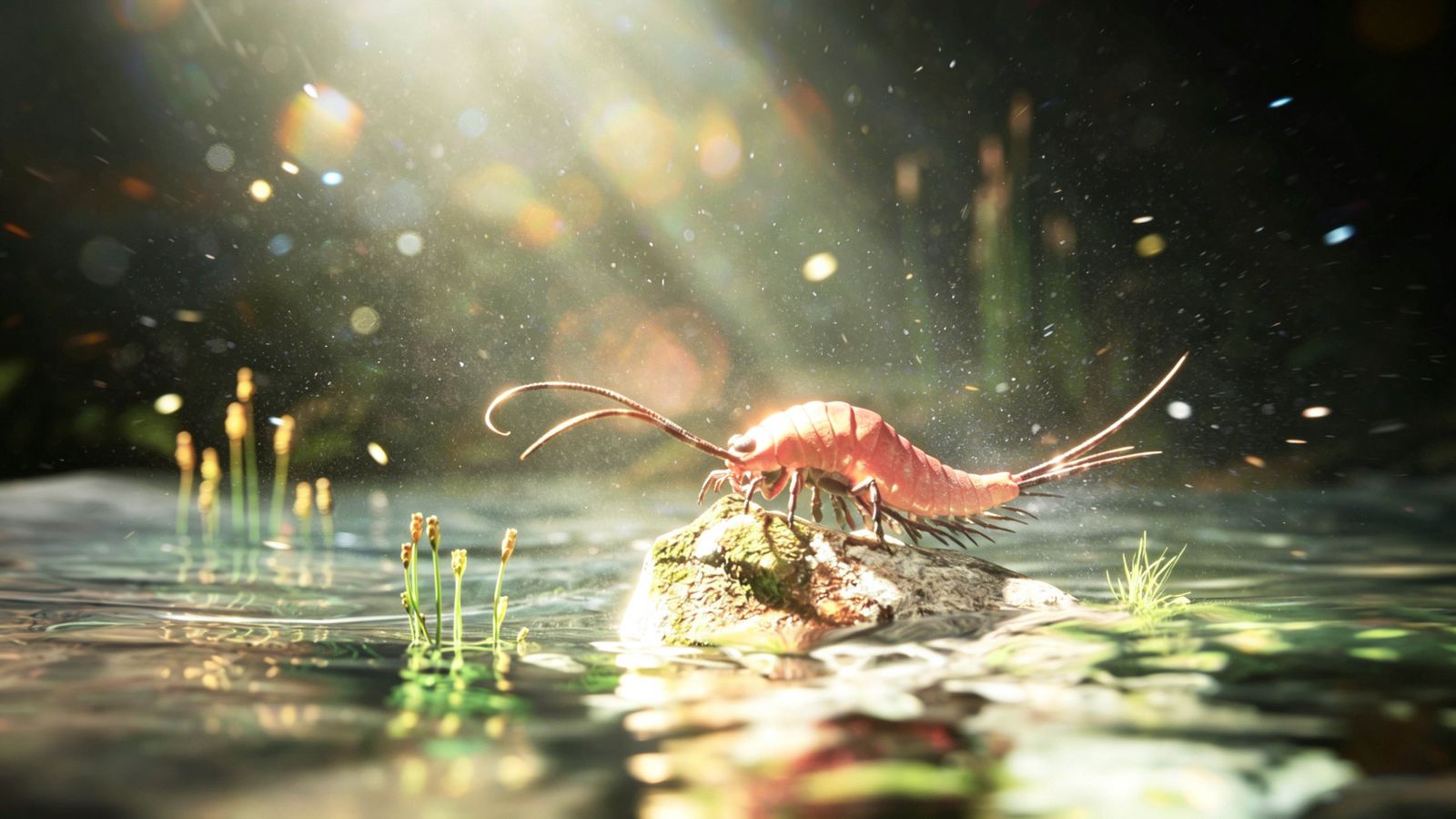
A previously undescribed critter that lived 324 million years ago appears to have been a transitional species that lived between land and sea. It could help researchers fill an 80-million-year gap in the fossil record of how crustaceans evolved into insects September 1, 2026 10:00 a.m. An artist's interpretation of what Chosha praecursor might have looked like while splitting its time between water and land 324 million years ago in what is now Texas. Chao Tan / NIGPAS Insects roam all over Earth, with an estimated 1.4 billion individuals for every human on our planet. Yet despite their ubiquity, scientists have many questions about their evolutionary origins. How did the water-loving, many-legged critters like shrimp and krill that lived millions of years ago become the land-dwelling, six-legged bugs we know today? A fossilized creature found in Texas is helping to fill a huge gap in the fossil record. It points to a previously undescribed transitional species that lived between land and sea around 324 million years ago, researchers report in a study published August 26 in the journal Nature. “This fossil is a major milestone in a puzzling period when everything was changing from mostly aquatic to terrestrial, and we had almost no fossil evidence from that time,” Dany Azar, a paleoentomologist at Lebanese University and the Nanjing Institute of Geology and Palaeontology in China, tells Science News’ Elie Dolgin. Azar peer-reviewed the paper but was not involved with the research. Five years ago, lead author Erik Tihelka, a paleoentomologist at the University of Cambridge, was flipping through a secondhand Russian paleontology textbook when a drawing caught his eye. It showed a small fossil discovered in 1985, which came from a part of western Texas that was underwater when the creature was buried in sediments 324 million years ago. The specimen was described as a juvenile of the crustacean Tesnusocaris goldichi, but Tihelka couldn’t shake the feeling that it had been identified incorrectly. So, he traveled to the fossil’s current home, the San Diego Natural History Museum, where the specimen had been tucked away in a drawer and overlooked for decades. At first, it was difficult to make out the finer details of the fossil, which is about the size of a business card. But when Tihelka turned to cross-polarized light imaging, a photography technique that uses polarized light filters to help reduce glare and sharpen contrast, the creature came into clearer view. It had whip-like antennae, a long tail sandwiched between two shorter ones, an egg-laying tube, an 11-section abdomen and a three-segment thorax—all characteristics of insects. The creature also had three pairs of walking legs, another decidedly insect-like trait. But Tihelka also counted nine additional pairs of short legs on its abdomen, for a total of 24 legs—far more than the six found on modern insects. The back legs also widened into flat, grooved paddles at the end. Taken together, the evidence suggests the creature was somewhere between a crustacean and an insect—a possible missing link in the 80-million-year evolutionary gap. Additionally, Tihelka and colleagues determined the unusual creature represented a previously unknown genus and species. They named it Chosha praecursor, drawing inspiration from the Navajo creation story, which tells how Earth’s first inhabitants were insect-like beings. The name blends the Navajo word ch’osh, which means “insect,” with the Latin word praecursor for “predecessor.” Did you know? Modern-day insects don’t live in the ocean Today, no insects live in the ocean. Researchers aren’t sure why, but one team just ruled out a longstanding possible explanation: that the critters’ respiratory systems would implode from water pressure. They did that by studying a species of fly whose larvae make a daily descent to deep depths in a lake in East Africa. After discovering C. praecursor, the researchers also revisited three other mysterious fossils with numerous legs. One creature, called Leverhulmia mariae, lived in what is now Scotland some 405 million years ago; the two others, which currently lack an assigned genus and species, inhabited present-day Illinois roughly 306 million years ago. The four fossils suggest that insects did not immediately become full-time land-dwellers after scuttling out of the ocean. Rather, they went through a semi-aquatic, amphibious phase, retaining some physical features that helped them split their time between land and sea. “The move onto land may have been gradual,” Tihelka tells Science’s Elizabeth Pennisi. At some point, though, one early insect crawled onto land and stayed put. Over time, these newly land-dwelling critters shed some of their legs, giving rise to the estimated six million—or even more—species of six-legged creatures alive today. The findings suggest that the loss of abdominal appendages was a “key evolutionary innovation” for adapting to life fully on land, according to a statement. “It’s a funny thing,” Tihelka tells Science News. “We call insects ‘hexapods,’ meaning six legs. But it turns out that the original ones had many more.” You Might Also Like Get the latest stories in your inbox every weekday. More about: Animals Biology Bugs Ecology Evolution Fossils Insects New Research Paleontologists Paleontology Sea Creatures Wildlife Zoology
This Ancient Insect Had 24 Legs—and Could Help Explain How the Ancestors of Modern-Day Bugs Took Over the Land
Full Article
Original Source
Read the full article at Smithsonianmag →KhanList aggregates and links to publicly available news content. We do not host full articles from third-party sources. Always verify important information with original sources.