
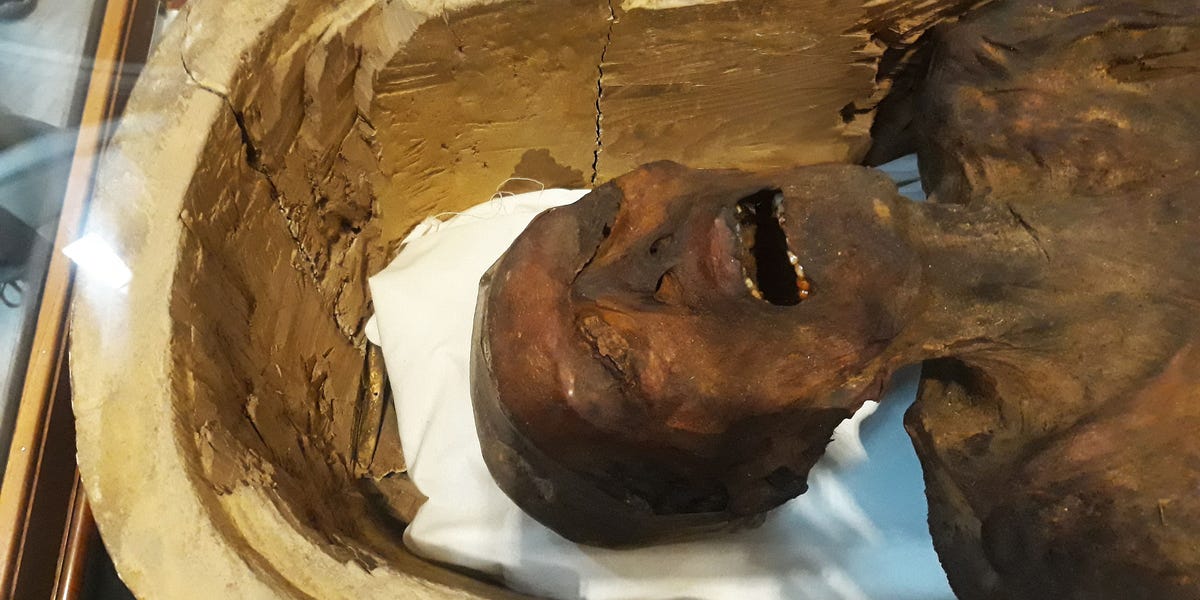
4 min readHere’s what you’ll learn when you read this story:Known only as the “screaming woman,” an upper-class mummy from Egypt’s 18th Dynasty has held the same frozen scream for 3,000 years.Researchers used sampling and noninvasive imaging to investigate her death, but the cause of her expression remains unknown. Her eternal screams is likely the result of a rare cadaveric spasm—a phenomenon where certain muscles lock in place at the moment of death—suggesting she died in extreme pain.Ancient Egyptian embalmers would do everything possible to make the bodies of the mummified dead appear as they had in life. After being dried out with natron salts for forty days, a mummy was rubbed with oils and unguents to make the skin supple again. It then underwent several more phases of preservation, including being coated in melted resins and wrapped in strips of linen. The faces of some mummies, such as Pharaoh Seti I, appear as if they’ve been sleeping for thousands of years. But in one case, the mummy’s face looks as if it never stopped screaming.When archaeologists unwrapped the face of an unnamed female mummy discovered in 1935 in Thebes, they were stunned to find her features frozen in a 3,000-year-old scream. They initially assumed that the mummification was botched. Further investigation into the woman’s past began to cast doubt on that theory, however. She had been buried with the family of Senmut, the royal architect of Hatshepsut, the 18th Dynasty queen who became pharaoh—and only the highest echelons of Egyptian society could afford the lavish mummifications believed to guarantee entrance into the afterlife. The one lingering question about her embalmers was why they hadn’t removed her internal organs, mummified them separately, and placed them in canopic jars to accompany her to the realm of the gods.More evidence firmly disproved the theory of a substandard mummification. From the elaborate wig she wore to the imported resins that coated her body, linens, and wig, it was unlikely that any expense was spared. Frankincense was brought back from the kingdom of Punt, which extended from the south coast of the Red Sea to the Horn of Africa, by servants of Hatshepsut. Punt was renowned for exporting aromatic resins along with gold and other riches. Embalmers also used juniper resin, another costly import reserved for only the most elite burials. The wig she wore was not made of human hair but was meticulously crafted from date palm fibers, dyed with rare, reddish henna, and finished with a crystalline powder of quartz, magnetite, and albite. It’s unlikely that someone wealthy enough for this treatment had been neglected.Why this woman was still screaming after such a lavish embalming confused scientists for decades. Careful wrapping of the face could have prevented even a collapsed jaw, but the expression frozen on the face of the “screaming woman” for three millennia was far more extreme than that. In 2024, she was examined by mummy radiologist Sahar Saleem of Cairo University and Samia El-Merghani of Egypt’s Ministry of Tourism and Antiquities using X-rays and CT scanning. They also used scanning electron microscopy (SEM), which creates a highly detailed image of the surface of a specimen with a beam of electrons, Fourier-transform infrared spectroscopy (FTIR), which determines molecular structure based on how infrared light is absorbed, and X-ray diffraction analysis (XRD), which analyzes molecular and crystalline structure.But Saleem and El-Merghani's investigation with these non-destructive techniques still couldn’t reveal the cause of death. What they were able to determine was that this woman stood about 5 feet tall, which was average for the time period, and died at around 48 years old, with some wear visible in her teeth and joints. Her arms were laid at her sides and barely met in her lap, indicating that, despite her high status, she was not of royal blood. Royals were always mummified with arms crossed over their chests. Why her organs were left inside her body is also unknown, though later embalming advancements sometimes allowed organs to be dried and returned to the body, making canopic jars purely symbolic. The problem is that there’s no visible incision.The researchers concluded that it’s possible the “screaming woman,” whose name wasn’t inscribed anywhere on her coffin, died of something painful that apparently left no detectable signs. It might have been a heart attack or stroke. Another potential cause could be a ruptured aneurysm that caused her sudden, extreme pain. She may have even been bitten by a poisonous snake (though no bite marks were seen during the physical examination). Her face was contorted and her head tilted slightly to the side. El-Merghani and Saleem have attributed this to a cadaveric spasm, a phenomenon that typically occurs in the event of severe pain or panic right before death. Cadaveric spasms are still not well understood. While there are some similarities to rigor mortis, they only affect certain muscles, rather than the entire body.“The mummy’s screaming facial expression in this study could be read as a cadaveric spasm, implying that the woman died screaming from agony or pain,” they said in a study published in Frontiers in Medicine, adding that “embalmers likely mummified the contracted body of the woman…before it decomposed or relaxed, thus preserving her opened mouth position at death. It is also possible that the contracted muscles must have prevented embalmers from closing the mouth.”Her embalmers moved quickly enough to preserve her final spasm before it could fade—and in doing so, preserved a mystery that CT scanners, electron microscopes, and X-ray diffraction have yet to solve, 3,000 years later.Elizabeth Rayne is a creature who writes. Her work has appeared in Popular Mechanics, Ars Technica, SYFY WIRE, Space.com, Live Science, Den of Geek, Forbidden Futures and Collective Tales. She lurks right outside New York City with her parrot, Lestat. When not writing, she can be found drawing, playing the piano or shapeshifting.
This Ancient Egyptian Mummy Has Been Screaming for 3,000 Years
Full Article
Original Source
Read the full article at Popularmechanics →KhanList aggregates and links to publicly available news content. We do not host full articles from third-party sources. Always verify important information with original sources.