
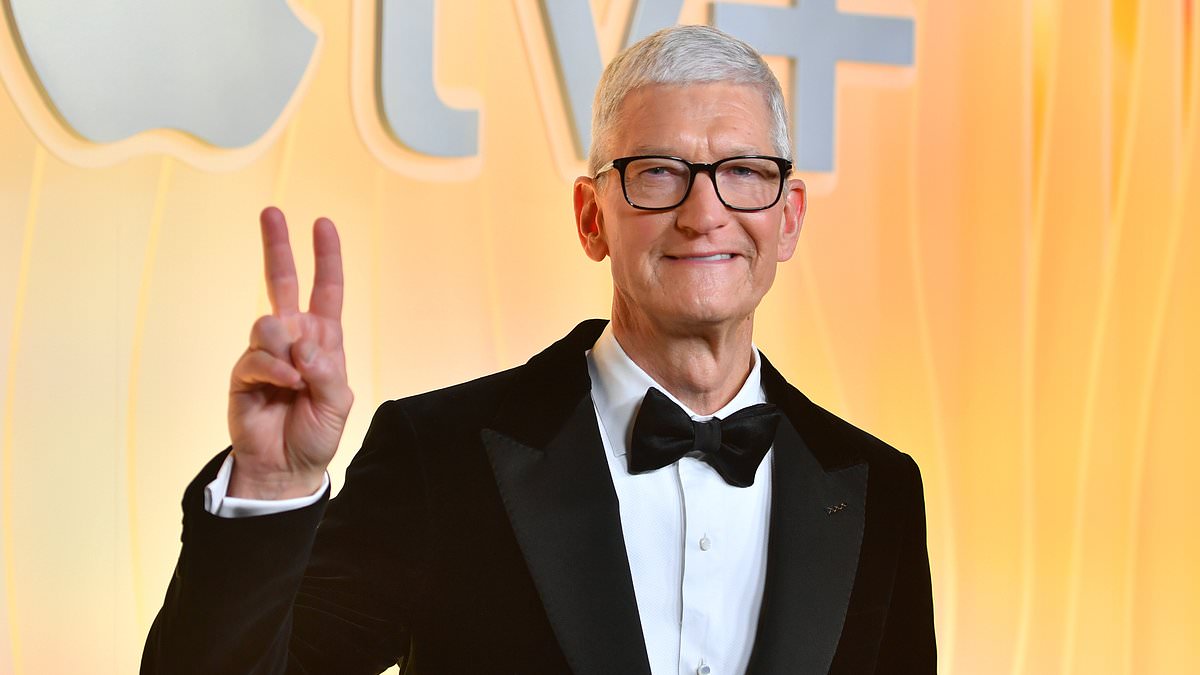
Fifteen years ago, Tim Cook started one of the toughest jobs in the world: Taking over from Steve Jobs as CEO of AppleNow, as he prepares to step down as Apple's chief executive, he is leaving his successor an even more daunting task – running a company valued at almost $5 trillion and somehow figuring out how to make it even more valuable.Cook officially hands the reins to Apple's new CEO John Ternus on September 1, bringing an end to one of the most remarkable runs in corporate history.Ternus, 51, is hardly an outsider. He has spent more than two decades at Apple and currently serves as its senior vice president of hardware engineering, overseeing the teams responsible for the iPhone, Mac, iPad, Apple Watch and other products.He joined Apple in 2001 and has risen through the ranks to become one of the company's most important hardware executives, playing a role in the development of products including the iPhone, iPad and Mac.But taking over from Cook means inheriting an almost impossibly high bar. When Cook became CEO in August 2011, Apple was worth around $350 billion - today, it's valued at close to $5 trillion.The company sold around 72 million iPhones in the year Cook took over. Counterpoint Research estimates it will sell around 255 million iPhones this year.Cook also oversaw the creation of huge new businesses around the Apple Watch, AirPods and digital services, while transforming Apple's manufacturing operation and returning more than $1 trillion to shareholders through dividends and buybacks. Tim Cook has had one of the toughest jobs in the world: following Steve Jobs. Now, as he prepares to step down as Apple's chief executive, he is leaving his successor an even more daunting task – taking over a company worth almost $5 trillionAnd while Cook leaves Apple in extraordinarily strong financial health, his successor faces some major problems of his own – from the company's struggle to keep pace in artificial intelligence to its dependence on China and mounting pressure on its lucrative App Store business.Here are Cook's greatest hits – and the challenges they leave behind for Ternus. 1. The Apple WatchCook's first major new product category was also his biggest test. The Apple Watch arrived in 2015, four years after he became CEO and following Jobs' death.There were plenty of questions over whether anyone really needed a computer strapped to their wrist.The answer, increasingly, has been yes. The device has evolved from a fashion accessory into a health and fitness gadget, with features including heart-rate monitoring, fall detection and crash detection.It has also become a huge business. Apple now sells more watches annually than Switzerland's entire watch industry, according to reports.For Ternus, that means one of the first challenges will be keeping Apple's wearables business growing without simply relying on ever more incremental upgrades.2. AirPods – the tiny gadget that became a phenomenon Then there were AirPods. When Apple's wireless earbuds launched in 2016, the internet had plenty of fun with their unusual appearance and eye-watering price.Yet consumers quickly got the joke. AirPods became one of the most recognizable pieces of consumer technology on the planet and helped make wireless earbuds mainstream.Their success also strengthened Apple's carefully constructed ecosystem. The iPhone, Apple Watch, AirPods and Mac could all work together with almost no effort from the user.Cook officially hands the reins to John Ternus on September 1, bringing an end to one of the most remarkable runs in corporate history Cook's first major new product category was also his biggest test. The Apple Watch arrived in 2015, four years after he became CEO and following Jobs' death AirPods became one of the most recognisable pieces of consumer technology on the planet and helped make wireless earbuds mainstreamThe scale of the business is now enormous, with AirPods sales comparable with the revenues of Major League Baseball, according to The Wall Street Journal.But again, Ternus inherits a mature category rather than a blank canvas. His challenge will be finding the next generation of products that can join the Apple ecosystem – and convincing consumers that they need them.3. He transformed Apple into a services powerhouse Perhaps Cook's most important achievement happened without the launch of a flashy new gadget. He dramatically expanded Apple's services business.Under Cook, Apple moved deeper into subscriptions and digital services including Apple Music, Apple TV+, iCloud, Apple Pay and the App Store.The strategy gave Apple something it desperately wanted: a huge stream of recurring revenue from people who already owned its products.The company now has around 1.5 billion paid subscriptions, while services have become one of its most profitable divisions. It has also created a formidable ecosystem in which the more Apple products you own, the harder it becomes to leave.There have been downsides. Apple's App Store commissions have faced growing legal and regulatory challenges, with developers increasingly able to steer customers towards alternative payment methods.It has been reported that Apple's App Store commission revenue in the US fell 6 percent in the June quarter. That makes the services empire one of Ternus' biggest assets – but also one of his biggest headaches.4. The Mac's incredible chip makeover Cook also made one of Apple's biggest technical decisions when he moved the Mac away from Intel processors and towards chips designed in-house.The first Apple silicon Macs, powered by the M1 chip, arrived in 2020.The result was a major leap in performance and battery life – and gave Apple far greater control over the relationship between its hardware and software.The move has proved particularly useful in the age of AI. Apple's chips are capable of running increasingly sophisticated AI models locally, helping give the Mac a new lease of life.As a result of these advancements, it has been reported that Apple has struggled to make some Macs quickly enough to meet demand. But AI is also where Ternus faces perhaps his biggest test.Apple has fallen behind rivals including OpenAI and Google in the race to develop cutting-edge AI products, while Siri has struggled to match increasingly capable AI assistants.For a hardware expert taking charge in the middle of the AI revolution, that is an uncomfortable inheritance.5. The world's first $1 trillion company – then $2 trillion, $3 trillion and beyond Then there is the achievement that doesn't fit neatly into a product launch: Money, lots and lots of it.Apple's market value has risen roughly 13-fold during Cook's tenure, taking it from around $350 billion when he became CEO to almost $5 trillion today.The company also became the first publicly traded business to hit $1 trillion, $2 trillion and $3 trillion valuations.Cook oversaw more than $1 trillion being returned to shareholders through dividends and share buybacks, according to The Wall Street Journal.But perhaps the clearest measure of his success is the number of iPhones Apple sells. The company sold around 72 million iPhones in the year Cook became CEO. Apple's market value has risen roughly 13-fold during Cook's tenure, taking it from around $350 billion when he became CEO to almost $5 trillion today This year, Counterpoint Research estimates that figure will reach around 255 million. That is more than tripling the number of phones being produced and sold every year.Ternus therefore isn't taking over a struggling company that needs to be rescued. He is taking over a machine that is already making extraordinary amounts of money – and that can make the pressure to find the next huge growth engine even greater.6. He made Apple a global manufacturing machineThis is the less glamorous part of Cook's legacy – but arguably the one that made everything else possible. Before becoming CEO, Cook was Apple's supply-chain mastermind.He helped streamline manufacturing, reduce inventory and build a system capable of producing extraordinary quantities of devices. As CEO, he perfected that model.Annual Apple product launches became almost clockwork, while the company was able to sell its gadgets simultaneously across the world.Jobs could make people want a device. Cook made sure there were enough of them sitting on shelves - but the global supply chain Cook leaves behind is now under pressure.Apple remains heavily dependent on China for manufacturing, at a time when the US and China are locked in a long-running trade and geopolitical battle.AI companies are also competing aggressively for key components such as memory and storage chips, pushing up costs and creating potential shortages for Apple.And although Cook will remain involved as executive chairman, Ternus will ultimately have to navigate those pressures as CEO.7. He made Apple bigger without trying to become Steve Jobs For all the products and billions, perhaps Cook's greatest achievement was simply surviving the impossible comparison.Jobs was the charismatic showman who helped create the Macintosh, iPod, iPhone and iPad.Cook was never going to replicate that. Instead, he concentrated on scaling Apple's existing strengths while expanding into new areas such as wearables, services and financial technology.Art Hogan, chief market strategist at B. Riley Wealth Management, described him as a 'transformational CEO' who 'always had a steady hand at the wheel.'That may ultimately be the most fitting description of his tenure. And it explains why Ternus has such big shoes to fill.He is not only replacing the man who followed Jobs. He is taking over from the person who turned Apple's extraordinary products into an extraordinary business.The irony is that Ternus inherits an Apple that may never have been stronger – and yet is facing some of its biggest questions in years.Artificial intelligence is the obvious one. Apple's upgraded Siri is expected to become much more capable, with Google technology helping power parts of the system. The company needs to persuade consumers that Siri can compete with the likes of ChatGPT and Google's AI offerings.It also needs to work out how AI fits into the iPhone itself. If Ternus can make Apple's devices the easiest and most useful way for hundreds of millions of people to use AI, he could unlock another enormous growth opportunity. Steve Jobs was the charismatic showman who helped create the Macintosh, iPod, iPhone and iPad Perhaps surprisingly, Cook isn't particularly interested in writing his own legacy. Asked by CBS News correspondent Jo Ling Kent how he would like to be remembered, he pushed back on the idea that a CEO gets to decide thatIf he cannot, Apple risks losing its long-held position as the company that defines how consumers interact with technology.Then there is the next generation of hardware. Ternus takes over just days before Apple's September 9 launch event16083641, where the company is expected to unveil its latest iPhones and potentially its first foldable model.That gives him an immediate chance to demonstrate that Apple's next chapter will contain something genuinely new.But he will also have to navigate tariffs, supply-chain disruption, China's role in manufacturing, rising component costs and the legal pressure on Apple's services business.So how does Tim Cook want to be remembered? Perhaps surprisingly, Cook isn't particularly interested in writing his own legacy.Asked by CBS News correspondent Jo Ling Kent how he would like to be remembered, he pushed back on the idea that a CEO gets to decide that.'You're asking a legacy question, and it's a good question,' he said. 'But in my view, your legacy is described by others, not yourself.'Then he offered a remarkably simple hope: 'I hope that people say I was a good and decent man.'It is a strikingly understated answer from a man who has overseen one of the greatest corporate success stories in modern history. And it neatly captures the difference between Cook and his predecessor. Jobs wanted to change the world.Cook's genius was making Apple's world bigger. Now Ternus has to figure out how to make it bigger still.The trillion-dollar rise of Apple1976: Founders Steve Jobs, Steve Wozniak and Ronald Wayne created the company on April 1, 1976, as they set about selling computer kits to hobbyists, each of which was built by Wozniak.The first product was the Apple I. 1977: Apple released the Apple II in June, which was the first PC made for the mass market. Steve Jobs unveils Apple Computer Corporation's new Macintosh in California on February 6, 19841981: Jobs became chairman. 1984: The Macintosh was introduced during an ad break for the Super Bowl and later officially unveiled during a launch event. It was discontinued a year later and Jobs left the firm.1987: Apple released the Macintosh II, the first colour Mac.1997: Apple announces it will acquire NeXT software in a $400 million deal that involves Jobs returning to Apple as interim CEO. He officially took the role in 2000. Steve Jobs, then-chief executive officer of Apple, with the iPhone2001: Apple introduced iTunes, OS X and the first-generation iPod.The first iPod MP3 music player was released on October 23, 2001, at an event in Cupertino and was able to hold up to 1,000 songs.2007: Apple unveils the iPhone. 2010: The first iPad was unveiled.2011: Jobs resigned in 2011 due to illness, handing the CEO title to Tim Cook. Jobs died in October from pancreatic cancer.2014: Apple unveiled the Apple Watch. It also unveiled its first larger iPhones - the 6 and 6 Plus. 2015: After purchasing Beats from Dr Dre, Apple launched Apple Music to compete with Spotify and other music streaming services. 2016: Apple returned to its roots and announced the 4-inch iPhone SE. Meanwhile, the firm is embroiled in a legal battle with the FBI, involving the agency demanding access to the locked phone used by Syed Farook, who died in a shootout after carrying out a deadly December attack in San Bernardino, California, with his wife. The court order was dropped on March 28 after the FBI said a third party was able to unlock the device. 2017: Apple introduces the iPhone X, which removes the home button to make way for a futuristic edge-to-edge screen design and a new FaceID system that uses advanced sensors and lasers to unlock phones with just the owner's face. Jobs at an Apple event at the company's headquarters in Cupertino, California2018: In a first for the company, Apple introduces new features in its latest operating system, iOS 12, that encourage users to manage and spend less time on their devices. The move was spawned by a strongly worded letter from shareholders that urged the firm to address the growing problem of smartphone addiction among kids and teenagers. 2019: In January, Apple reports its first decline in revenues and profits in a decade. CEO Tim Cook partly blamed steep declines in revenue from China.2020: In March, Apple closes all its brick-and-mortar retail stores outside of China in response to coronavirus. 2021: In an online virtual event in April, CEO Tim Cook declares Apple's goal of becoming carbon neutral for Earth Day. Later in the year, the iPhone 13 was announced. 2022: In September, the iPhone 14 was announced. One of the new features included a new sensor to detect if a user had been in a car crash, as well as an improved camera system. 2023: Apple brings back its 'Home Pod' after the first generation was discontinued. The 'Home Pod' can be seen as an alternative to Amazon's Alexa or Google Home, as it is powered by voice commands. 2024: Apple makes its first steps into artificial intelligence with the release of Apple Intelligence. The features are not all released at once, with many delayed until the following year. 2026: Apple announces a leadership shakeup. After 15 years leading the company, Tim Cook steps aside from his position as CEO to become executive chairman. John Ternus, 51, Apple's widely respected hardware chief, will take over as CEO on September 1.
Apple's CEO is stepping down after building the company into a $5trillion juggernaut... The new chief has big shoes to fill
Full Article
Original Source
Read the full article at Dailymail →KhanList aggregates and links to publicly available news content. We do not host full articles from third-party sources. Always verify important information with original sources.