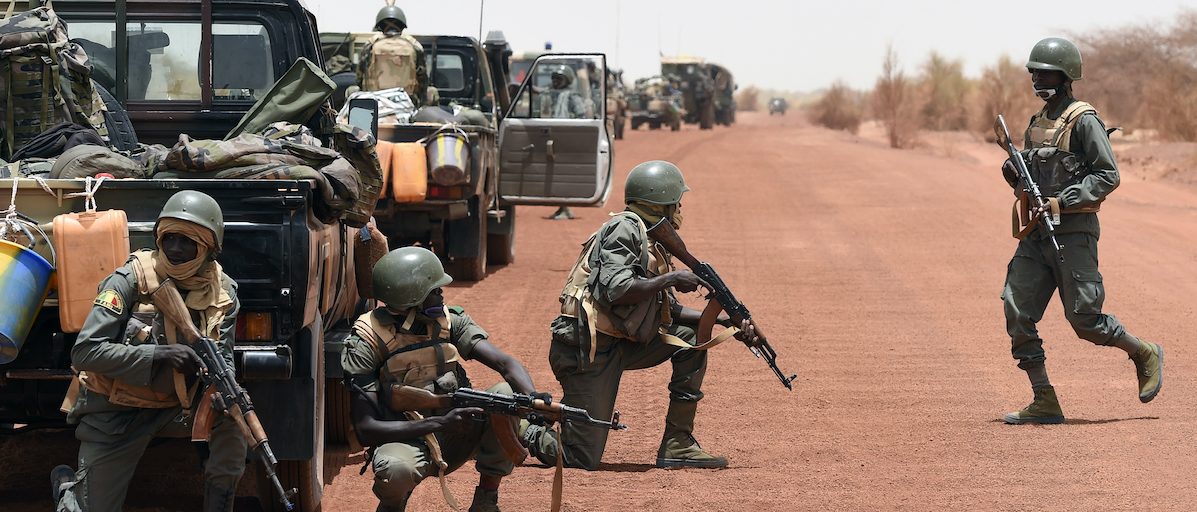
Recent attacks in Central Sahel reflect a worrying evolution of the terror threat in West Africa. The situation demands more from the region’s states and partners than declarations of solidarity with those affected. Active security cooperation is urgently needed with Burkina Faso, Mali and Niger – the three countries of the Alliance of Sahel States (AES). On 25 April, the al-Qaeda-affiliated Jama’at Nusrat al-Islam wal-Muslimin (JNIM) and the separatist Azawad Liberation Front (FLA) launched a series of coordinated attacks on several cities in northern, central and southern Mali. This was the most ambitious operation by the armed groups since the outbreak of the Malian security crisis in 2012. It led to Defence Minister Sadio Camara’s death and enabled insurgents to seize the towns of Kidal and Tessalit in the north. On 4 July, the FLA-JNIM coalition replicated the synchronised offensive against six localities across the country. Although the Malian Armed Forces (FAMa) contained most of the attacks, the insurgents seized part of Anéfis in the north, forcing FAMa and its Russian partner, Africa Corps, to entrench themselves in their military base. After six days of intense fighting, FAMa and Africa Corps suppressed the offensive and retook Anéfis. The events suggest that the FLA-JNIM coalition is part of a more structured form of operational complementarity. The two groups pool their in-depth knowledge of the field and their local networks. FLA is more active in the northern regions, while JNIM brings its experience in asymmetric warfare to the central, western and southern regions. The al-Qaeda-affiliated group is also able to conduct complex, coordinated operations, such as on 1 July last year, when seven simultaneous attacks were launched in the west of the country. At the same time, it was targeting the various economic corridors leading to Bamako to block or disrupt commercial traffic. While the FLA-JNIM alliance is disrupting security in Mali, the increasing use of bold, collective attacks is also evident in the other two AES countries. On 30 June, Burkina Faso’s armed forces announced that they had thwarted ‘complex and coordinated’ attacks by terrorist groups in the east and north of the country. In Niger, the army repelled two attacks against Niamey’s Diori Hamani International Airport. The first, on 28 January this year, was claimed by Islamic State Sahel Province, and the second, on 18 June, by JNIM. The increase in collaborative operations on several fronts, the targeting of strategic infrastructure, the use of increasingly sophisticated technologies (in particular commercial drones) and targeted assassinations of leaders reflect a strategic reconfiguration of the terror threat. By showing governments’ inability to protect their people, the armed groups are challenging the foundations of Sahelian states’ authority and possibly creating conditions for their overthrow. While a jihadist group is unlikely to take over a government in the short term, the risk cannot be ruled out. Such a scenario would have major consequences not only for the Sahel but for West Africa and beyond. The gradual expansion of armed groups into coastal countries, particularly northern Benin and Togo, as well as JNIM’s disruptions of trade corridors, reflects the risks of terrorism becoming regionalised. Repercussions could extend from security to trade flows and international interests. The April attacks in Mali sparked a wave of official statements of support. Several neighbouring states, including Senegal, Mauritania, Algeria, Morocco and Benin, condemned the attacks and reaffirmed their support for Mali. The Economic Community of West African States (ECOWAS) and the African Union (AU) also denounced the violence and called for collective mobilisation. Beyond Africa, the European Union, Turkey and Saudi Arabia condemned the attacks and reaffirmed their support for Mali’s authorities. The AU has, however, emerged as the main institutional source of support. It was the only organisation that decried the 4 July attacks in Mali, and also condemned the January and June attacks in Niger. Algeria, which has good relations with Niger, was the only neighbouring country to express its ‘deep indignation’ and full solidarity with the Nigerien government and people. These expressions of solidarity are encouraging, but should be accompanied by more concrete engagement. Several diplomatic developments could revive security cooperation across the region. These include the recent rapprochement between Mali and Algeria, and between Niger and Benin. Senegal has good relations with the AES countries and could use its presidency of ECOWAS and its role as chair of the ECOWAS Commission to improve security cooperation in the region. Constructive engagements with the central Sahel states by Togo and Ghana are also significant, as is the strengthening of dialogue between the AU Commission and AES countries. At least two levels of action should be prioritised to consolidate this dynamic. First, the rapprochement between Algeria and Mali, and Niger and Benin, should be quickly translated into pragmatic security cooperation measures. Re-establishing military coordination and intelligence-sharing mechanisms between security officers would help manage border incidents and cross-border threats, while reducing the risk of diplomatic crises. Second, the AU, which has recently strengthened its engagement with AES countries, has a diplomatic window to broker dialogue, paving the way for a resumption of regional security cooperation. Better relations between Bamako and Algiers also offer an opportunity to revitalise the Nouakchott Process, a cooperation mechanism for combating terrorism that the AU created in 2013. The process brings together Algeria, Burkina Faso, Côte d’Ivoire, Guinea, Libya, Mali, Mauritania, Niger, Nigeria, Chad and Senegal. It could be expanded to include Togo, Ghana and Benin. The AU could seek support for its regional peace initiatives from the United Nations under Resolution 2719, which authorises financing of peace support operations in Africa. Preventing the Sahel from reaching a security tipping point has become a collective imperative for preserving stability across West Africa. Fahiraman Rodrigue Koné is the Sahel Project Manager in the Institute for Security Studies’ (ISS) Regional Office for West Africa and the Sahel. (This article was first published by ISS Today, a Premium Times syndication partner. We have their permission to republish). Discover more from Premium Times Nigeria Subscribe to get the latest posts sent to your email.
ANALYSIS: Sahel security crisis demands action beyond assurances of solidarity
Full Article
Original Source
Read the full article at Premiumtimesng →KhanList aggregates and links to publicly available news content. We do not host full articles from third-party sources. Always verify important information with original sources.