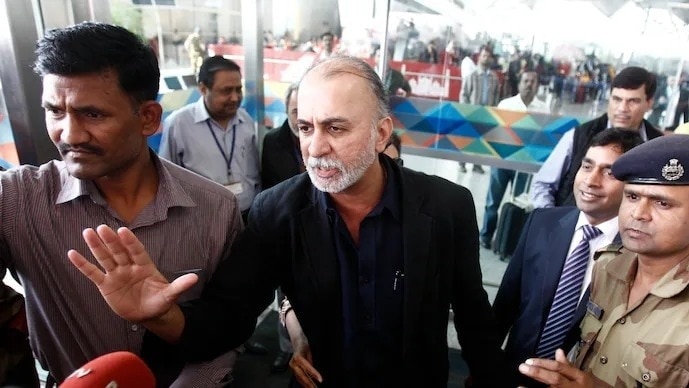
The Bombay High Court's Goa bench reserved its verdict on the Goa government's appeal against journalist Tarun Tejpal's acquittal in the 2013 sexual assault case after hearing final arguments from both sides.Tarun Tejpal was acquitted in the 2013 case after a lower court passed the judgement in May 2021.The Goa bench of the Bombay High Court on Thursday reserved its judgment on the Goa government's appeal against the acquittal of journalist Tarun Tejpal in the 2013 sexual assault case, after hearing final arguments that largely centred on whether Tejpal's apology email amounted to an admission that a physical encounter had taken place.A Bench of Justices Dr Neela Gokhale and Amit Jamsandekar reserved the order after hearing Solicitor General Tushar Mehta for the Goa government and senior advocate Abad Ponda for Tejpal. The court did not specify when it would pronounce its verdict.Tejpal, the former editor-in-chief of Tehelka, was acquitted by a sessions court in Goa in 2021. The Goa government challenged the acquittal before the High Court.Opening his rejoinder arguments, Solicitor General Mehta criticised the trial court's approach, saying it had wrongly evaluated the complainant's conduct against preconceived notions of how a sexual assault survivor should behave. "My primary objection is to the way in which the trial court has examined the entire matter as if it is setting down a model code of conduct on how the victim should behave and if the victim does not behave in this way, then it is not right," Mehta submitted.He argued that the conduct of victims differs depending on their education, social background and circumstances, and courts cannot reject allegations merely because a complainant did not behave in a stereotypical manner. "The behaviour of a victim of molestation can be different based on the background they come from, their educational qualification. One cannot say one's behaviour is not like the other, so it is to be disbelieved," Mehta said.Referring to the complainant's role as a journalist, he argued that continuing with professional responsibilities after the alleged incident could not undermine her credibility."We should be proud that our daughter was part of an international event, she was an educated journalist. An allegation is that she was behaving normally. My professional responsibilities were different. I will not let my personal responsibility come in the professional responsibility," he submitted.Mehta also objected to the trial court's reliance on alleged inconsistencies in the complainant's testimony.He argued that expecting an educated and legally aware person to react in a particular way was flawed, adding that minor discrepancies did not make a witness "tutored"."That is not right. I am giving citations for my satisfaction that this victim has come across as a truthful victim," he said.Addressing the allegation that the complainant changed her accusation to rape only after a press conference by then Union minister Arun Jaitley, Mehta said the record showed otherwise.He told the court that the alleged first incident occurred on November 7, 2013, inside the hotel lift. On November 18, 2013, the complainant sent a formal complaint titled "testimony" to then Tehelka managing editor Shoma Chaudhury, before Jaitley's press conference. Mehta said the complaint specifically referred to Tejpal's text message mentioning "fingertips" and that the FIR reproduced the contents of the document verbatim."The term rape is not an afterthought either for the victim or the police," Mehta argued.He also referred to the complainant's WhatsApp message dated November 19, 2013, in which she spoke about what had happened, and the November 22, 2013 letter seeking the Goa Director General of Police to initiate suo motu action.Questioning the defence's suggestion that the complainant fabricated the allegations, Mehta submitted, "Why would she fabricate? She did not want to criminally prosecute the accused."He also objected to the defence's reliance on the complainant's lifestyle and personal conversations."They repeatedly say she is a modern girl, she chats with friends in sexually coloured language. Even for these girls, their physical autonomy cannot be breached. This is the message this matter carries," Mehta argued.During the hearing, the Bench pointed out that the defence's primary case was that no such incident had taken place."Mr Ponda's argument is this incident did not happen. He is not saying it is consensual or anything. He is saying it did not happen," the Bench observed.Responding to the observation, Mehta questioned how Tejpal's apology email could then be explained."When the apology on mail—it is on the assumption that it is consensual. But now when he says it did not happen, then what are you apologising for? What are you saying sorry to her mother? What are you shameful for? This is bogey that nothing has happened. He is entitled to raise it. But it is bogey," Mehta submitted.Referring extensively to Tejpal's email sent after the alleged incident, Mehta argued that the accused apologised for his "lapse of judgment", described the episode as "devastating", expressed shame and stated that he believed the encounter had been consensual.According to Mehta, these statements amounted to an admission that an encounter had taken place and were inconsistent with the defence's present stand that no incident occurred inside the hotel lift.He further argued that if nothing had happened, there would have been no reason for repeated expressions of remorse, shame or references to lifelong punishment in the apology email. Mehta also highlighted Tejpal's statement that he would not dispute the complainant's account or underplay her anger and hurt, calling them significant admissions.Countering the submissions, senior advocate Abad Ponda argued that the prosecution had wrongly interpreted the apology emails as admissions of a physical sexual encounter.Relying on the testimony and cross-examination of prosecution witness Shoma Chaudhury, Ponda submitted that although her statement recorded under Section 164 of the Code of Criminal Procedure referred to Tejpal having a "different version" of the incident, she clarified during cross-examination that according to Tejpal, the only "sexual encounter" was a sexual conversation outside Block No. 7 on November 7, 2013.Ponda argued that the prosecution was incorrectly treating the expression "fleeting consensual encounter" in the apology emails as an admission of physical intimacy.He submitted that none of Tejpal's apology emails admitted to any consensual physical or sexual encounter and that they referred only to a consensual verbal conversation of a sexual nature.Ponda further argued that if the apology email truly amounted to an admission of a physical sexual encounter, the defence would not have extensively challenged the CCTV footage, the evidence regarding the alleged incidents inside the lift and other factual aspects of the prosecution's case.Referring to the complainant's WhatsApp messages, Ponda also argued that her own reaction to the apology indicated that she did not treat it as an admission of sexual assault.The case relates to allegations by a woman colleague that Tejpal sexually assaulted her inside a hotel elevator on November 7 and 8, 2013, during an event organised by Tehelka magazine in Goa. A court in Mapusa acquitted Tejpal of all charges in 2021, following which the Goa government filed the present appeal before the Bombay High Court.- EndsPublished By: Akshat TrivediPublished On: Jul 30, 2026 17:46 IST
Tarun Tejpal's 'apology mail' in focus as HC reserves order in sexual assault case
Full Article
Original Source
Read the full article at Indiatoday →KhanList aggregates and links to publicly available news content. We do not host full articles from third-party sources. Always verify important information with original sources.