
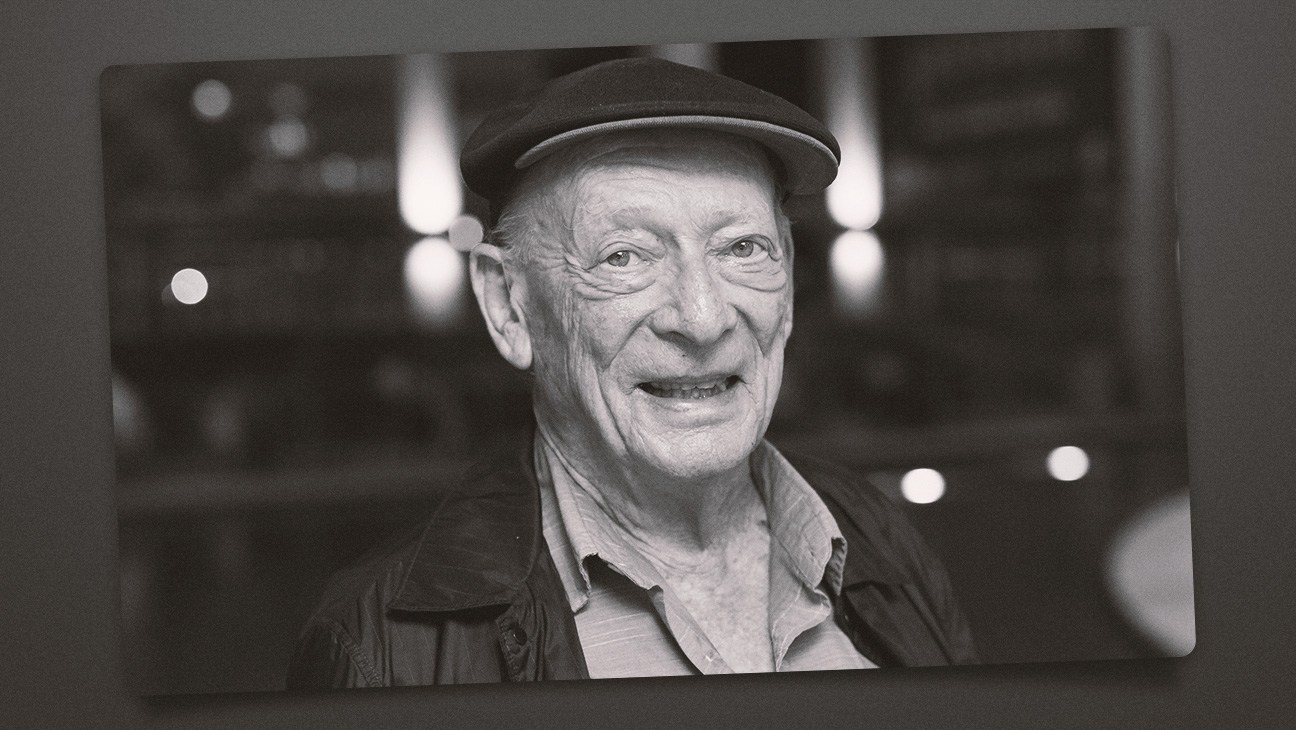
Alan Mandell, the distinguished stage veteran known for his interpretations of Samuel Beckett’s absurdist plays going back to a landmark 1957 production of Waiting for Godot inside San Quentin State Prison, has died. He was 98. Mandell died Tuesday of natural causes at his home in Westwood, his son, Peter Mandell, and daughter-in-law, Sarah Mandell, told The Hollywood Reporter. In films, the Toronto native played the aging rabbi whose counsel consists solely of lyrics from the Jefferson Airplane’s “Somebody to Love” in the Coen brothers’ A Serious Man (2009), and he appeared for John Cameron Mitchell in Hedwig and the Angry Inch (2001) and Shortbus (2006). On television, he could be seen on episodes of Cannon, The Six Million Dollar Man, Baretta, Eight Is Enough, Sisters and Grey’s Anatomy. In November 1957, Mandell was a member of the San Francisco Actor’s Workshop, led by Jules Irving and Herbert Blau, when he portrayed the slave Lucky in a performance of Waiting for Godot for 1,400 inmates in San Quentin. (The production would serve as the introduction to Martin Esslin’s influential 1961 book Theatre of the Absurd.) From that, Mandell co-founded the San Quentin Drama Workshop with inmate Rick Cluchey, who would become an actor and playwright, and the pair would guide many other plays at the prison over the years. Later, Beckett himself would direct Mandell in Waiting for Godot and Endgame (as Nagg) in Europe — they first got together in Cuba — and their relationship would last until the Irish playwright’s death in 1989. “The text for [Beckett] was like a score, and the important thing for us was to find the rhythm of the line,” he told veteran Los Angeles Times theater critic Charles McNulty in 2015. “Once you had that, you were set.” Mandell appeared in Beckett plays dozens of times in his career, and in L.A. he received an Ovation Award in 2012 for his turn as Estragon opposite Irishman Barry McGovern as Vladimir in Waiting for Godot at the Mark Taper Forum. For his final Beckett performance, he portrayed Hamm alongside McGovern again in Endgame at the Kirk Douglas Theatre in Culver City in 2016. And when Keanu Reeves and Alex Winter were preparing to play Estragon and Vladimir, respectively, in their revival of Waiting for Godot at the Hudson Theatre on Broadway last year, they sought out Mandell for his expertise, meeting with him at his home. “He was a brilliant manager and producer, which made him sought after for the way he could put on a production, run a theater company, run a business,” Daniel Segura, his main assistant for the past 10 years, told THR. “As an actor, he just had a lyricism to him that was poetic. Hearing him do Beckett, I was always blown away by his musicality. He could deliver it to an audience that all of a sudden got it.” Alan Mandell with Marion Ross on a 2010 episode of Grey’s Anatomy. Ron Tom/ABC/Courtesy Everett Collection One of eight kids, Albert Mandell was born in Toronto on Dec. 27, 1927. His parents, Bella and Louis, owned a restaurant, and the family lived above it. After performing in Oliver Twist as a youngster, he set his sights on a stage career. “I was a dropout or ‘throw-out.’ It was one of those things,” he told the Times in 1992. “My father wanted to know what was going to happen to me. I was 17 or 18. I told him I was going to go into the theater. He looked at me and said, ‘A nice Jewish boy goes to the theater.’ It was a great remark. I didn’t know what to say.” Mandell served as the artistic director of Theater ’49, an offshoot of the Toronto Civic Theatre, through the early 1950s, then visited his sister in San Francisco in ’54. He discovered the San Francisco Actor’s Workshop, then a teaching studio working out of a converted garage, and became its business manager. The workshop would become a pillar of the regional theater movement, renowned for its experimentalism and as a home for Beckett, Bertolt Brecht and Harold Pinter premieres in the U.S. When Irving and Blau were hired to run the Repertory Theatre at Lincoln Center in 1965, Mandell accompanied them to New York as the company’s manager. During his time there, he appeared on Broadway in The Country Wife and managed the 1973 revival of A Streetcar Named Desire that starred James Farentino and Rosemary Harris. In 1976, Mandell came to L.A. to work on an NBC adaptation of Dark Victory that was produced by Irving, starred Elizabeth Montgomery and Anthony Hopkins and was directed by Robert Butler. He also joined the Los Angeles Actors’ Theatre, which would become the Los Angeles Theatre Center in 1985, as a consulting director and actor, and he developed and oversaw the poetry/literary series there. Mandell won his first Ovation Award in 2009 for playing the down-and-out poet Spooner in Pinter’s No Man’s Land at the Odyssey Theatre, then portrayed the furniture trader Gregory Solomon in 2015 in Arthur Miller’s The Price at the Taper, where THR in its review found fault with his performance: “It’s too good. He literally steals the show and takes it in an unexpected direction.” McNulty was a big fan, and he wrote that “listening to Mandell’s refined diction is like reading a handwritten letter by someone with the most marvelous penmanship.” In 2010, Mandell revisited his San Quentin Waiting for Godot experience in the documentary The Impossible Itself. In addition to his son and daughter-in-law, survivors include his daughter, Olivia, and her husband, Dean; his grandchildren, Elizabeth, Ethan and Spencer; and his brother, Jerry. His wife of 30 years, arts patron Elizabeth Heller, died in 1997 at age 65. “Alan was tremendous, the most steadfast human I know, nothing ever fully got him down,” Segura said. “He just kept marching on. I think we are all in a little bit of shock because there was an immortality to him.”
Alan Mandell, Esteemed Actor and Interpreter of Samuel Beckett Plays, Dies at 98
Full Article
Original Source
Read the full article at Hollywoodreporter →KhanList aggregates and links to publicly available news content. We do not host full articles from third-party sources. Always verify important information with original sources.