
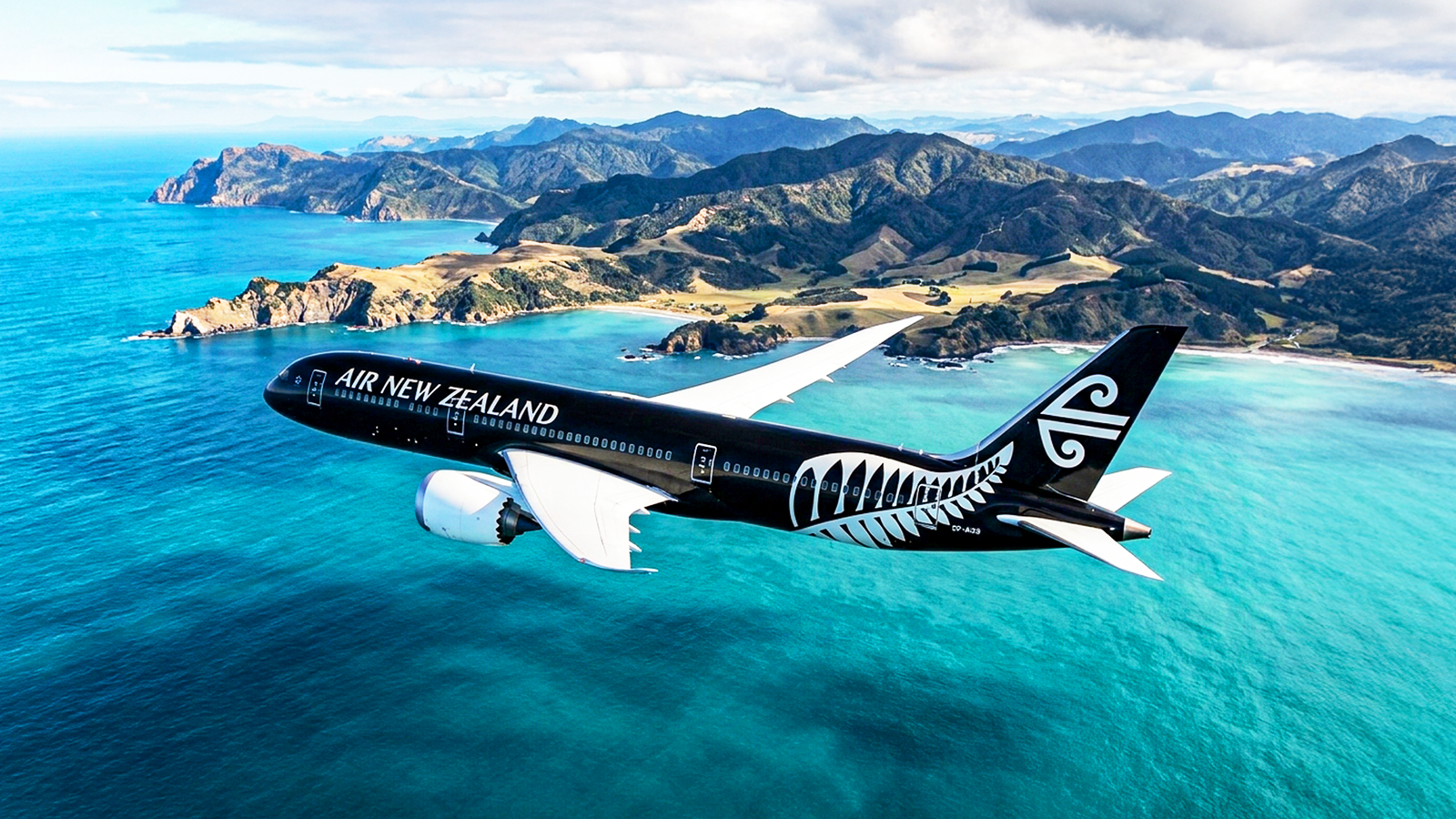
Published Nov 16, 2026, 11:00 AM EST Aaron is an aviation enthusiast and world traveler with a deep interest in aerospace history and technology. He has traveled around the world numerous times, often incorporating visits to aviation museums and historic aircraft collections into his journeys. A native of New Zealand, he is an expert in aviation and maintains a broad interest in a variety of other subjects. Being at the bottom end of the South Pacific, the distances faced by Air New Zealand are often vast. A useful way to think of Air New Zealand's network is domestic routes within New Zealand, trans-Tasman flights to Australia, South Pacific routes (excluding Australia), and long-haul flights further out. Air New Zealand is one of the most important airlines connecting the South Pacific, including some extremely thin routes. One of the most notable features of the Kiwi airline's fleet is that it is unusually focused on turboprops for domestic routes. For example, it is the largest operator of the De Havilland Canada Dash 8-300. This is driven by passenger demand often being too small to justify jets, and by turboprops being particularly economical for short hops over NZ's mountainous islands. But it also operates the 787-9 to service some of the world's longest routes. Here is what to know about Air New Zealand maintaining a large network in the South Pacific. Context Of Air New Zealand In The South Pacific Credit: stockphoto mania l Shutterstock To understand Air New Zealand, it is important to first understand New Zealand and its place in the Pacific. New Zealand is by far the largest Polynesian nation and has by far the largest Polynesian population. While most of the Polynesians in New Zealand are native Māori, there are also large populations of immigrant Polynesian populations which sometimes outnumber the populations remaining on their home islands (e.g., Niue, Cook Islands). New Zealand was more than just another colony of the British Empire. It also ran a smaller sub-empire within the Empire. New Zealand seized German Samoa in WWI, with Samoa achieving independence in 1962 from New Zealand. New Zealand was also charged with administering the Antarctic Ross Dependency, Tokelau, the Cook Islands, and Niue. Today, these form the Realm of New Zealand with New Zealand proper. The arrangement is somewhat analogous to Denmark vis-à-vis Greenland. Additionally, New Zealand does have one set of populated outlying islands that are part of New Zealand proper: the Chatham Islands. Air New Zealand plays a major role in connecting all these far-flung islands (not the Chathams). Some Polynesian islands have strong links to New Zealand, such as Tonga. This does not apply to Tokelau, as it is the only country without an airport and is inaccessible from any other neighboring airport. Air New Zealand's Fleet Credit: James Frith l Shutterstock Air New Zealand has a diverse fleet to serve its domestic, Pacific, and intercontinental needs. It operates a fleet of 17 domestically configured A320ceos and a mixed domestic/international fleet of 20 A320neo/A321neos. Its flagship aircraft are ten Boeing 777-300ERs and 14 Boeing 787-9 Dreamliners that serve some of the longest non-stop scheduled passenger flights, including Auckland to New York. Air New Zealand operates a large turboprop fleet made up of 31 ATR 72-600s and 23 Q300s. In total, it has a fleet of 115 aircraft and 14 orders. The orders are made up of ten new Boeing 787-9s and 787-10s and four more A321neos. It's worth noting that in the context of New Zealand, a very large share of the international market is just flying trans-Tasman to Australia. While these are legally international flights, in practice they can blur the line in a similar way that US-Canada and intra-European flights do. Air New Zealand doesn't offer flights to NZ's third-largest island, Stewart Island (pop 500); flight connections there are offered by Stewart Island Flights from Invercargill. Notably, Air New Zealand does not currently serve New Zealand's only outlying populated islands. The Chatham Islands are exclusively served by Air Chathams, which is independently owned and has a formal domestic interline partnership with Air New Zealand. Its main fleet is made up of two ATR-72-500s and six Saab 340 turboprops. The islands have a population of around 620 residents. Auckland's Pacific Connections Credit: Air New Zealand Auckland Airport is by far the largest and most important airport in New Zealand and is one of the major hubs of the South Pacific. From there, Air New Zealand operates flights to France's New Caledonia (A321), Samoa (A321neos and 787-9s), Tonga (A320s), Fiji (A320s, Boeing 777s, 787s), Niue (A321), the Cook Islands (A320s, 787s), French Polynesia (Boeing 777, 787), and Hawaii (787), which is technically not in the South Pacific. There are also connections with Papua New Guinea, Vanuatu, and the Chatham Islands, but these are not operated by Air New Zealand. Some of these routes (e.g., to Fiji) are operated multiple times daily and with competing airlines, while others are sparse. Air New Zealand is the only airline that serves Niue, a tiny island country with a population of around 2,000. The weekly flight to Auckland is Niue's only connection to the outside world. Auckland is a particularly important hub for the South Pacific. Other hubs include Australia's Brisbane, Fiji, Hawaii's Honolulu, and Nauru. There is overlap between these hubs, although they also sometimes serve unique routes that lack the demand to accommodate multiple competing airlines. Guam in Micronesia is another Pacific hub, but its connections don't extend into the South Pacific. Other International NZ Airports Credit: Brave Behind the Lenz l Shutterstock Christchurch is the largest airport on the South Island, and it serves as the second most important international gateway for New Zealand, even if it's much less than Auckland. Besides Australia, it has international connections to Guangdong, Hong Kong, Singapore, and Fiji. That said, these routes are often operated by foreign airlines; e.g., only Fiji Airways operates on the Fiji route. Like Christchurch, Wellington does have flights to the Chathams (operated by Air Chathams) and Fiji (operated by Fiji Airways). Otherwise, Wellington's only other international flights are to the Australian East Coast. Auckland, Christchurch, and Wellington all have extensive domestic connections via Air New Zealand within the main two islands. Current Air New Zealand fleet Quantity Average age Boeing 777-300ER 10 14.1 years Boeing 787-9 Dreamliner 14 9.5 years Airbus A320 17 12.2 years Airbus A320neo / A321neo 20 5.6 years ATR 72-600 31 8.6 years De Havilland Canada Dash 8-300 23 19.3 years The duration from New Zealand's key international airports (Auckland, Wellington, Christchurch, Queenstown) to Australia's populated East Coast is around three to four hours. In the context of Queenstown, all international flights are to Australia, and the bulk of Wellington's international flights are likewise trans-Tasman. Queenstown is an alpine adventure resort town that functions as the fourth most important international airport with flights to four destinations in Australia. Other airports (e.g., Dunedin) also sometimes have international flights to Australia. A Small, Isolated, But Notable Airline Credit: Petr Podrouzek l Shutterstock Air New Zealand is currently retrofitting all its existing Boeing 787-9s to a common cabin and is expected to complete the transition by the end of 2026. This introduces the new Business Premier Luxe suites. It also recently added an upgraded Boeing 787-9 that is able to fly farther. That aircraft is configured with 219 seats, made up of eight Business Premier Luxe, 34 Business Premier, 52 Premium Economy, and 125 Economy seats. The airline is adding more A321neos on Australian routes and to the Pacific Islands as its Boeing 787-9s can't handle the growth as they are being refitted. Within the global aviation industry, the Kiwi carrier is particularly well regarded for its product innovation, customer experience, ability to compete internationally, and operational culture. It is often seen as something of a small, isolated industry innovator. Notable cabin designs include the Skycouch, Skynest, and Spaceseat, while the airline has been particularly competitive in premium economy. It has leaned heavily into New Zealand's love of rugby and, more importantly, the Lord of the Rings and Hobbit franchises. It was one of the first airlines to introduce high-quality themed safety videos. Air NZ Safety & Domestic Competition Credit: aiyoshi597 l Shutterstock I grew up in New Zealand, and Air New Zealand was the first airline I flew with, both domestically and internationally. The day I first flew to Australia was during the 2011–2012 Puyehue-Cordón Caulle volcanic eruption. Ash from the volcano circulating around the world had caused Australia's Qantas, Jetstar, and Virgin Australia airlines to suspend trans-Tasman flights to New Zealand. New Zealand announced it would fly lower, under the ash, and accept a fuel penalty from thicker air. AirlineRatings.com has consistently given Air New Zealand one of the top safety ratings of any airline in the world. Separately, Air New Zealand formerly had monopoly status on New Zealand's domestic routes. In 1996, the Australia–New Zealand Single Aviation Market was signed, followed by more bilateral agreements. Consequently, New Zealand's domestic market is open to qualifying Australian airlines, while Australia generally protects its domestic routes but has reciprocal New Zealand exceptions. This allowed Australia's Jetstar to compete on trunk domestic New Zealand routes, ensuring competition on its core inter-Auckland, Wellington, Christchurch, and Queenstown routes. Air NZ provides most or all of the services to other regional destinations within New Zealand. In practice, Air New Zealand has not chosen to take up reciprocal domestic routes in Australia for commercial reasons. Trans-Tasman flights to Australia account for the largest share of Air NZ's international network, and it has a special relationship with Virgin Australia.
Air New Zealand's Fleet In 2026: How The Kiwi Carrier Covers The Pacific
Full Article
Original Source
Read the full article at Simpleflying →KhanList aggregates and links to publicly available news content. We do not host full articles from third-party sources. Always verify important information with original sources.