
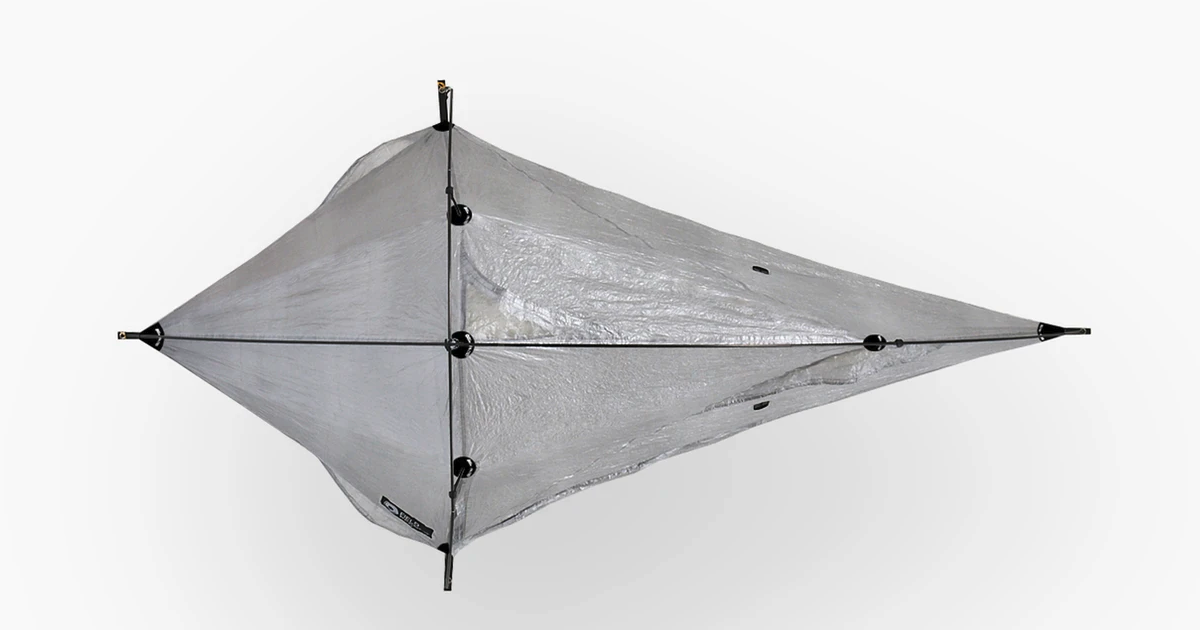
Using some of the most advanced ultralight materials the world has at its disposal, Japanese outdoor gear brand Field Record offers the lightest freestanding tent we've ever seen. Its FR-SCD tent weighs less than half of what some other ultralight backpacking and mountaineering tents weigh, going so light as to undercut many pole-free, non-freestanding shelters. Whether scaling cloud-engulfed granite or emerging out the belly of dense jungle to enjoy camping on untouched tropical beach, the FR-SCD is the tent that will carry like air before bedding down into a cocoon-like shelter. Based in Shizuoka, Field Record is a spinoff of design firm Kyouei Design, whose work has long focused on daily wares crafted from unconventional materials and forms. Field Record applies that same strategy to the sports and outdoor gear world. Since launching in 2018, it has gradually rolled out a lineup of ultralight, ultra-portable outdoor products that combine unique shapes, origami-like folding capabilities, and high-end materials like Dyneema Composite Fabric (DCF), carbon fiber and titanium. Though Field Record's lightest, smallest tent certainly has a cutting-edge design that bests every other freestanding tent we've ever seen in terms of minimizing weight, the FR-SCD tent isn't a brand-new launch. Field Record originally introduced it in 2023, immediately billing it the world's lightest single-wall freestanding tent, which would make it a shoe-in as world's lightest freestanding tent, period, since double-wall tents involve more material and weight. The FR-SCD is easily one of the lightest freestanding tents in the world, the lightest we've ever come across Field Record The lightest freestanding tent we've covered previously remains the Samaya Radical 1 we looked at in 2022. That one-person single-wall mountaineering tent packs down into a feathery package that Samaya now lists at just 695 g (1.5 lb), all components sacked up and ready to go. The solo-sleeper FR-SCD tent, meanwhile, weighs in at 490 g (1.1 lb), as listed on its spec sheet. That's the type of insanely low weight we'd typically expect to see from a non-freestanding tent, like a trekking pole tent or bivy/tarp combo that saves weight by not incorporating its own pole system.An aside: Samaya, a French brand, and Field Record were both founded in 2018, apparently a year of legend in ultralight backcountry tent-making.Field Record actually kicked off with an even lighter version of the FR-SCD during its 2023 launch campaign, which it developed specifically for trail runner Shogo Mochizuki, four-time champion of the grueling 415-km (258-mile) Trans Japan Alps Race. It used a lighter construction of Dyneema to hit a 470-g (1-lb) weight point for that custom pro model but opted for a slightly heavier Dyneema to increase overall durability on the consumer version. So the average trail jockey is stuck "lugging" that extra 20 grams. When Field Record first launched the FR-SCD series in 2023, it kicked off with a special custom version weighing in at 20 grams less than its production model, designed specially for competitive trail runner Shigo MochizukiField Record It's critical to note that Field Record's listed weight includes just the Dyneema tent body and Easton carbon fiber poles, technically the only components you need to pitch it since it's freestanding. The weight does not include the carry sacks, stakes or guy lines that would commonly be brought along as part of the package. Unfortunately, Field Record doesn't list a fully packed weight for the FR-SCD that includes all those extras, but we do know that the FR-SCD's 490-g weight is still a full 120 grams (4 oz) lower than the Samaya Radical 1's listed minimum weight (tent body and poles). Similarly, 490 grams is lighter than some ultralight solo tent bodies alone, before even getting into poles, stakes, carry sacks or other components. That list includes Gossamer Gear's 558-g (1.2-lb) The One trekking pole tent body and Big Agnes' 590-g (1.3-lb) String Ridge VST 1.5 tent body. The pointed ends and crisscross carbon frame give the FR-SCD a unique look Field Record Long story short, the FR-SCD is incredibly lightweight no matter how you cut it. Ironically, its very existence prevents us from outright declaring it the lightest freestanding tent in the world, as the tent serves as a reminder that there's always a small brand somewhere in the world working hard at making something lighter or better. And while we've previously zeroed in on the new wave of ultralight freestanding tents from boutique brands in the US, Europe and Canada, we clearly haven't been paying as close attention to the awesome innovations happening in Japan ... and undoubtedly elsewhere around the world. While single-wall tents offer weights savings over double-wall and single/double-wall hybrid designs, they also threaten to stifle ventilation and create condensation issues inside. Field Record attempts to work around this potential pitfall with specially placed vents keeping air flowing. The FR-SCD is designed to pull air in through the bottom vents and let it circulate inside, escaping out the top ventsField Record More often than not, freestanding single-wall designs are applied to four-season mountaineering tents aimed at the extreme weather conditions of high-alpine exploration. The FR-SCD, on the other hand, is a three-season design, so comparing it to a burlier single-wall mountaineering tent like the aforementioned Samaya Radical 1 is not precisely apples to apples. Still, if you were looking for the lightest possible freestanding tent out there for use during fairer weather ultralight activities like fastpacking, multi-day ultra-running, bikepack racing or summer mountaineering, you wouldn't necessarily be concerned with how the FR-SCD's ridiculously low weight compares to its nearest four-season counterparts. You'd just be happy to have the lightest possible fully enclosed freestanding tent in your pack. Similarly, if you needed a tougher tent for rougher weather, you'd take on the extra weight of a proper four-season design. It would be interesting to see if Samaya could build a three-season solo tent at a lower weight than the FR-SCD, but the French brand only offers three-season tents in two-person+ sizes. So the Japanese tent remains the lightest freestander either brand has on offer while handily undercutting every ultralight freestanding solo tent with which we compared. As for size, Field Record lists the FR-SCD's complete dimensions at 258 x 108 x 95 cm (101.5 x 42.5 x 37 in, L x W x H). That's plenty of length and width to fit a single person inside, though the sharply tapered diamond shape of the tent might make it cramped for those who are on the taller or broader side. The height is a little lower than other ultralight freestanding tents, which tend to run over 101 cm (40 inches) tall. Each FR-SCD tent uses bonded reinforcement points to ensure integrity Field Record A true Japanese boutique, Field Record builds each ¥149,600 (approx. US$950) FR-SCD tent to order in Japan, advertising a current lead time of three months. It does ship internationally but notes that buyers will have to handle custom duties separately. Our shipping fee in the US came out to ¥5,900 ($38) when we dropped the FR-SCD in a cart on the company's web shop – just to get an idea of international shipping costs, unfortunately, as we don't have a burning need for a $950 half-kilogram tent ... as cool as it is. Field Record also offers the FR-SCD Duo at a price of ¥220,000 ($1400). That freestanding two-person Dyneema tent is also incredibly lightweight at just 650 g (1.4 lb). The FR-SCD Duo tent has a more centered frame for a more symmetrical diamond shapeField Record Kyouei Design's most recent Facebook post several weeks ago noted Field Record was preparing to attend Overland Expo East, which took place in Virginia in late October. The company was listed on the show's official exhibitor registry, so it seems it was at least testing the waters in the US market. Of course, that doesn't mean it's launching its handmade wares in the States, but we're certainly hopeful it has some kind of collaboration or market presence in mind. The Overland Expo calendar has closed for 2026, but hopefully we can catch up with the brand at one of next year's shows, assuming it attends again. Source: Field Record
Absurdly lightweight Japanese pod tent is an ethereal camping marvel
Full Article
Original Source
Read the full article at Newatlas →KhanList aggregates and links to publicly available news content. We do not host full articles from third-party sources. Always verify important information with original sources.