
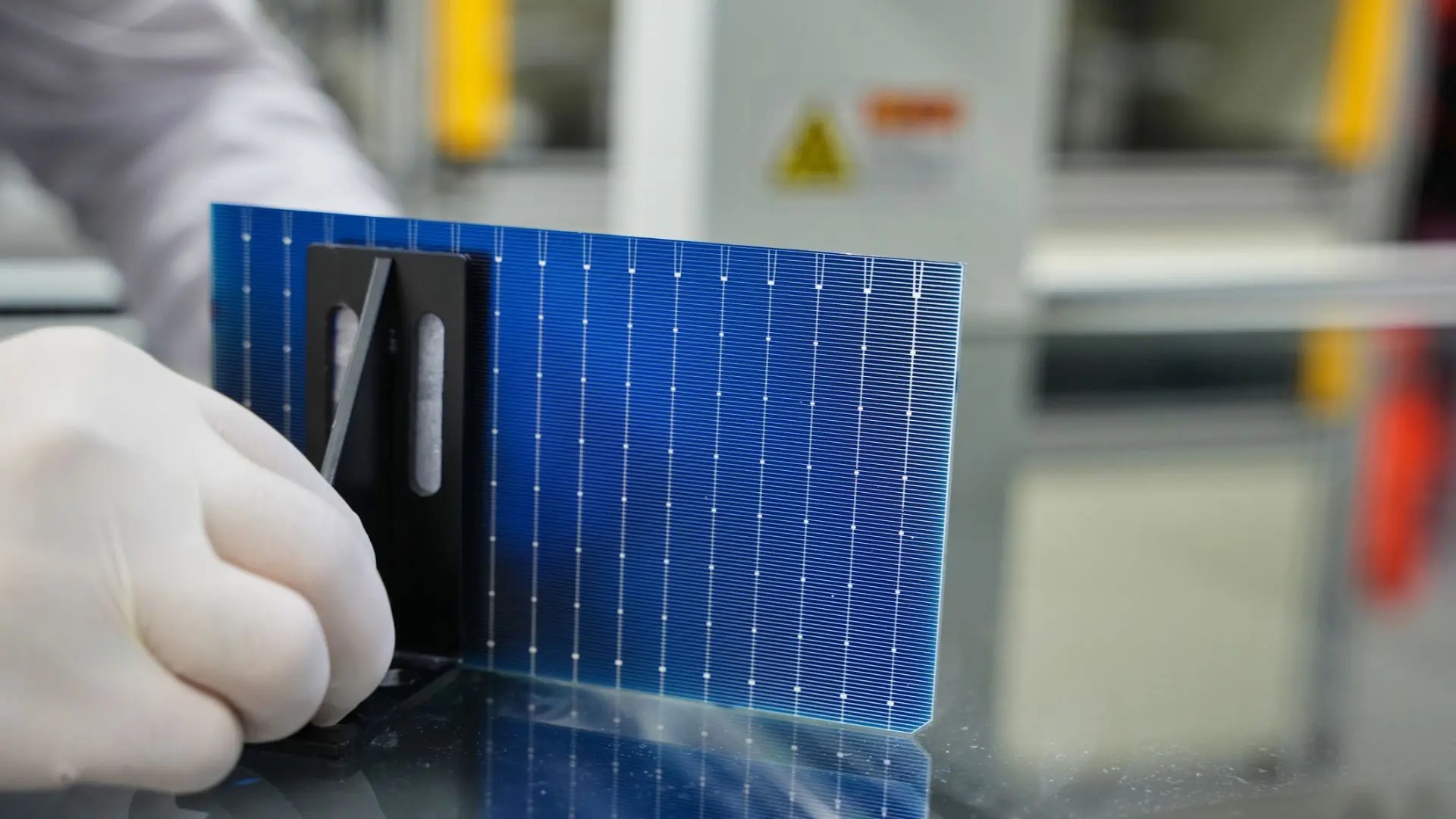
Miami-based NAED Energy Holding has announced a new solar cell manufacturing platform capable of processing up to 96,000 wafers per hour. The company says its PV-1 PECVD-V vertical in-line deposition system doubles the throughput of its previous XL-class platform, which was rated at 48,000 wafers per hour. The announcement marks a new step in NAED’s effort to scale production of perovskite and heterojunction (HJT) tandem solar cells. The platform is designed to manufacture its T2X two-terminal tandem cells, targeting a 30 percent conversion efficiency. NAED also plans to offer the cells for terrestrial and space applications. Vertical design increases production speed The PV-1 PECVD-V combines plasma-enhanced chemical vapor deposition (PECVD) and physical vapor deposition (PVD) on a shared-carrier production line. Its vertical design allows solar wafers to remain upright as they move through different processing stages. To process the opposite side of a wafer, the system lifts and rotates the entire carrier by 180 degrees. This removes the need to flip individual wafers between stages, reducing direct handling during manufacturing. NAED said the vertical arrangement helped it increase production capacity while developing the platform specifically for tandem solar cells. “Going vertical let us double throughput and build the line around tandem cells from day one, rather than retrofitting tandem onto a platform designed for something else,” said Malcom Longair, media and development lead at NAED. The company said six of the platform’s 13 process tools are complete, while the remaining seven are still being manufactured. NAED designs the equipment in-house and machines the components at its own facility in the United States. It is now accepting reservations from manufacturers interested in securing production tool slots. The company has not disclosed any customers or provided a timeline for completing the entire platform. NAED said its PV-1 system has a rated capacity of 96,000 wafers per hour. Its 30 percent cell efficiency figure is also a target rather than a confirmed production result. Full technical specifications and measured station test data are available to qualified manufacturers upon request. The company has not disclosed the wafer size, production yield, or system uptime. Patent applications cover key technology NAED said pending US patent applications cover the production line, carrier-turning mechanism, wafer-retention carrier, and T2X solar cell. The company also reported that its intellectual property has been appraised at $179 million using an ASC 820 Level 3 fair-value methodology. This accounting approach relies on unobservable inputs, including management assumptions, when valuing assets. NAED has not identified the appraiser. The company describes itself as an aerospace, engineering, and utility-energy business with operations in South Florida, New York and Nevada, along with a presence in Indonesia. Tandem solar cells advance beyond 30 percent NAED’s 30 percent efficiency target comes as perovskite-silicon tandem technology continues to improve. Laboratory results have already surpassed that figure. In July, China’s Longi reported a world-record efficiency of 35.5 percent for a perovskite-silicon tandem solar cell. The development highlights the potential of combining perovskite materials with conventional silicon cells to capture more sunlight. In the United States, Tandem PV began commercial perovskite-silicon solar manufacturing in California in April. The company has since announced a demonstration module with 30.4 percent efficiency. NAED plans to sell its T2X cells alongside glass-glass solar modules starting at 600 watts. Its ability to reach the targeted efficiency and rated production capacity at commercial scale will be important measures of the platform’s performance. Get the latest in engineering, tech, space & science - delivered daily to your inbox.A versatile writer, Sujita has worked with Mashable Middle East and News Daily 24. When she isn't writing, you can find her glued to the latest web series and movies.
96,000 wafers per hour: US firm’s new vertical line targets double solar cell output
Full Article
Original Source
Read the full article at Interestingengineering →KhanList aggregates and links to publicly available news content. We do not host full articles from third-party sources. Always verify important information with original sources.