
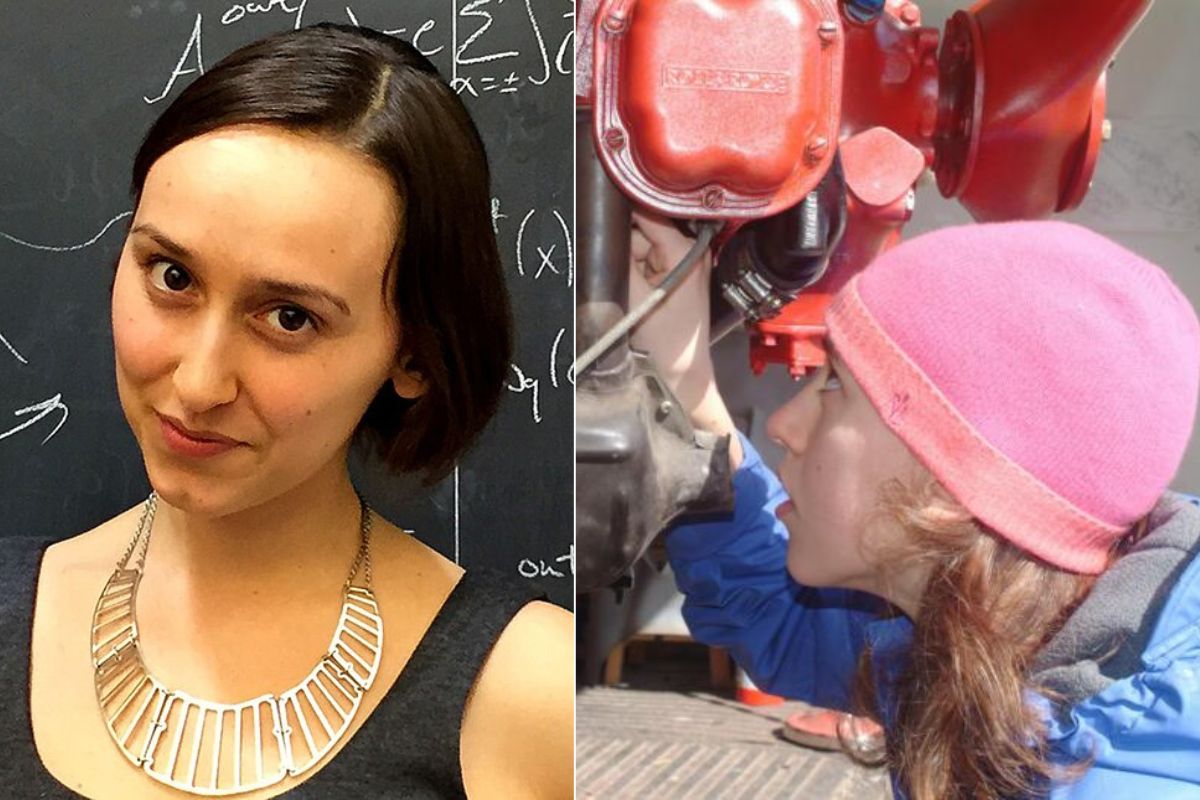
Most people find a child prodigy to be fascinating. It’s amazing to see such raw talent in a young person: genius in its purest form. But while the stories are impressive, we don’t always hear what becomes of these kids later in life. They often burn out due to the extreme pressure, but sometimes they go on to do incredible things. Theoretical physicist and former prodigy labeled as the ‘Next Einstein’ Sabrina Gonzalez Pasterski is a Cuban American born in Chicago in 1993. Her amazing aptitude was evident from an extremely young age when she became fascinated with flying and space travel. But Pasterski didn’t just want to be a pilot or astronaut someday. She wanted to fly right now. She took flying lessons as a child and began building her own aircraft when she was 12. As a starting point, she used a kit known as the Zenith CH 601 XL but made several modifications on her own to make it airworthy. At 13, she flew another small plane completely solo, and at 16, she soloed in her modified Zenith. The flight was one for the record books. Pasterski became the youngest person to solo pilot a plane they had built themselves. Her achievements quickly garnered attention, with Jeff Bezos taking an interest in her work and offering her a job with Blue Origin, his space technology company. She interned there in 2009 when she was just 16. But Pasterski didn’t stop there. Soon, she was off to MIT, where she graduated with a perfect 5.0 GPA in just three years. She then pursued her doctorate at Harvard. During her time there, she published eight research papers in peer-reviewed journals. In addition to being published, other scientists widely cited her research work. Stephen Hawking cited Pasterski’s work multiple times before she even graduated. This astounding achievement and recognition in the field caused many to dub her the “Next Einstein.” She was no longer a smart, precocious kid but rather a working and highly respected theoretical physicist, as sharp as the smartest minds on the planet. Pasterski and colleagues discover new property of gravity While at Harvard, Pasterski began tackling some big problems in theoretical physics. Such as what happens when two black holes collide. She and her coauthors published a paper detailing something called the “spin memory effect,” which furthers our understanding of gravitational waves. When a gravitational wave passes through a region of space, it leaves a permanent imprint. Physicists already knew about the displacement memory effect, which says objects in that region will no longer be the same distance apart after the wave passes. The spin memory effect, which Pasterski had a large hand in discovering, says that light or particles orbiting those objects may experience a time lag depending on which way they’re rotating. Quanta Magazine puts it this way: “Space-time becomes gnarled and twisted from gravitational waves that carry angular momentum.” It’s not something that’s easy to imagine or comprehend for average folks not deeply acquainted with theoretical physics. Extremely brilliant minds such as Stephen Hawking, however, picked up on it immediately and cited Pasterski’s paper in his own work—all before she’d even earned her doctorate. Next up: making a hologram of the universe Now, at 33, Pasterski is tackling even bigger challenges in physics. In fact, she’s taking on a problem that neither Einstein nor Hawking ever cracked. She’s trying to marry the two biggest theories in physics: quantum mechanics and general relativity. Quantum mechanics is the physics of extremely small things: particles, atoms, and units of energy. General relativity is the physics of large things such as gravity, space-time, black holes, and the edges of the universe. The problem is that these two fields don’t play nicely with each other. For years, physicists have been searching for a unifying theory that brings them both together. Pasterski thinks she might be onto it using “celestial holography.” The theory is that all of the information that makes up the entire universe could be encoded onto a 2D plane, the way a normal flat object projects into a 3D hologram when light hits it the right way. Her ideas simplify the math problems and would successfully unite the two biggest theories of the universe. If she can make it work. Pasterski embraces the spotlight but rejects the ‘Einstein’ label Pasterski gets a lot more public attention than your average theoretical physicist not named Hawking or Einstein. She doesn’t mind the attention, but not because she wants to hog the spotlight; she wants to use it. “I’m treating the spotlight as a resource, not a trophy. Concretely, that’s getting more attention and funding for [my work],” she told Be Giant. “I also hope that I can show more young people, especially ones who don’t see themselves in physics, that the door is open.” As for being anointed as the next all-time great? She’s got bigger fish to fry. According to TIME, Pasterski stated, “No one will be Einstein. He was who he was. I’m not cool. Not yet.”
33-year-old former child prodigy is working on problems Hawking and Einstein never cracked
Full Article
Original Source
Read the full article at Upworthy →KhanList aggregates and links to publicly available news content. We do not host full articles from third-party sources. Always verify important information with original sources.