
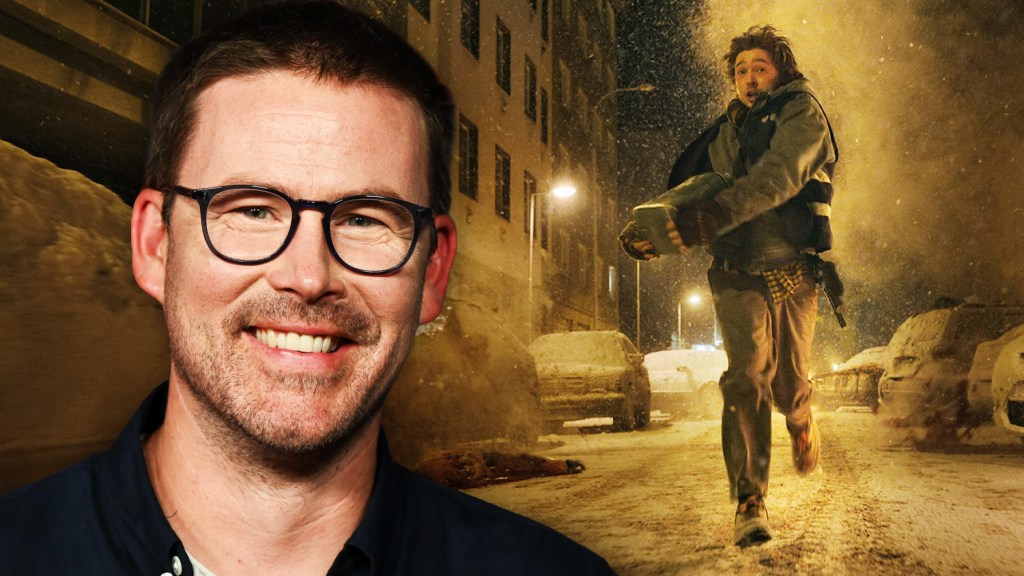
Sony‘s new Resident Evil movie hit tracking today, poised for a franchise record domestic opening — and with that, Zach Cregger is back. Coming off the Academy Award-winning Weapons, after a breakthrough moment with the 20th/New Regency horror film Barbarian, Cregger recently kicked off screenings for his latest, sharing only a select 30 minutes with the media to avoid spoiling all the surprises he has in store. The footage suggested that Cregger may have delivered his best work yet. No less an original, in his mind, than his past films — even if it comes with the trappings of hot video game IP — this Resident Evil is an intensely propulsive and compelling tale following a medical courier played by Austin Abrams, one of the stars of Weapons. While driving through the snowy darkness one night, the courier comes face to the face with the results of a contagion — the Umbrella Corporation’s infamous T-virus — and chaos ensues. The creative challenge with Resident Evil, Cregger says — which comes in at a lean and mean 95 minutes — was to “floor it at minute six and not take my foot off the gas,” driving the viewer straight into hell. Watch on Deadline Ahead of his film’s September 18 debut in theaters, Cregger spoke candidly with Deadline about a wide variety of topics, from the brutal conditions that birthed his Resident Evil to the star quality of Austin Abrams, Mikey Madison casting rumors, “elfing” scripts, and why he’s “not going to go tackle any other franchises” — though perhaps he has a romantic comedy in him. Casting new light on the inception of his next film, the outer space-set Warner Bros. sci-fi thriller The Flood, Cregger also touches on his Weapons prequel Gladys, the tonal inspirations of the forthcoming dark comedy Little One, on which he’s a producer, the film that had him “laughing my ass off” in theaters this year, Obsession/Backrooms mania, and more. DEADLINE: You’ve talked in the past about a creative writing technique you’re partial to called ‘elfing,’ where you pretend that a stupid elf you’ve paid $10 is penning your first draft. It’s a way of transcending the intimidation of the blank page that’s proven helpful for you. Did you do that with Resident Evil? ZACH CREGGER: You know, there was not really an ‘elfed’ version of this script. This was a different process altogether for me because it came about [when] I was on the set of Barbarian. I was in Bulgaria and my producer, Roy Lee was like, “Is there any video game franchise you would want to adapt?” And I was like, “Only Resident Evil.” But I mean, yeah, good luck, right? Because at that time, Barbarian hadn’t come out; I didn’t have any juice whatsoever. And he was like, “Well, you should think about a take. You should think about what it could be.” I couldn’t help myself; I was thinking. And then Barbarian came out and it was a success. And so I figured, okay, I can go knock on their door and pitch this idea. I’d come up with the concept — the conceit? [Laughs] What a pretentious prick I’ve become. I’d had the concept for the movie. So I had lunch with Constantine and I was like, “Here’s what I would do. I would like to just bring this to survival horror. I’d like to make a movie that feels like it feels when you play a Resident Evil game. So, gritty, horror first, medical courier, blah, blah, blah.” I kind of mapped out the whole story. It took 30 seconds — it’s a very simple story — and they dug it. They were down, and so I was able to go start writing where I had the beginning and the middle and the end in my head already. I wrote it with my buddy Shay [Hatten], and it was a really fast writing process where it was just basically me being like, “Okay, so basically you go here.” And it was one of those things where you have too many ideas. There was never a moment where I was like, “God, what should happen?” It was always just like, “Oh! Then they’ll jump off the roof.” So it was just easy. I was still not thinking, by the way, they were going to let me direct it. I was thinking they’re going to hire some big shot to make this movie, obviously. It’s their most valuable property; it’s like a household name, and that’s fine. I don’t give a sh*t. And so I wrote it really free, really careless, which is a healthy way to write. And by the time I was done, I loved it and I was like, “I hope I get to do this thing. That’d be cool.” So then, it was Weapons time, and then on the other side of that, I was able to do it. DEADLINE: You reteam with Austin Abrams here after giving him an incredible role in Weapons. Between that film, Resident Evil and Whalefall, you and Brian Duffield have given him a major opportunity — the chance to show that he’s a movie star. When did you first see that quality in him? CREGGER: Oh, well, when I was doing Weapons, it was obvious to me. I mean, first of all, I’ve got to say, I was an Austin Abrams fanatic from the time he did Brad’s Status. I remember seeing Brad’s Status, that Mike White movie, and just being like, “Okay, who is this guy? Who is this kid that is just absolutely bulldozing his way through this movie and doing nothing?” I was like, “I can’t believe the nerve of this kid to be starring with Ben Stiller, and it’s a two-hander, and just absolutely slaying with no energy expenditure.” It was one of the most courageous performances. I mean, he was 19 years old or something when he did that, and it is so restrained and he makes it look so easy. That is the kind of performance that masters of acting will spend 60 years prepping and then finally be able to deliver a performance like that — and Austin just did it. So I was immediately like, “I am all in on this kid.” I was even trying to figure out if I could get him in Barbarian. That’s how in on Austin I was. And so then we’re making Weapons and everything I thought about this guy is true. And he’s awesome. We got along so well. We just make each other laugh. He’s such a good energy on set. I was like, “This is it, dude. This is my guy.” And so when it was time to put Resident Evil together, there was not even a second choice. I went to [Sony’s] Tom Rothman. I was in New York editing Weapons, but we got on a Zoom to talk about Resident Evil and I was like, “It’s Austin Abrams.” And to his credit, he was like, “Totally, he’s great.” He knew. He had seen Austin in [Jon Watts’] Wolfs and was like, “Yeah, that kid is the real deal.” DEADLINE: I did forget about that performance — that was certainly a big stepping stone on his way to Weapons… CREGGER: Yeah. He just utterly destroyed that part. It’s amazing. So anyway, what a long-winded way of saying I’m a big fan. DEADLINE: Before news of Austin’s casting emerged, rumors swirled that you were eyeing Mikey Madison for a role in Resident Evil. Was there ever any substance to that? CREGGER: Never. I don’t know how that started. I love her, she’s great, but that was just never a thing. DEADLINE: You’ve talked about approaching Resident Evil as an original work created within the framework of pre-existing IP… CREGGER: Yeah, but that has been taken horribly out of context. What I mean is it’s an original story, but it’s still a Resident Evil story. I’m not taking a story from the games; that’s what that means. DEADLINE: Exactly. It seems like the savviest and most exciting creative move you can make today is demonstrating your command of an IP-based tentpole, while still making something totally your own. You’ve been explicit about the passion for Resident Evil that drove you to the project and that you initiated it because of that — but as a filmmaker at your level with a lot of choices, has there ever been any pressure around wading into tentpoles, or big IP? Projects that you had less of a clear angle on? CREGGER: I have never been approached by another franchise. Maybe I have, but it would never get to me because I have been very clear that I’m not doing that. I’m doing this, and that’s it for me. So I’m not going to go tackle any other franchises — just because I’m a writer, and I want to write whatever I want to write. I don’t want to write something where I have to make sure I’m tagging different data points to satisfy X. I just want to satisfy me. And the only reason that I think Resident Evil is okay for me to do is because I’m enthusiastic about the games and I like the story that I thought of with the games and I’m making it for me. I think this movie is cool, and I hope it checks the fan boxes because I’m a fan and I’m checking my boxes. I’m making the Resident Evil movie that I wish existed, so I can do that with a clean heart and a clear conscience and not feel like I’m getting f*cked by some weird industry thing. DEADLINE: Your three films to date reveal you as a filmmaker interested in structure. What about innovating around cinematic structure excites you? CREGGER: I mean, I’m fascinated with how we tell stories. I like structure, I like to pick it apart, I like to understand it. You have to know the rules to break the rules, right? For example, Flood, my next movie, is another movie that is structurally bizarre. Like Barbarian and Weapons, it doesn’t jump perspective, but it structurally is, I think, dexterous. Whereas the goal for Resident Evil was to be the opposite: I wanted to prove that I didn’t need to do some sort of narrative trickery, that I could just follow one person from Point A to Point B and still be compelling. The real challenge of Resident Evil was, can I floor it at minute six and not take my foot off the gas? If I could do that, holy sh*t, that would be a fun challenge for me to do. And there are a couple of moments in this movie where [Austin’s character] does have a quiet moment of rest, so maybe I failed. But I love the result. DEADLINE: You’re someone who came out of comedy — and The Flood, as it’s understood, is a sci-fi thriller of some sort. Are you excited by the thought of spanning all genres? CREGGER: No, I don’t care about genre. I just care about whatever idea I have. So I don’t think in terms of, what genre should I tackle? I just hope I get a good idea, and whatever that idea is, that’s enough. So I just happen to resonate the strongest lately with genre fair. But if I came up with a banger for a romantic comedy, I would try it. DEADLINE: The Flood was one of three scripts you penned in quick succession — it was always one you were going to do. But is there anything you can share yet about what you’ve tapped into there? What made that project a must-do? CREGGER: Flood, I kind of came up with the idea because I was very excited to work with Steven Spielberg, and we had a weird situation where there was a short window where I could have an idea and we could link up together. So I had like five days, basically, to have an idea. And I entered a mental state I have yet to ever repeat or do prior where I was in some sort of frenzy where I was just like, “I’ve I got to have an idea for Steven Spielberg!” I was just in a frenzy. And then I was watching this movie, and somebody in the movie I was watching was entering an abandoned spaceship. And my wife was like, “There’s nothing scarier than being trapped in space.” And I was like, “Oh, that’s interesting. Maybe there’s something here.” And then this character goes into the ship and they find something that was pretty weird and scared them. And I was thinking, “What would be weirder and scarier than that? What could happen in this scenario that would freak me out more than this?” And it’s never happened to me before, but in a flash, I had the whole movie explode in front of my eyes. I just knew what it could be; I think I probably stood up and was like, “I have it!” It was a total ridiculous moment, but I love it. So then I wrote that as I was writing Resident Evil. I was writing those two movies at the same time. DEADLINE: Returning to Resident Evil, I love what you’ve said about filmmaking as a psychic war… CREGGER: Yeah. I mean, it’s a psychic war just in the terms that making a movie is just completely unrelenting. It’s prolonged, and so every day, you are absolutely withered, and yet you’ve got to do it again the next day, and the next day, and the next day, for many, many months. It is so demanding, and it’s so funny. I don’t think I appreciated that the hardest part of filmmaking is not the creative aspects. It’s not where to put the camera and what to tell the actor. It’s just the immense, unending pressure of the logistics and navigating the people and all of those things that they don’t talk about in film school. DEADLINE: But what was the most brutal idiosyncrasy of this project? CREGGER: Oh dude, it was night shoots that were nocturnal. The weather was an absolute motherf*ck. I’m shooting in the Czech Republic, so there’s a severe language and culture gap, and I’m trying to make sure that everybody is seeing exactly the movie that I’m seeing, and it just required a lot of energy expenditure. You know, when you’re making a movie, however many hundreds of people that are on set, they’re all feeding on your energy. You have to be supplying the energy to the entirety of the organism, and it’s a lot. DEADLINE: I can only imagine. You’ve said you even ended up directly, with an IV in you, on Weapons. CREGGER: Yeah. My body just gave out on me, dude. But that was also, I was shooting in Atlanta and the insane heat and humidity, and I’d spent however many days trying to corral 17 children to run and jump through windows. [Laughs] And I’d been shooting double shifts six days a week with my cinematographer. It was brutal! DEADLINE: Do you think the mental fortitude you’ve had to find within yourself as a filmmaker is innate to you? Or has it been something you’ve really had to cultivate? CREGGER: No! I don’t even have it: I’m just doing it because you have to do it. I’m not special. I’m just a normal person, so no, it’s hard. DEADLINE: As a producer, you’ve already wrapped on another movie — a dark comedy called Little One that we scooped over the summer. What excites you in the comedy space — and what’s your perspective on comedy now, as someone known for reaching audiences with event movies? What would it take to make people remember that a comedy can be one? CREGGER: Oh, I don’t know, dude. I want comedy to come back to the theater so bad, man. When I saw The Drama this year, I was laughing my ass off in that movie, and the theater was laughing its ass off. And I was like, “This feels so good. Can we just have this back? Please, can we have this back?” Little One, I’m involved with that because the filmmaker, Alex Kavutskiy, is a friend of mine and one of the more talented people that I know. I think that guy is truly special, and so anything I can do to be involved with him is an honor. I feel like that guy is beginning a very, very exciting career, and I’m pumped. And he’s making a weird kind of a Todd Solondz, Alexander Payne kind of a thing, which is a little bit more subtle, and my vibe totally. I love it. I don’t know what comedy is going to come along that is going to finally blow the doors open and we can have our friend back, but I miss him. I miss our friend, and I hope he smiles on us again soon because we need it to. DEADLINE: I mentioned Brian Duffield earlier — in July, news broke that you’re teaming with him on a Warner Bros. film adaptation of the viral horror meme Siren Head from Trevor Henderson. This is one of those projects emerging from a moment of incredible fervor around Obsession and Backrooms, projects from hot, young digital-first talents. We’ve seen historically that it can sometimes be perilous to chase a trend. Are there wrong lessons to take from this moment, in your mind? CREGGER: I mean, I don’t know about wrong lessons. All I know is that if you find a story that turns you on and that you feel like is really compelling and works, then you’re on the right track. If you’re trying to just, “Hey, here’s a hot IP, I think we can shoehorn something in here and get it in a theater,” well, then you’re coming at it from kind of a bad place, and I think you’re probably going to make a bad movie. I think that the North Star should be like, “Do I love this story? Do I love this story enough to spend a year of my goddamn life telling this story?” That’s a heavy thing, and I made the mistake in my 20s of being like, “Oh, I have an opportunity to make a movie [2009’s Miss March]. I don’t really love the story, but I could make a movie that I’m in.” And what happened? I made a bad movie and I suffered for it, and I wasted a year of my life making that movie. And that’s not fair to say because Trevor [Moore], who I made it with, is no longer here. He had a pretty different attitude towards that movie, and I think he would disagree with me. So I’m only speaking for myself. But look, Siren Head, I think that the story that we have is super cool, and so whether it was an internet meme or not, I would be interested in telling this story. And I think that’s the lesson. It should stand on its own. DEADLINE: What has it looked like for you to find a story you’re obsessed on enough to commit to for years and roll up hill? That seems very difficult. CREGGER: It is long. Weapons took two and a half years, man. Barbarian took me four years to get that movie made. DEADLINE: And 10 years or more is not uncommon… CREGGER: Absolutely. I don’t know, dude. For me, I just get a feeling. Like for Flood, I have this feeling where I’m just like, “I will burn my house down to make this movie.” You know what I mean? If God came down and was like, “You can make this movie, but you’ve got to burn down your house,” I’d be like, “Okay, done.” So if you have that attitude, then you’re probably in the right spot. DEADLINE: Are there other young filmmakers, along the lines of Kane Parsons and Curry Barker, that you’re really excited by right now? I know you’re a huge fan of Ari Aster, who’s a contemporary… CREGGER: I think Ari is the most interesting person to me. I can watch an Ari movie 30 times because the explosion of ideas in every scene is really, really miraculous. I think he’s profoundly talented and a serious inspiration. I’m kind of in awe of him, and I hope that he makes movies for the rest of my life. DEADLINE: What about younger guys? CREGGER: Dude, I think Curry is like, “Holy sh*t.” To come out of the gate with a movie like Obsession… I loved Obsession. It actually scared me. I thought it had such a voice, and if this is this guy’s first at bat… I know he made [the self-released] Milk & Serial, but if this is his first at bat with a real crew and an actual team, holy sh*t. I’m so excited to see what comes next, and I hear good things about his next movie, so I’m pumped. DEADLINE: Do you have other projects percolating right now as a writer, beyond Siren Head and the Weapons prequel? CREGGER: Oh, actually, Zach Shields is writing [Gladys]. I was developing the story with him, but he’s writing it. Yeah, I’m always writing stuff. But my process is so broken. I write in a way that is kind of like I leap before I look. So I’ll start something, I’ll get 30 pages, and then I’ll be like, “Ehhh, no.” And then I’ll move on and write 50 pages of something else, and I’ll be like, “Eh.” Or I’ll write half of a script, I’ll love it, and then I don’t know how it needs to resolve, and then it’ll sit there torturing me for years. So I’m trying to stay productive, but we’ll see.
Zach Cregger Talks ‘Resident Evil,’ Creative Impetus & Intense Drive To Work With Spielberg That Led Him To ‘The Flood,’ ‘Siren Head,’ ‘Obsession’/’Backrooms’ Fervor & More – The Deadline Q&A
Full Article
Original Source
Read the full article at Deadline →KhanList aggregates and links to publicly available news content. We do not host full articles from third-party sources. Always verify important information with original sources.