
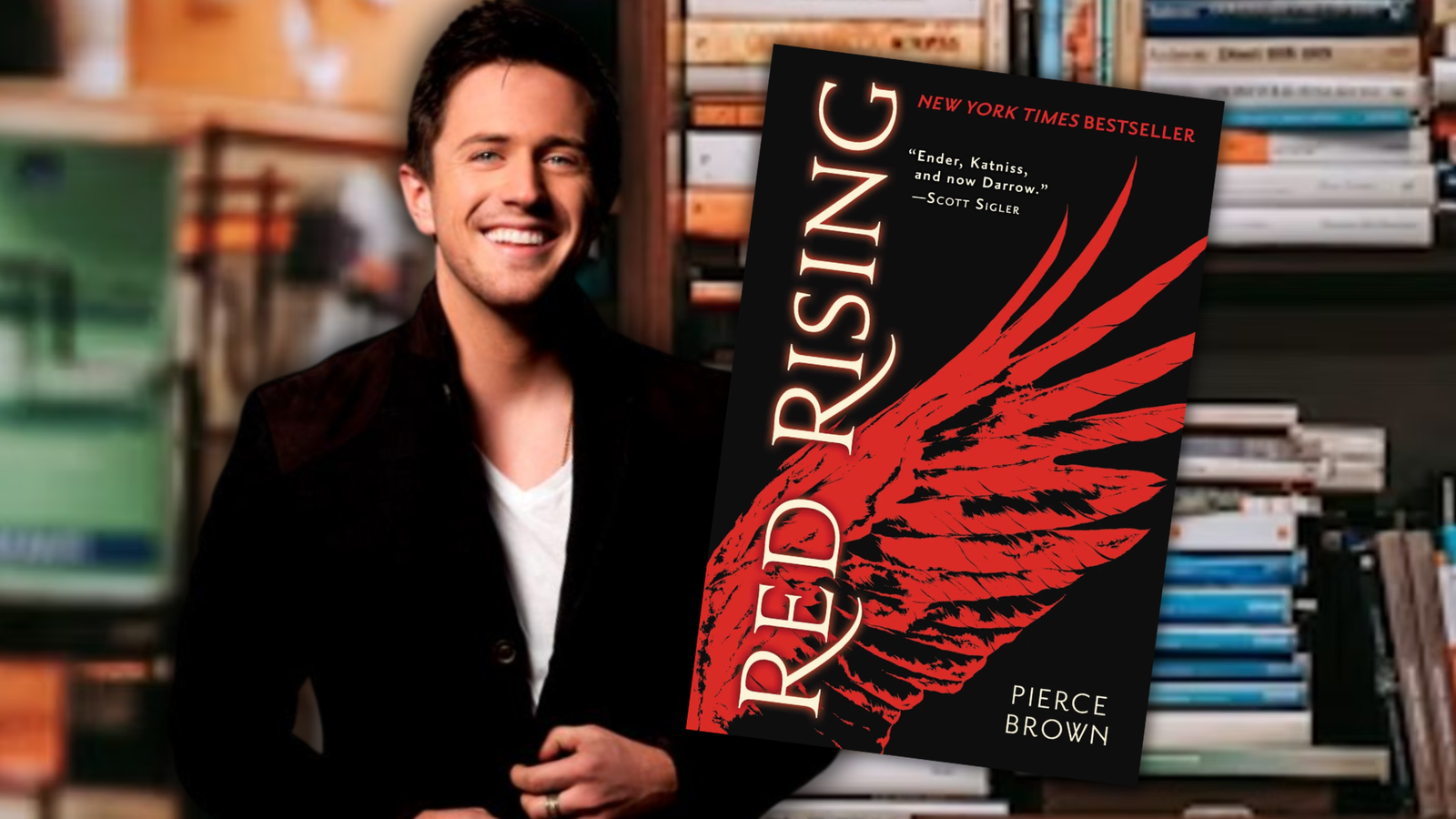
Published Sep 4, 2026, 4:00 PM EDT Hannah is a senior writer and self-publisher at ScreenRant. There, she focuses on writing news, features, and list-style articles about all things comics, books, anime, and manga. She works as a freelance writer in the entertainment industry, focusing on video games, anime, and literature. Her published works can be found on Screen Rant, FinanceBuzz, She Reads, and She Writes. Pierce Brown’s Red Rising saga is packed with military science fiction, political maneuvering, ancient empires, rebellion, and massive space battles, so it makes sense that readers would be curious about the books that shaped the author’s tastes. Brown has publicly recommended many of the titles below, including several foundational works that stretch from 1912 to the 21st century. What makes the list especially interesting is how broad it is. Brown’s recommendations move from classic sword-and-planet adventure to dense literary science fiction, dystopian fiction, space opera, and science fantasy. Some are obvious choices for Red Rising fans, while others reveal a more unexpected side of Brown’s reading life. Here are the 12 sci-fi books and collections worth reading, according to Pierce Brown. 12 The Forever War by Joe Haldeman Published in 1974, Joe Haldeman’s The Forever War follows William Mandella, a reluctant soldier pulled into an interstellar conflict with the alien Taurans. Relativity turns military service into something horrifyingly literal: Mandella experiences months or years while much longer stretches pass on Earth. The novel won the Nebula Award in 1975 and both the Hugo and Locus Awards in 1976. That combination of warfare, technology and the alienating effects of time makes it a natural recommendation for readers interested in the harsher side of space opera. Brown has specifically cited The Forever War among his science-fiction favorites, placing Haldeman alongside definitive sci-fi writers such as Frank Herbert and Dan Simmons. 11 The Book of the New Sun by Gene Wolfe Gene Wolfe’s The Book of the New Sun is actually a four-volume sequence published from 1980 through 1983: The Shadow of the Torturer, The Claw of the Conciliator, The Sword of the Lictor, and The Citadel of the Autarch. A fifth work, The Urth of the New Sun, followed in 1987. The story follows Severian in a far-future Earth whose sun is fading. Wolfe makes the future feel ancient, mysterious and almost mythological. Severian is an apprentice torturer whose journey through the Commonwealth becomes increasingly strange and unreliable. The series is famously demanding, but that density is part of its appeal. Brown’s recommendation places one of science fiction’s most intricate works beside his own sprawling approach to futuristic civilizations. 10 Shadow & Claw by Gene Wolfe Shadow & Claw is technically not a separate story from The Book of the New Sun. The 1994 Orb edition collects the first two volumes, The Shadow of the Torturer and The Claw of the Conciliator, into a single 413-page omnibus. That makes it an especially convenient way to experience the opening half of Wolfe’s larger saga. The distinction matters because Brown’s list effectively doubles down on Wolfe. The first half introduces Severian, his exile and the strange world of Urth while establishing the series’ elaborate mixture of science fiction, fantasy and historical imagery. For a reader who finds Red Rising’s deeper lore and worldbuilding appealing, this is one of the most intriguing recommendations on the list. 9 A Canticle for Leibowitz by Walter M. Miller Jr. Walter M. Miller Jr.’s A Canticle for Leibowitz appeared as a novel in 1959 after its three major sections had originally been published in The Magazine of Fantasy and Science Fiction between 1955 and 1957. The book is set after nuclear war and follows monks preserving fragments of humanity’s scientific knowledge in a desert monastery. Its scale is enormous despite its relatively compact structure, because the story examines civilization over thousands of years. The novel also won the 1961 Hugo Award for Best Novel. Brown’s inclusion suggests an interest not merely in futuristic warfare, but in what happens after societies destroy themselves and attempt to rebuild. 8 Consider Phlebas by Iain M. Banks Published in 1987, Consider Phlebas was Iain M. Banks’ first science-fiction novel and the opening book of the Culture series. The story takes place during the Idiran-Culture War and follows Bora Horza Gobuchul, an opponent of the Culture, as competing forces pursue a fugitive artificial intelligence known as a Mind. The book is especially notable because Banks begins his Culture universe from the perspective of someone hostile to the supposedly utopian Culture. That lets the novel examine war, ideology and morality from an unusual angle. The Culture ultimately grew into a ten-book science-fiction series, making this recommendation a big reading recommendation for anyone who loves sprawling interstellar settings. 7 The Stars Are Legion by Kameron Hurley Kameron Hurley’s The Stars Are Legion, published in 2017, takes the idea of a generation ship and turns it into something radically biological and alien. The story centers on the women living aboard a vast fleet of living worlds while rival factions struggle for survival and control. Its setting deliberately blurs the line between spaceship, planet and organism. That strangeness separates it from more traditional space opera. Instead of simply filling familiar military-science-fiction machinery with new characters, Hurley imagines an ecosystem built into the setting itself. Brown’s recommendation is one of the more adventurous choices on the list, especially for readers seeking science fiction that feels genuinely unfamiliar rather than merely futuristic. 6 Ancillary Justice by Ann Leckie Ann Leckie’s 2013 debut novel Ancillary Justice introduces Breq, the surviving fragment of a starship artificial intelligence that once controlled thousands of bodies. It is the first novel in the Imperial Radch trilogy, followed by Ancillary Sword in 2014 and Ancillary Mercy in 2015. Its awards record alone makes it difficult to overlook. Ancillary Justice won the Hugo, Nebula, Arthur C. Clarke, BSFA, and Locus awards, among others. The Science Fiction and Fantasy Writers Association notes that it remains the only novel to win the Hugo, Nebula, and Arthur C. Clarke Awards. For Brown readers, its combination of empire, artificial intelligence and identity makes it especially compelling. 5 Hyperion by Dan Simmons Dan Simmons’ Hyperion was published in 1989 and became the first novel in the four-book Hyperion Cantos. Rather than following a single conventional protagonist, it brings together seven pilgrims traveling toward Hyperion and its mysterious Time Tombs, with each character revealing a different story. Simmons won the 1990 Hugo Award for Best Novel for the book, along with the Locus Award for Best Science Fiction Novel. The structure gives Hyperion the feeling of several genres operating inside one space opera: military fiction, horror, literary storytelling, and epic adventure. Brown’s affection for this weird sci-fi novel is one of the clearest clues to the ambitious scope of his own saga. 4 A Princess of Mars by Edgar Rice Burroughs Long before modern space opera took shape, Edgar Rice Burroughs sent readers to Mars. A Princess of Mars was serialized from February through July 1912 in All-Story Magazine before appearing in hardcover in 1917. It introduced John Carter and became the first novel in the Barsoom series. The book helped establish the planetary-romance tradition, mixing alien worlds with swordplay, romance, and adventure. It also has an amusing connection to Brown’s own fiction: readers have pointed out that Mustang’s flagship in Red Rising is named after Dejah Thoris, the Martian princess from Burroughs’ novel. 3 The Left Hand of Darkness by Ursula K. Le Guin Ursula K. Le Guin published The Left Hand of Darkness in 1969, introducing the planet Gethen, where inhabitants are capable of changing their sex. Human envoy Genly Ai arrives hoping to persuade Gethen to join an interstellar civilization, only to discover that understanding the planet’s culture is as important as any political mission. The novel won both the Nebula Award in 1969 and the Hugo Award in 1970. Instead of relying primarily on combat or technological spectacle, Le Guin uses an alien society to explore politics, identity, loyalty and human relationships. That makes Brown’s recommendation a reminder that great science fiction does not need constant battles to feel enormous.
12 Must-Read Sci-Fi Books, According to Red Rising's Pierce Brown
Full Article
Original Source
Read the full article at Screenrant →KhanList aggregates and links to publicly available news content. We do not host full articles from third-party sources. Always verify important information with original sources.