
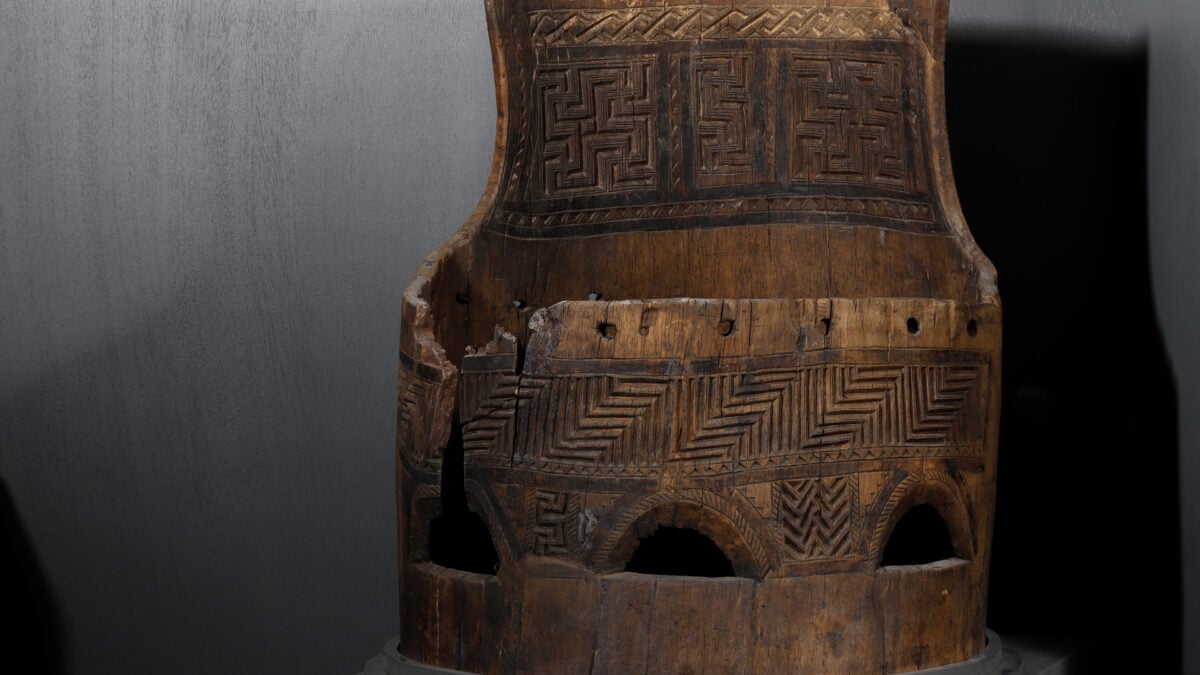
In the 1990s, archaeologists uncovered a cemetery near the Fallward settlement with burials dating from the late 3rd to the late 5th century CE, spanning the Late Roman Iron Age and the Migration Period. The Fallward cemetery preserved a rich collection of graves, burials, and artifacts—already a lot of information—but only recently did scientists examine the DNA of the people buried there. In research recently published in iScience, archaeologists extracted DNA from 12 skeletal samples belonging to 11 individuals put to rest at Fallward. One particularly interesting individual was the man from “Grave 265,” who died around the second quarter of the 5th century CE. His final resting place was a boat holding numerous wooden and metal goods and a Roman military belt, with an ornate alder chair placed outside the vessel. Genetic analysis suggests his roots were in the Danube region—quite the distance from his final resting place. He also had a rare form of leprosy that hadn’t been found before in Central or Northern Europe. “He is the first individual from this group to have been identified in Europe,” Daniel Myburgh, the study’s lead author and a doctoral researcher at Kiel University in Germany, said in a statement. Overall, the new findings demonstrate the complexity and mobility of humans—and pathogens, perhaps—in Late Antiquity. Carefully interred According to the paper, the Fallward graves, located in what is now northwestern Germany, include roughly 200 cremation burials and 60 inhumation graves. Previous research suggests the settlement was founded during the 1st century BCE and gradually declined during the 5th century CE. The wooden and metal grave goods, as well as plant and textile accessories, were remarkably well preserved. Some of the graves held foreign items of Mediterranean origin. In other words, just the “visible” aspect of the graves, so to speak, already offered a ton of information for experts. And even before genetic analysis, Grave 265 already stuck out from the others for several reasons. Items of interest from Grave 265. (A) a boat covered with wooden panels forming a roof-like structure, (B) an ornate chair made of an alder trunk, and (C) a footstool with a hunting scene on its underside. © Myburgh et al., 2026 “The grave goods placed in the tomb aroused particular scientific interest,” Hauke Jöns, a study co-author affiliated with the Lower Saxony Institute for Historical Coastal Research in Wilhelmshaven, Germany, said in the statement. “These included a chair, artfully decorated and carved from an alder trunk. Furthermore, the man possessed a late Roman military belt, which suggested that the deceased had had connections across great distances.” Connecting the dots The team kept these theories in mind while unpacking the implications of its genetic analysis. According to the study, some of the samples had “low genomic coverage,” limiting the clarity of the information the team could collect. Still, the researchers were able to determine the genetic sex of eight out of 11 individuals—seven males, one female—including three whose genomes provided “sufficient” data for a population analysis. A map showing the locations of the Fallward burial ground, located near the North Sea coast, between the Weser and the Elbe. Credit: Petra Horstmann, Cluster ROOTS/Uni Kiel The genetic analysis bolsters some suspicions the team had about the man in Grave 265. For example, the analysis suggests that he or his recent ancestors may have come to Fallward from a part of the Danube region under Roman influence. It’s also possible that he was a mercenary for the Roman army or that he acquired the belt through trade, inheritance, or the spoils of war. Osteological analysis indicated he had well-developed upper arm muscles, so he could have been a boatman or a fisherman. Taken together, these findings strongly suggest that he lived a fairly mobile life. A traveling pathogen? That thought becomes even more fascinating when you consider that he carried an unusual strain of the bacterium that causes leprosy. According to the statement, the earliest known example of this bacterial lineage comes from Egypt and dates to between the 4th and 2nd centuries BCE. This lineage had never been detected in Central or Northern Europe. That said, the man hadn’t suffered bone damage, which makes sense since leprosy symptoms can take years to show up, Almut Nebel, a co-author of the new study and a biologist at Kiel University, said in the statement. “Either he was affected by an asymptomatic form of the disease, or the disease had so far only affected soft tissues,” Nebel said. “He may have travelled long distances whilst carrying the diseases.” The team estimates the man was around 50 years old at the time of death. But it’s unlikely that he died from leprosy, the researchers added in the paper. The elaborate collection of goods and the unique structure of the grave—an oak boat with a roof-like structure—all point to the guy probably coming from a privileged background. As the team noted in the study, by nature of how old the samples are, these interpretations are best taken as just that: interpretations. But the science does appear to tell an interesting story. And just like us, people who lived long ago led complex lives that sometimes took them to faraway places.
1,600 Years Ago, This Man Traveled Across Europe. So Did His Rare Strain of Leprosy
Full Article
Original Source
Read the full article at Gizmodo →KhanList aggregates and links to publicly available news content. We do not host full articles from third-party sources. Always verify important information with original sources.