
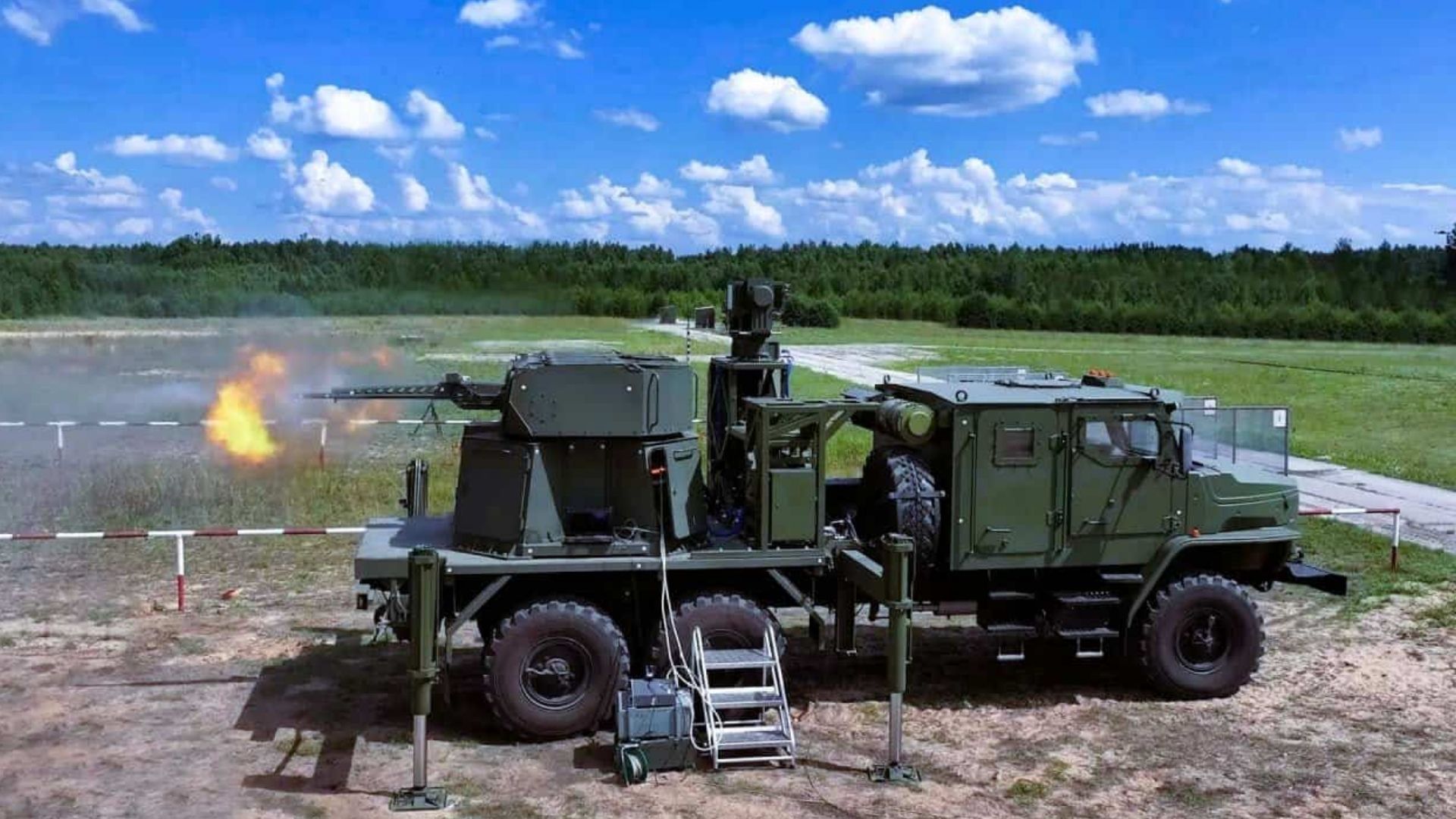
Russia’s Rostec has developed a mobile version of its Citadel air defense artillery system, moving the weapon and its detection equipment from a stationary installation onto a vehicle chassis. The change is intended to let Russian air defense teams relocate the system more quickly to sites requiring protection against drones and other aerial threats. Rostec announced the development on November 6, saying the new configuration places the combat module, radar and optical detection systems on a vehicle. The corporation did not disclose the chassis type, vehicle specifications, deployment timeline, or whether the mobile version has entered production. The original Citadel was designed to protect stationary facilities. Rostec says it has demonstrated effectiveness in combat against different types of drones and cruise missiles, although the company has not published independently verified performance data. How the Citadel system detects and engages drones Citadel, also identified as the ZAK-30, is a 30 mm anti-aircraft artillery system. Rather than relying on guided missiles, it uses automatic guns and specialized ammunition intended to destroy aerial targets at relatively short ranges. The system combines radar with electro-optical sensors to detect and track incoming threats. Rostec says its optical equipment operates in both visible and infrared wavelengths, allowing it to track targets in different lighting conditions. Its ammunition is another defining feature. Citadel uses shrapnel-filled projectiles with remotely controlled fuses. Instead of relying entirely on a direct hit, the fire-control system calculates an appropriate detonation point based on the target’s flight path. The projectile then releases fragments near the aircraft, creating a cloud that can damage or destroy it. This approach is particularly relevant against small drones, which can be difficult to hit with conventional gunfire because of their size and maneuverability. Programmable airburst ammunition can increase the likelihood of hitting a target without requiring a projectile to strike it directly. Rostec also claims that fewer rounds are needed per engagement compared with conventional ammunition. Why put the system on a vehicle? The move to a vehicle-mounted configuration addresses a limitation of the original design: a stationary air defense installation is tied to the location it protects. Mounting Citadel on a vehicle could allow operators to move the system between airfields, industrial facilities, military sites, and other locations as threats change. It could also make it easier to reinforce areas facing increased drone activity without building a new permanent installation at each site. Mobility is particularly important for short-range air defense, which often provides the final layer of protection around valuable infrastructure and military assets. Such systems are intended to engage threats that penetrate wider air defense networks, including low-flying drones and cruise missiles. The Center for Strategic and International Studies describes Russian air defense as a layered structure, with short-range systems such as Pantsir providing point defense for important locations. Citadel’s role appears to fit within this broader category of close-range protection rather than replacing longer-range missile systems. A shift toward gun-based counter-drone defenses Citadel is part of a trend toward using automatic cannons and programmable ammunition against drones. One comparable system is Germany’s Rheinmetall Skynex, which uses 35 mm guns and programmable AHEAD ammunition to provide short-range air defense. Like Citadel, the German modular air defense system Skynex combines sensors, target tracking and gun-based engagement. Rheinmetall says its system is particularly suited to very short-range situations where guided missiles may be less practical or more expensive. Its architecture can also connect different sensors and weapons through a command-and-control network. The comparison shows why gun-based systems are receiving renewed attention. Using a relatively inexpensive projectile against a low-cost drone can help avoid expending more expensive guided missiles on every target. However, gun systems have limited engagement ranges and require accurate detection and tracking, making them one component of a layered defense rather than a complete solution. The mobile Citadel configuration adds flexibility to a system originally intended to guard fixed facilities. Get the latest in engineering, tech, space & science - delivered daily to your inbox.Kaif Shaikh is a journalist and writer passionate about turning complex information into clear, impactful stories. His writing covers technology, sustainability, geopolitics, and occasionally fiction. A graduate in Journalism and Mass Communication, his work has appeared in the Times of India and beyond. After a near-fatal experience, Kaif began seeing both stories and silences differently. Outside work, he juggles far too many projects and passions, but always makes time to read, reflect, and hold onto the thread of wonder.
Anti-drone system with radar, thermal imaging and a 30mm cannon gets wheels
Full Article
Original Source
Read the full article at Interestingengineering →KhanList aggregates and links to publicly available news content. We do not host full articles from third-party sources. Always verify important information with original sources.