
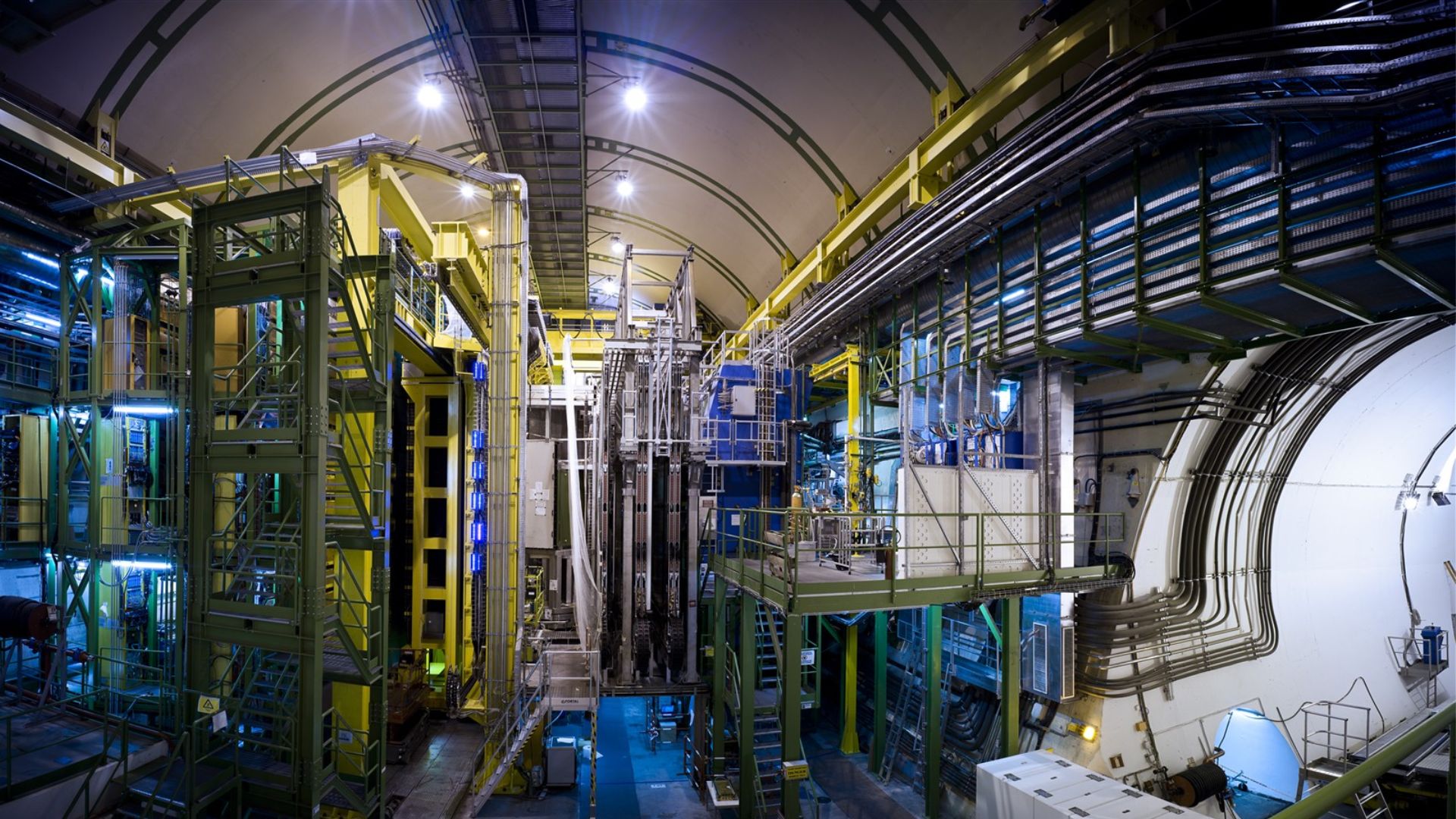
Scientists at the University of Manchester in the UK have found evidence for a rare particle decay that occurs once in 10 billion particles. The decay was spotted after a major upgrade at the LHCb experiment at CERN, and it also opens up avenues for further investigation at the zeptometre scale in the future. The LHCb experiment at CERN is different from the ATLAS and CMS detectors, since it is a forward spectrometer. Instead of looking for evidence of decay in all directions, LHCb focuses on the forward region of the beamline to study the behavior and decay of beauty and charm quarks. Beauty quarks are heavier than up and down quarks and are produced in large numbers in the LHC. However, they last for just one and a half trillionth of a second before decaying. For more than a decade and a half, researchers from the University of Manchester have been involved in the upgrade of the LHCb experiment, which now allows data collection at five times the rate of what was previously possible. Rare decay spotted Precise measurements of beauty-quark decays allow scientists to detect the influence of new particles that may be too small to be detected by the LHC. If a decay is rare, it can be more sensitive to the influence of new particles. UK’s contribution to the LHCb upgrade was a Vertex Locator, a silicon pixel detector that sits a mere five millimeters from the beams, letting scientists pinpoint where particles are produced and where they decay. The team detected a ‘Bd to mu mu’ decay, where a beauty quark decays into two muons, which are electron-like particles but a bit heavier. Estimates suggest that these decays happen only once in 10 billion beauty particles, so it is not a surprise that it has never been spotted before. “This decay is remarkably unlikely; the chance of it happening is roughly like going on a romantic date and, on your very first try, finding the one perfect match for you among everyone on Earth”, said Chris Parkes, the Head of the Department of Physics and Astronomy at The University of Manchester, who was also involved in the upgrade of the LHCb experiment. Zeptometre-scale research The statistical significance for this find is 3.2 sigma, which is still less than the 5 sigma threshold needed to call this a major physics discovery. Nevertheless, it opens up avenues for physicists to explore particles and forces of nature hiding in spaces as small as a billionth of a trillionth of a meter. This distance is called a zeptometre, and the space is called the zeptoverse. The measurements made in this experiment are still in agreement with the Standard Model of Physics. However, further research into the Zeptoverse could help scientists find signs of new physics, which the Standard Model cannot explain. ““The results from this experiment are expanding our understanding of nature at its most fundamental level,” said Conor Fitzpatrick, Deputy Physics Coordinator of the LHCb collaboration in a press release. “We are excited to have finally seen this elusive signal and are looking forward to the future discoveries that will come from our data.” Even as the upgraded experiment will collect data till early 2030s, a further upgrade could increase data collection by another order of magnitude and reveal more about particles and forces in the zeptoverse. Get the latest in engineering, tech, space & science - delivered daily to your inbox.Ameya is a science writer based in Hyderabad, India. A Molecular Biologist at heart, he traded the micropipette to write about science during the pandemic and does not want to go back. He likes to write about genetics, microbes, technology, and public policy.
‘Zeptoverse’: Scientists find evidence of particle decay sought for over 40 years
Full Article
Original Source
Read the full article at Interestingengineering →KhanList aggregates and links to publicly available news content. We do not host full articles from third-party sources. Always verify important information with original sources.