
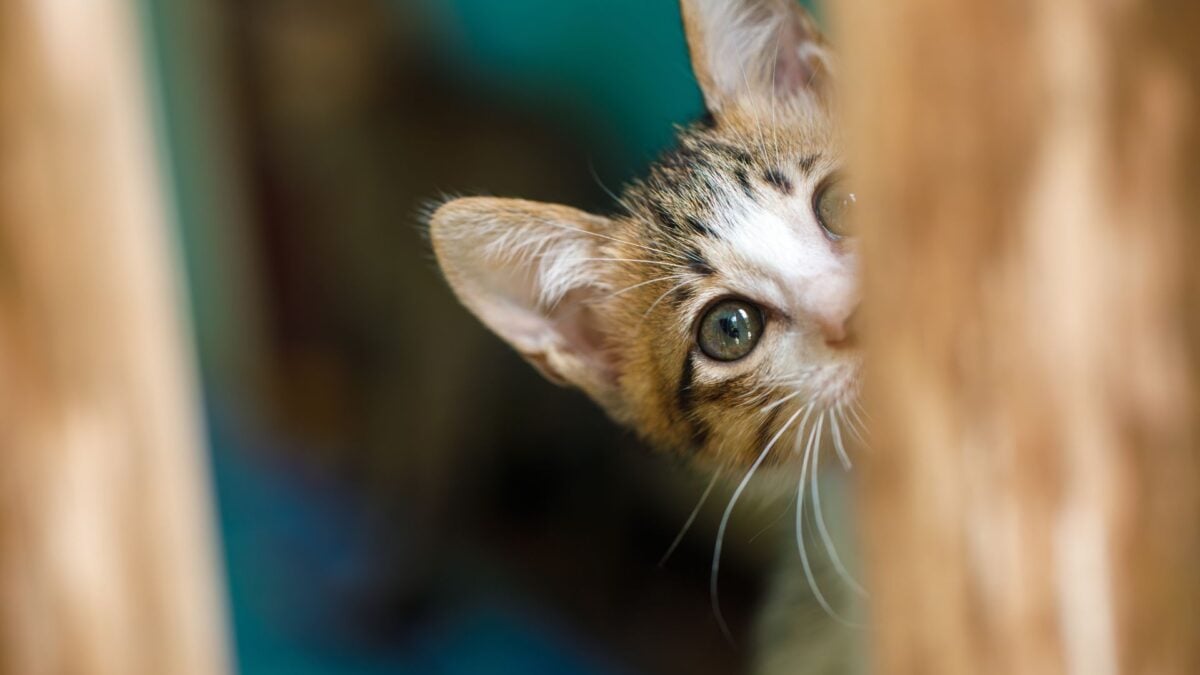
Many a person has referred to their cat as their own little fur baby. Research out today hints that for some felines, that comparison is even more apt than we knew. Scientists in Japan surveyed hundreds of cat owners about their furry angel’s disposition and behavior. Some cats, they found, were often fearful about unfamiliar things and people but still willing to approach them—a kind of curious shyness seen in human infants. Though further study is needed, the findings indicate that cats are more complicated than commonly assumed, the authors say. “I hope this research encourages people to reconsider stereotypes such as ‘dogs are friendly’ or ‘cats are aloof.’ Animal personalities are much more diverse and complex than these labels suggest,” lead author Madoka Hattori, a cat researcher at Kyoto University in Japan, told Gizmodo. The curiously shy cat Hattori has literally been studying cats since childhood. When she was six, she wrote a paper on the experiments she conducted to determine whether her pet cat—Cedric Hanzo Hattori—was right- or left-pawed (he was right-pawed). More recently, she and her colleagues have studied how oxytocin, a hormone important to social bonding between humans, might also influence cat-human interactions. And it was during these experiments that the team noticed some cats with an infant-like shyness to them. Human babies starting around the nine-month mark often display a seemingly contradictory attitude toward novel things such as an unfamiliar person: they’re easily spooked by strangers but still highly curious about them. If you’ve ever noticed a friend’s baby staring intensely at you, only to dart their head away with a coy smile when you catch them looking, then you know what I’m talking about. Hattori and her team hypothesized that cats generally might have this same sort of ambivalence toward novelty. So they conducted several rounds of surveys with cat owners, with questions designed to gauge a cat’s level of fearfulness, shyness, and sociability around novel people. Ultimately, more than 300 cat owners were surveyed. Based on the owners’ responses, the more fearful cats were, the more shy they tended to be, which was something the researchers expected to see. But to their surprise, they found that cat shyness didn’t exactly look like infant shyness. Cheddar “Chiz” Cara firmly belongs in the shy-and-fearful-around-anything-new camp. © Ed Cara Studies have found that both shy and not shy human babies are willing to approach strangers at a relatively high rate, which is not what the researchers saw in their surveys. Instead, there seemed to be four distinct groups of cats: highly sociable cats with little fear; fearless cats that were still sociable but less likely to approach strangers; fearful felines that stayed away from strangers as much as possible; and fearful cats that were still curious and likely to approach the scary new thing. It’s this last group that resembles the classic sort of infant shyness seen in humans, the researchers say. Male cats and cats that were born as strays were more likely to display these behaviors, they additionally found. The team’s findings were published Wednesday in the journal PLOS One. More to learn This research is only the start of trying to understand cat shyness, Hattori says. The next step will involve studying cats’ actual behavior directly. That’s a feat easier said than done, though, since cats tend to act very differently in a lab setting or around a scientist with a clipboard than they would usually. Ideally, such experiments will involve the close help of cat owners. “[A] researcher visiting a cat’s home may itself change how the cat behaves, so collaboration with owners will be essential. A citizen science approach, with owners helping us collect behavioral observations at home, could be particularly useful,” she said. What we learn about cats’ personalities may someday help us raise them and improve outcomes for cats in shelters, the researchers say. In the meantime, this work should highlight just how unique cats really are. “Cats differ from one another, and there are many ways in which they interact with people—just as there are among humans. I hope people will take the time to understand each cat as an individual,” Hattori said.
Your Cat May Be Even More Like a Baby Than We Knew, Scientists Find
Full Article
Original Source
Read the full article at Gizmodo →KhanList aggregates and links to publicly available news content. We do not host full articles from third-party sources. Always verify important information with original sources.