
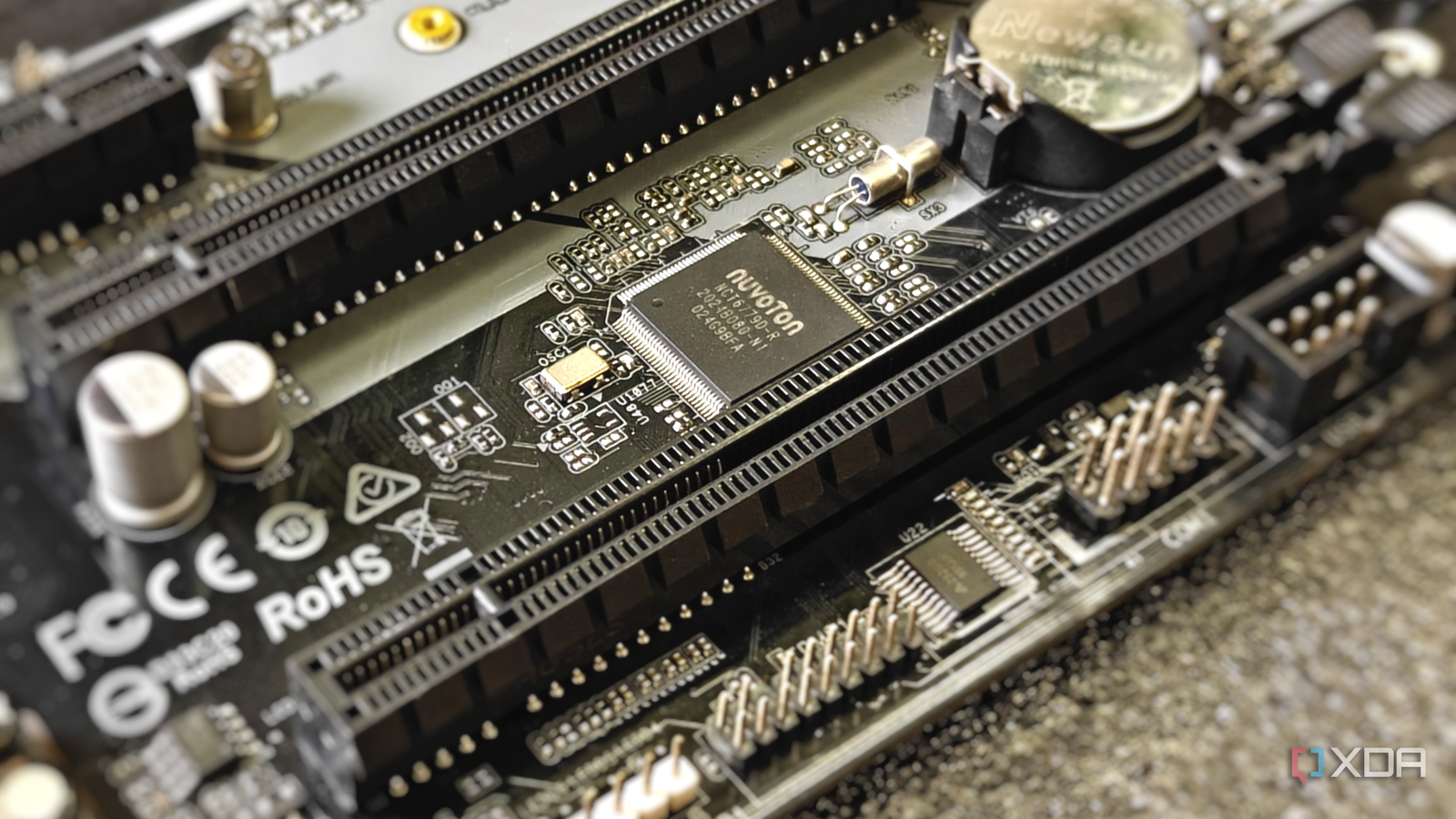
Published Sep 24, 2026, 7:00 AM EDT After a 7-year corporate stint, Tanveer found his love for writing and tech too much to resist. An MBA in Marketing and the owner of a PC building business, he writes on PC hardware, technology, and Windows. When not scouring the web for ideas, he can be found building PCs, watching anime, or playing Smash Karts on his RTX 3080 (sigh). Whenever your motherboard reads a temperature sensor or reports a fan speed, the underlying computation is happening not on your CPU but on a chip that came about back in the 1980s. The Super I/O chip is a dedicated microchip on your motherboard managing low-bandwidth I/O devices. Back then, this meant serial and parallel ports, PS/2 controllers, and floppy disk controllers. These legacy ports are gone from modern PCs, but the Super I/O chip still manages key functions, namely system monitoring and power management. Instead of going extinct with legacy hardware, it evolved to take on newer responsibilities. Super I/O was built for a PC that looked nothing like yours It brought multiple controllers together Credit: Unsplash Before Super I/O chips showed up on computers around four decades ago, expansion cards were used to add basic ports like serial, parallel, and floppy disk controllers via the ISA bus. As manufacturing costs dropped around the late 1980s and early 1990s, vendors started integrating these multi-court circuits into a single Super I/O chip soldered on the motherboard. Gradually, every single one of these jobs became extinct on newer PCs. Floppy disks became museum pieces, parallel-port printers gave way to USB models, and PS/2 keyboards and mice went away, too. The chip that was purpose-built to consolidate legacy device connections should have disappeared along with them, but it has lived on to this day. It picked up newer jobs along the way You probably make use of it everyday Somewhere along the way, the Super I/O chip picked up a second job that eventually became more important than its primary one. Newer Super I/O chips absorbed hardware monitoring duties that they're handling even today. Handling the communication with temperature, fan speed, voltage, and chassis intrusion detection sensors became the job of the Super I/O chip. Over the years, the communication bus changed from the ISA bus to PCI and then to the LPC (Low Pin Count) bus, a simple and low-cost interface. However, the responsibilities of the chip have remained the same ever since. You can find it on your motherboard typically near the PCIe slots — it's a square or rectangular chip with an ITE or Nuvoton label. Super I/O has evolved physically, but remains functionally the same It's not always a dedicated microchip From expansion cards to dedicated microchips on motherboards, the functionality handled by Super I/O chips kept switching form factors. Today, they still exist as discrete microchips, but they can also be found integrated into the primary chipset on some motherboards. On server boards, many management tasks are offloaded to the Baseboard Management Controller (BMC), but a compact Super I/O controller can still be found. On laptops, Super I/O chips are present in the form of embedded controllers, and perform many of the same functions. Since temperature and fan speed monitoring are basic functions on any modern PC, the Super I/O chip will remain on motherboards in one form or another. Modern motherboards have more than a few legacy holdovers The Super I/O chip isn't the only decades-old remnant on modern motherboards. The serial header and PS/2 port can still be found on your PC despite being useless for the average user. That said, they have a reason to exist, whether it's for latency or troubleshooting benefits by enthusiasts and technicians.
Your modern motherboard still needs a chip designed for decades-old PC hardware
Full Article
Original Source
Read the full article at Xda-developers →KhanList aggregates and links to publicly available news content. We do not host full articles from third-party sources. Always verify important information with original sources.