
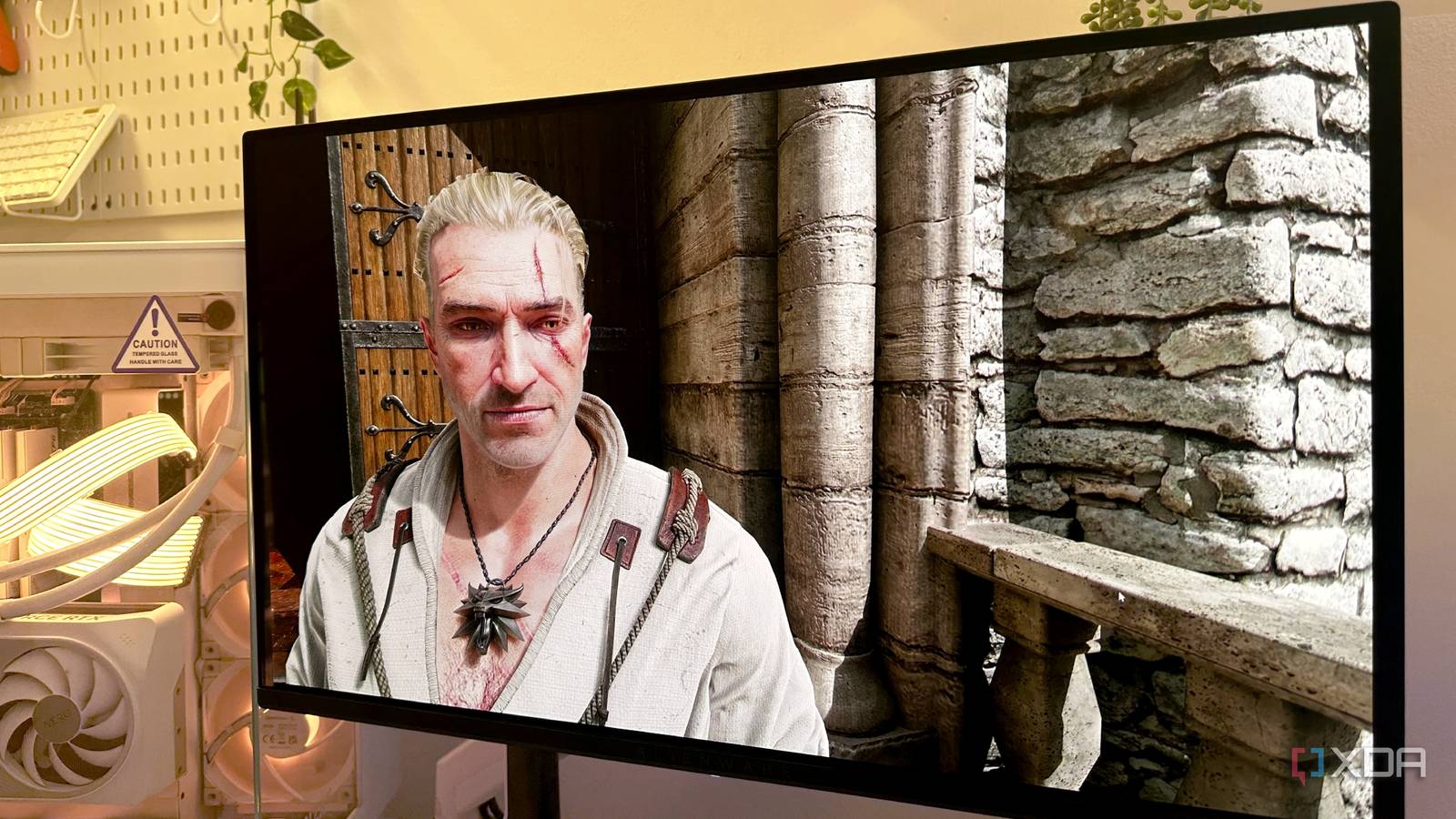
Published Sep 25, 2026, 7:00 AM EDT Gaming has been Samarveer’s greatest passion, and the Literature graduate in him takes immense joy in dissecting games for their themes, messages, and impact. Samarveer holds a deep appreciation of gaming, and considers the platform to be the most immersive and impactful across all media. He can be found engaging with gaming communities online, always ready to debate the finer points of ray tracing or itching to write an 8-page collegiate thesis on any game that impacts him emotionally. Much like any gamer in the world before me, and many after, I, too, have spent years desiring and chasing better graphics. I've obsessed over DLSS modes, ray tracing, frame rates, textures, lighting, and all the other little things that make a game look "closer to reality." As such, it feels rather strange to say this, but DLSS 5 has genuinely made me question whether that pursuit has finally gone too far. From a technical standpoint, DLSS 5 is undeniably impressive. It makes the faces of characters sharper, enriches skin textures, and dramatizes lighting, too. Admittedly, the screenshots look ridiculously impressive, but the more I stare at them, the less convinced I am that I'm looking at "better graphics." Somewhere between photorealism and artificial perfection, something has gone missing. And I think I've finally figured out what it is. Uncanny Valley was never the problem We spent decades trying to cross a line we didn't need to For most of my life, better game graphics have always meant something tangible. They translated to more polygons, better textures, smarter lighting, improved animation, and better materials. Every new generation has given artists new tools for making their worlds more convincing. Games like Death Stranding 2, Cyberpunk 2077, Alan Wake 2, Kingdom Come: Deliverance II, and The Last of Us Part II Remastered are proof that this approach has taken us remarkably far. I can just look at a character in these games and know that I'm looking at an extremely photorealistic person without needing every pore sharpened out of existence. Realism was never really about copying reality, nor should it have been. Instead, it's much more about coherence — where skin, eyes, hair, lighting, animation, and environments all had to agree with one another. We've talked about the uncanny valley for years now as the point where things didn't quite seem right, treating it like a ditch standing between games and photorealism. The uncanny valley was warning us all along that we didn't need to make illusion stronger. Astoundingly, DLSS 5 should make us all understand that the uncanny valley was a warning all along — a warning that adding more detail wouldn't necessarily make the illusion stronger. DLSS 5 changes that equation because previous versions of DLSS were fundamentally reconstruction technologies. They were trying to approximate imagery the renderer was already working toward. Neural rendering, on the other hand, introduces something entirely different in the form of an AI model that can contribute to the final appearance itself. It synthesizes visual characteristics that weren't explicitly rendered by the game in the first place. It's important to understand that DLSS 5 isn't just another jump in image quality. We aren't asking the renderer to execute an artist's vision with greater fidelity anymore. In asking a learned model to interpret what that vision should look like, the question thus becomes whether crossing the uncanny valley should have been the goal of game graphics in the first place. The other side of the valley isn't reality — it's just worse More detailed faces, less convincing graphics I use DLSS 5 on my RTX 4070 Ti-powered PC with the right mods, but the more I use it, the stranger it gets. Nvidia's Neural Rendering layer gives characters more pores and sharper facial detail, and there's no denying the improvement in lighting. And yet, I often find myself staring at a face that looks like it has been run through an extremely expensive beauty filter. Everything is technically richer, but it's all the graphical equivalent of someone discovering Photoshop and immediately going hard on the clarity slider. Officially, DLSS 5 is exclusive to Blackwell-era RTX 50-series GPUs. However, Nvidia has promised that the neural rendering layer of DLSS will come to RTX 40-series in due time. With DLSS 5, there are no obvious artifacts to speak of, which is what makes it all harder to dismiss. When DLSS 5 works, it looks remarkably clean. But realism isn't a checklist where enough pores, wrinkles, and skin highlights eventually unlock "human." Real faces are messy, asymmetrical, and above all, inconsistent. These imperfections make faces recognizable in the first place — they aren't waiting around for AI to restore some missing detail. That's where I think we've stumbled into a second uncanny valley. The first made characters look almost human. The second one, with DLSS 5, makes them look almost AI-human: polished, hyper-detailed and strangely uniform. Different games can start drifting toward the same visual idea of what a perfect face should look like, regardless of the artistic identity that made those characters distinct. And this is why I don't particularly care whether future versions eliminate every wobble or artifact. If the technology eventually becomes flawless at producing this aesthetic, it only perfects my argument instead of disproving it. Graphical beauty shouldn't come at the cost of AI sloppification Perhaps the future of games shouldn't be a race toward photographic reality I could talk for hours about how "photoreal" games like Forza Horizon 6 could never be nearly as much fun as hyper-stylized games like Driveclub or Split/Second, and that's only because the former chases something that's inherently boring. It's easy to say DLSS 5 will get better, and we all know that it will. Models will become faster, artifacts will basically disappear, and developers will gain more control, with today's rough edges becoming history much like DLSS 1 and DLSS 2's problems. However, none of that addresses my objection. I'm not arguing that neural rendering is unfinished, by any means. I'm simply questioning the destination. Game graphics never needed to be like photographs to be convincing. What matters is whether everything on screen feels like it belongs together. I'd rather have better facial animation, expressive eyes, body language, reactive and destructible environments, and movement than a layer of neural polish making a screenshot look like a still. Game graphics never needed to look like photographs to be convincing. That's the trap in calling every improvement "better." More detail is measurable. More realism sounds measurable. But artistic quality isn't a benchmark score. If every game shares the polished interpretation of a face, we've gained fidelity while losing identity. That's what the uncanny valley had been trying to tell us all along. The goal was never to make games indistinguishable from reality, after all. The real goal was to make worlds believable enough that we stopped thinking about the rendering altogether, and I think on that front, we had all already won. A reminder that the best graphics have never been polarizing I don't think the allure of better graphics will ever stop. That's half the fun of being a PC gamer. I'll still enable every ridiculous setting that makes my GPU buckle, pixel-peep like my life depends on it, and I'll always be happy to sacrifice frames to see what a new rendering technique can do. And yet, I don't want every technical breakthrough to drag games closer to the same definition of perfection. There was something wonderful about graphics having a little restraint. A character could have imperfect skin, slightly exaggerated features, or lighting that wasn't physically flawless, and somehow that made the world feel more intentional. That's the future I'm actually hoping for, where games don't try to fool me into thinking they're real but are just so confident themselves that I forget to ever ask.
DLSS 5 crosses the uncanny valley — and what's on the other side is worse
Full Article
Original Source
Read the full article at Xda-developers →KhanList aggregates and links to publicly available news content. We do not host full articles from third-party sources. Always verify important information with original sources.