
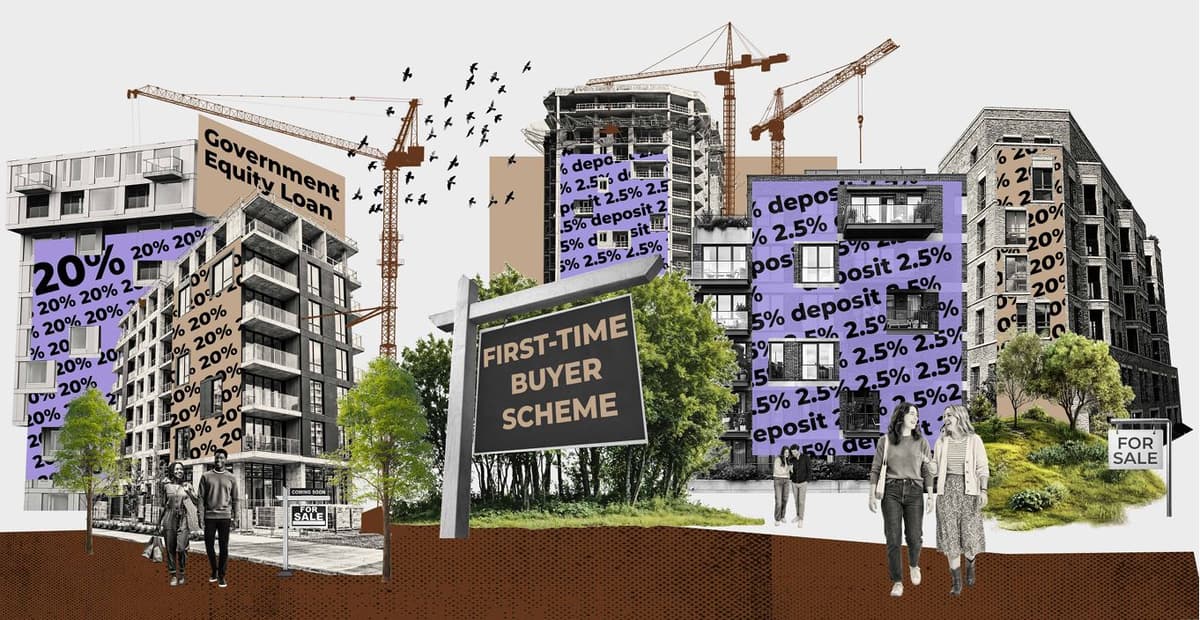
London’s property market has been marked by a distinct lack of optimism in the past few years. For no-one has this been more true than aspiring first-time buyers without family money to help them onto the ladder, and for the capital’s housebuilders facing down the triple threat of decreased demand from said buyers, increased construction costs and a raft of new legislation.So can Your First Home, announced in the Budget today and promising first-time buyers with a 2.5 per cent deposit and backed by a 20 per cent government loan on a new-build property, reinvigorate the capital’s stalled market and help ease the ongoing housing crisis?The announcement has certainly given a ray of hope to the capital’s young private renters, many of them on decent salaries (necessary to pay London rent) but struggling to save for a deposit (that rent again).“The option for a 2.5 per cent deposit is really quite exciting because saving is definitely the biggest hurdle,” says Rosie, 29, a conference organiser who currently rents a one-bedroom flat in Clapham with her boyfriend costing more than £1,000 per month each plus bills. This equates to between 35 and 40 per cent of her take-home salary.“I look at properties for sale frequently but I find it quite disheartening when I think I’m looking within a realistic budget and then work out the deposit we would need to save to afford it. It can be quite upsetting. A lot of my friends have also given up thinking about it, and others have moved really far out of London and are commuting from places like Birmingham.”Your First Home promises first-time buyers with a 2.5 per cent deposit a 20 per cent government loan on a new-build propertyThe London StandardThat includes people like Abigail, 29, a native Londoner who recently moved to Manchester with her partner. They are currently paying the equivalent rent for a two-bedroom flat in the city centre as they were paying for one room in a house share in London. But, while Abigail’s partner is from Manchester originally, both of them would prefer to settle in London.“I’m from London and it is where my friends and family and support network is, as well as the most exciting job opportunities,” she says. “But I’ve moved every year or two with renting and we’d like to start a family and put down roots in a community, so our goal is to buy somewhere in the near future. That has felt impossible in London.“We’re both on decent salaries but neither of us have family help. We try to save what we can but I pay about 36 per cent of my salary on rent alone. From that perspective, Your First Home looks quite exciting.”Almost two thirds of aspiring buyers in London are hopeful that the scheme would help them on the ladder sooner, according to research from Fairview New Homes.However, separate data from mortgage broker Tembo has warned that the scheme threatens to lock out those with lower household incomes, who cannot borrow enough to cover the remaining 77.5 per cent of the purchase price. The broker found that lower earners would need a mortgage 9.9 times their income in the capital, potentially possible for a couple, but out of reach for many single buyers.Chancellor of the Exchequer John Healey delivering his Budget in the House of CommonsPA“The mortgage is definitely the bigger sticking point for me as a single person,” says Kyle, 32, who works in PR and shares a flat near Oval with a friend, paying just under £1,000 per month in rent plus bills. “Like a lot of people my age, I’m living paycheck to paycheck, month to month. I’m lucky enough to have some money saved from relatives, but even with that I would struggle to get a mortgage alone. The majority of my friends who have bought have done it with two incomes, so it does feel stacked against single people.“At some point I would have to consider moving out of London to somewhere more affordable but I moved to London for a reason, I’ve built a life here, if it’s going to be possible I would 100 per cent like to stay. I’m optimistic, and hearing about Your First Home has been encouraging.”Under the scheme first-time buyers with a 2.5 per cent deposit can access a 20 per cent government-backed equity loan, interest-free for five years, to buy a new-build property from a registered developer. The purchase price will be capped at £650,000 in inner London and £500,000 in outer London and the household income of potential buyers cannot exceed £140,000 in the capital. Pre-registration will open in December this year with full applications allowed from February 2027 and first loans issued that April.Read MoreAnnouncing the scheme as part of his autumn Budget, Chancellor John Healey said: “Two in five young people are trapped paying more than a third of their income on rent while they watch their hopes of buying their own home slip away. For every young person who's working hard, saving what they can and dreaming of their first home, I'm taking action.”The Government also hopes that by boosting buyer demand it can boost the housing market and encourage developers to build more housing. Only 6,325 new private sector homes were started in London between mid-2025 and a year later, just seven per cent of the Mayor’s overall annual target. Meanwhile just 600 new homes were sold to individual buyers in London in the first quarter of this year, according to Molior London data.First-time buyers have had little help since Help to Buy closed in October 2022. Under that scheme London buyers with a five per cent deposit could get a government equity loan of 40 per cent on a new home costing up to £600,000.The capital’s leading developers have welcomed the new scheme as a step in the right direction.“With this new offer the lower deposit element is an absolute game changer. People want to get out of renting and even with a 20 per cent loan this is going to help,” says Joe Antoniazzi of London Square. “But the 40 per cent loan that was on offer in London last time really helped affordability and made the mortgage payment and service charge much more competitive compared to rent.”Many have expressed reservations about the efficacy of the scheme in isolation. The price caps will put only around a third of homes for sale in the capital within reach of buyers, according to estimates from property consultancy Montagu Evans.Will Your First Home invigorate London’s property market?AFP/GettyOther hurdles to building in the capital including the high cost of materials and labour, and the large delays and additional costs caused by new regulation.“The housing crisis in London is a multi-headed beast. You need to deal with all aspects of that simultaneously in order to kickstart what is a completely stalled engine,” says Tom Goodall of Related Argent.“Clearly demand-side stimulus is a very important part of that, and so we very much welcome the concept of it, but is it going to encourage us to build more? Not in isolation.“The other main head of the beast is cost. Costs have risen well over 50 per cent in 10 years, while values have risen less than five.”Craig Carson, regional managing director, Barratt London, adds that in order to be effective Your First Home will need to be simply administered and ideally to be guaranteed to run for at least five, ideally 10 years, to account for the building pipeline.Lessons to learn from Help to BuyBuying agent Nina Harrison advises potential Your First Home buyers to avoid paying over the odds, taking lessons from Help to Buy when, she says, some developers “pushed prices towards the artificial thresholds set by the Government”.Jess Parkinson and Elliot Fitzpatrick paid £460,000 for their first home, a two bedroom flat in Crystal Palace, thanks to a 40 per cent equity loan from the Government in 2019. In 2022 the couple were ready to move out of London, put the flat on the market and got an offer for the full asking price — £475,000. Unfortunately the deal didn’t progress. Then came Liz Truss’s disastrous mini budget which caused interest rates to spiral — and prices started to flag.Eventually, they accepted an offer of £450,000 — £10,000 less than they had paid for the flat.“We accepted partly because we needed to sell within five years because after that we would have had to start paying interest on our Help to Buy loan,” says Jess.Looking back, Jess feels the flat was over-priced because it was part of the Help to Buy scheme. Despite all this Jess doesn’t regret using Help to Buy on the basis that it gave her a secure, affordable home in London for five years. They are now happily settled in a three-bedroom 1960s semi in Faversham, Kent, which is more than twice the size of their old home and cost £325,000.Ruth Bloomfield
Your First Home: Will Budget move get Londoners on the ladder?
Full Article
Original Source
Read the full article at Standard →KhanList aggregates and links to publicly available news content. We do not host full articles from third-party sources. Always verify important information with original sources.