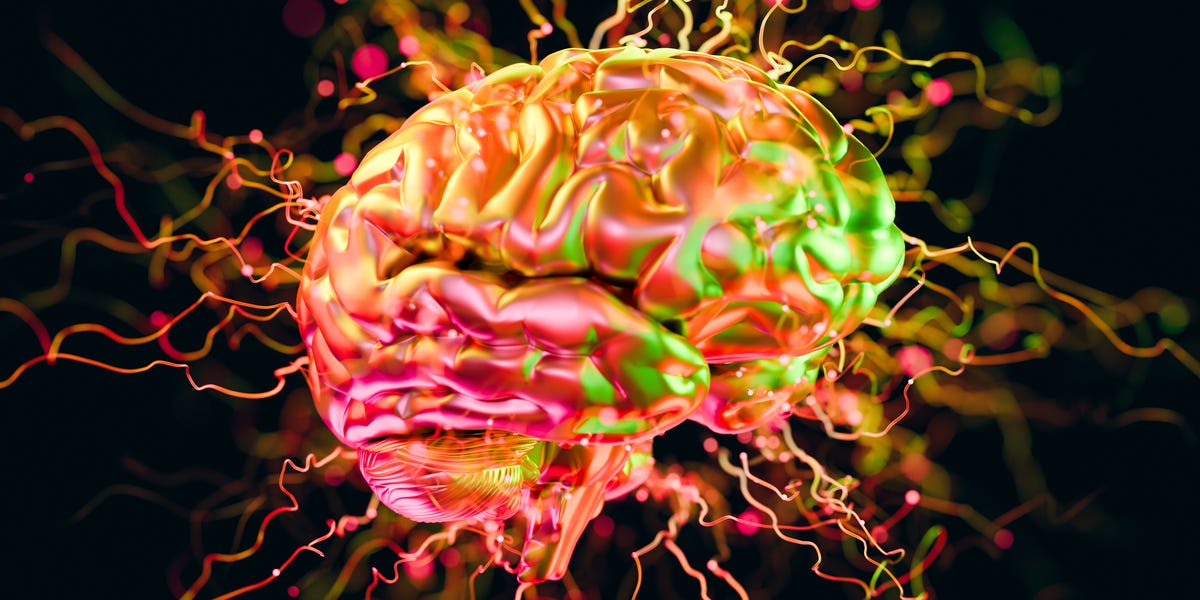
5 min readOur brains have evolved to construct a version of reality that actively fills the gaps in our perception.Perception can also be socially shaped, and so we tend to depend on other people to reinforce the same “map” of the world. This can stabilize or distort perception.Independent thinkers and diverse viewpoints help prevent groups from such distorted groupthink.Your Brain Curates Its Own RealityIt turns out our brains create an illusion of reality based on both our previous experiences and the evolutionary design of our primary visual cortex. Located at the back of the brain, where it receives signals from our eyes, this first layer of image sensing (called V1) doesn’t just take pictures. In fact, it helps decide—if not dictate—what we see.And that’s crucial, because this design enables our ability to make decisions quickly based on how we perceive the world around us. Otherwise, we might spend too much time trying to recognize important stimuli in our environment, such as danger, scientists say.In a study, assistant professor of neuroscience at Seoul National University Hyeyoung Shin, PhD, and her colleagues zapped the brains of six mice with ultra-precise holographic lasers, targeting a tiny cluster of cells in V1. They asked whether sparking those cells alone could make the brain “see” something that wasn’t really there.The animals’ brains lit up as if they were seeing phantom shapes, like the Kanizsa triangle, where Pac-Man cutouts trick you into seeing a triangle that isn’t there. The team baptized these cells “IC-encoder neurons,” because a spark from them can ripple outward, recruiting tens of thousands of other neurons to finish the picture.This kind of pattern-filling in V1 isn’t brand new; past studies showed the brain works less like a camera passively relaying signals, and more like an intelligent guesser filling in information gaps. In this novel study, though, Shin’s team identified the exact cluster that actively broadcast illusions and drove the process. Shin says she hadn’t expected this “filling-in” to happen so early, right in the brain’s first visual processing area.That means reality is in the eye of the beholder. It implies that “perception is not a direct recording of reality, but a process of inference,” says Shin. In neuroscience, inference means the brain makes its best guess about what’s out there—filling in perception gaps and leaning on past experience. She’s quick to dismiss going so far as to call reality a “controlled hallucination,” though, since hallucination means making up things that aren’t there. “Instead, illusion—and perception in general—is the brain interpreting sensory evidence based on your beliefs about the sensory world,” she says. It turns out that the more our sensory worlds overlap, the more we share the same “predictive code.”“Our brains do create reality, at least the only reality that any of us can ever know,” says James Hyman, PhD, a psychology professor at the University of Nevada, Las Vegas. “The brain isn’t trying to give us the ‘true’ picture of the world; it’s trying to give us a useful one. What matters most is survival.” A monkey swinging through trees doesn’t analyze every line—it assumes brown is branch and green is not. That shortcut works because branches hold weight and vines don’t—but if snakes curl along branches, detail becomes critical, he says.The obvious question is: can we really trust our consciousness to tell us the truth, or is it just spinning the most useful story? Perhaps we’re doomed to never know, because we’re trapped by our survivalist brains.... But Reality Can Be a Shared HallucinationWhat if the 1978 Jonestown cult’s mass suicide was not just a collapse of judgment, but a collapse of reality itself, a moment when a group slipped into what he calls a faulty shared model of the world? Leader Jim Jones had conditioned more than 900 followers to believe that collective death was their only escape from persecution, persuading them that dying together was a revolutionary act.In other words, it was a kind of socially synchronized hallucination, says Chris Frith, PhD, a professor of neuropsychology at the Wellcome Centre for Neuroimaging at University College London. “We are conscious not of the physical world—but of our model of it,” he says. It’s a claim he developed in his 2025 paper in the peer-reviewed journal Open Mind. In this light, what failed in Jonestown was not simply morality, but the internal map of the world that nearly a thousand people were using to orient themselves.What feels like solid, unquestionable reality is not a direct window onto our environment. Instead, as we move, learn, and interact, our brains automatically build a mental model of the world. That model is similar across different individuals, because we are all navigating the same physical environment and constantly fine-tuning our mental maps using one another.But when a group starts reinforcing a distorted version of that shared map, entire communities can end up living inside a constructed world that no longer matches the one outside it.Long before language, brains had to solve a simple but profound problem: how to move safely through space without crashing into other moving creatures. The solution was to build stable internal maps of the environment, ones that persist even when no one is looking. In fact, no single brain successfully produces the feeling that the world is solid and truly “out there.” Reality is socially anchored—it feels real because the physical bodies of other individuals are a continual confirmation for our brains.This is why Frith believes isolation is so destabilizing. Cut off from others, internal models no longer have a natural stimulus, and isolated people can slide into hallucination, derealization, and depersonalization. We might even call this an altered state of reality, caused not by hallucinogens, but by extreme drift away from the shared-world map.The danger comes from too many minds locking onto the same local (virtual) map. It causes a strain on the brain systems that normally keep our shared world feeling steady. However, having people with diverse views and opinions helps protect the group from veering too far into unreality.If extreme isolation can loosen reality for an individual, so does over-conformity to a group. That’s why every society needs its “odd one out.”“Some people are genetically less socially influenced,” Frith says. These are the people questioning reality and stemming the tide of blind consensus. Think about the famous Asch conformity experiments, where participants had to judge the length of lines shown on cards. Most people conformed about one-third of the time, even when the truth was obvious. But when just one person dissented—when even a single voice gave the correct answer—conformity collapsed, and participants almost always trusted their own perception again.If only one such “odd one out” in the Jim Jones group could have done the same in November 1978.Stav Dimitropoulos contributed to this article.
Your Brain Distorts Reality, Groundbreaking Research Shows—Putting You at Risk of Dangerous ‘Shared Hallucinations’
Full Article
Original Source
Read the full article at Popularmechanics →KhanList aggregates and links to publicly available news content. We do not host full articles from third-party sources. Always verify important information with original sources.