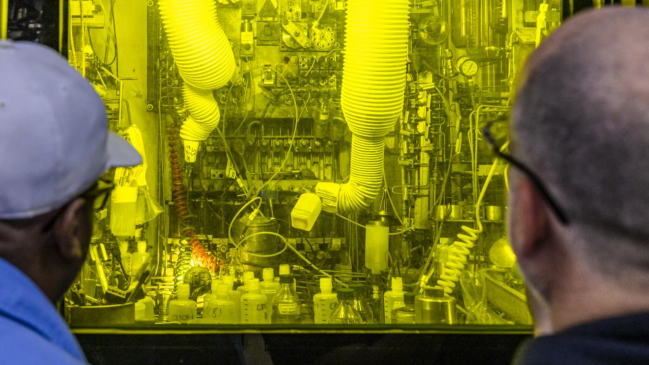
A new chemical process developed at a US national laboratory could save a week or more from the production schedule for californium-252, a rare radioactive isotope used to start nuclear reactors and support a range of industrial and national security applications. Oak Ridge National Laboratory (ORNL) is currently the only producer of californium-252 in the Western world. The laboratory expects demand for the neutron-emitting isotope to increase as the US expands its nuclear energy ambitions and new reactor technologies move toward deployment. The isotope is used to initiate nuclear reactor startup and analyze fresh reactor fuel. It also has applications in oil well logging, coal analysis, instrument calibration and security systems. ORNL produces the isotope for an industrial consortium that manufactures and distributes the finished, sealed radioactive sources to customers around the world. Nuclear expansion could drive demand The expected increase in demand is linked in part to US plans to expand domestic nuclear power. Federal policy calls for additional nuclear capacity, including efforts to begin construction of 10 new large reactors by 2030 and increase the maximum operating power of existing reactors. Several companies are also developing small fission reactors that could use californium-252 during startup. Separately, an executive order has directed the US military to deploy a nuclear reactor at a domestic Army base within the next two years. The isotope is already used beyond conventional power generation. National security applications include fuel rod scanners and port security systems, while industrial users rely on californium-252 for applications such as oil well logging, coal analysis and instrument calibration. ORNL Cf-252 Program Manager Samantha Schrell said the laboratory is therefore looking to significantly increase production output. “This is an exciting new chapter in Cf-252 production,” Schrell said, describing the effort as an attempt to improve heavy-element production while increasing the laboratory’s internal efficiency. A decade-old idea could save a week ORNL currently produces californium-252 on a two-year cycle. Schrell examined whether annual production campaigns would be more effective, but concluded that the approach would not make economic or operational sense because of costs, limited hot-cell capacity and the isotope’s relatively short half-life. Instead, the laboratory is looking at ways to increase output through more efficient processing. One of the most promising changes originated nearly a decade ago with radiochemist Lætitia Delmau. During a californium-252 separation campaign in 2015, Delmau considered whether a different solvent extraction technique could eliminate a lengthy step in the process. For decades, ORNL had used bis-diethyl hexyl phosphoric acid, or HDEHP, to separate trivalent actinides and lanthanides from solutions created by dissolving irradiated targets. These elements are produced alongside californium-252 and need to be separated during processing. The existing method requires the acidity of the solution to be substantially reduced before the extraction can take place, and that adjustment can take approximately a week. To test the idea, Delmau obtained a small sample of waste solution from an ongoing production campaign. The material was diluted sufficiently to reduce its radioactivity so it could be studied in a glovebox rather than inside a heavily shielded hot cell. The experiments formed the basis for a new processing approach that could make future californium-252 production campaigns significantly more efficient.The discovery is significant because californium-252 is difficult to produce and has applications that extend from nuclear energy to national security and industrial operations. As the US looks to expand its nuclear fleet and develop new reactor technologies, increasing the efficiency of the world’s Western supply of the isotope could become increasingly important.Recommended ArticlesGet the latest in engineering, tech, space & science - delivered daily to your inbox.Bojan Stojkovski is a freelance journalist based in Skopje, North Macedonia, covering foreign policy and technology for more than a decade. His work has appeared in Foreign Policy, ZDNet, and Nature.
US lab’s new technique could accelerate production of critical nuclear isotope
Full Article
Original Source
Read the full article at Interestingengineering →KhanList aggregates and links to publicly available news content. We do not host full articles from third-party sources. Always verify important information with original sources.