
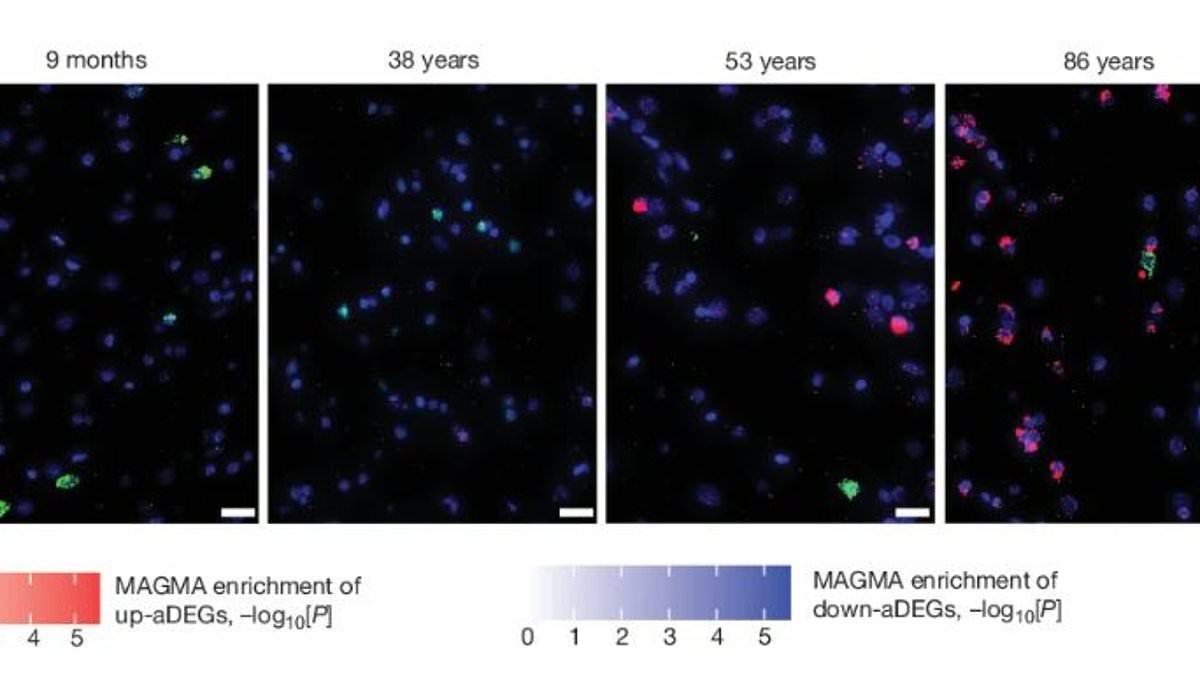
Your brain 'changes gear' twice in your lifetime, according to the results of a massive new study.Scientists studied more than 1.3 million brain cells from donors ranging from infancy to 97 years old to map the prefrontal cortex, the region where decisions are made and memories are formed.They discovered that the brain goes through two major organisational changes – one at 24 when it matures and another at 60 when the effects of ageing become more apparent.Co–author Dr Kiran Girdhar, of the Icahn School of Medicine at Mount Sinai, says: 'This atlas provides an essential reference for understanding healthy brain ageing at the molecular level.'During infancy and the teenage years, the researchers found that a mixture of different cells changed rapidly as the brain formed new connections and reorganised.However, they found that there is an 'unexpected inflexion point' around the age of 24 when the rate of change suddenly falls.From this point onwards, the prefrontal cortex is marked by relative stability until we hit the age of 60.After 60, the brain changes again and the cells responsible for maintaining and protecting the brain become much more active. Researchers have found that the brain 'shifts gears' twice in your life, once around 24 when it matures and again at 60 when ageing becomes more apparent. Pictured: Samples of brain tissues tested in the studyThese results are part of an ambitious project called PsychAD, which aims to create an unprecedentedly detailed map of the human brain.Across the entire project, scientists have analysed the cells from nearly 1,500 donated brains, looking cell by cell for the subtle signs of ageing and disease.In this study, the researchers looked at the genes inside different brain cells taken from various points in the human lifespan.By looking at a type of genetic material called RNA, they were able to see which genes are active and work out what the cells are doing at different points in our lives.This revealed three distinct periods of activity: a wave of rapid development in childhood, followed by a period of stability through adulthood, and a series of changes at the molecular level as ageing takes effect.These findings are similar to the results of a study published last year by researchers at the University of Cambridge that compared thousands of brain scans from people of different ages.That research found that the brain rapidly rewires itself through childhood before settling into a more organised, efficient structure and becoming stable by the age of 32.The difference with this new research is that RNA testing allows researchers to see what is happening right down to the molecular level of individual cells.Previous studies have also shown that the brain's structure stabilises during adulthood (pictured) as the formation of new connections slows The brain's three key stages 0–24: Rapid cellular remodelling during early development. The proportion of cell types changes quickly as new connections form.24–60: A period of relative stability. The brain's structure remains mostly unchanged, and cell activity settles into a 24–hour schedule.60 onwards: Molecular changes take place at the level of individual cells as the effects of ageing become more pronounced. Cells are more active in repairing damage and maintaining the brain. This showed that it isn't just the brain's structure that changes, and there are also massive changes in function – particularly to the internal clock.In young adults, nerve cells that are related to planning, memory making, and decisions tend to follow a clear 24–hour timetable.These critical cells are predictably more active at various parts of night and day, but this pattern starts to break down once we hit 60.Dr Girdhar says: 'In young and middle–aged adults, neurons exhibit tightly coordinated 24–hour rhythms governed by core circadian clock genes.'After age 60, those neuronal rhythms largely disappear, while the brain's immune cells acquire new rhythmic activity associated with cellular stress and inflammation. The brain does not simply stop keeping time—it changes what it is timing.'In particular, the researchers found that the brain's immune cells and the cells that insulate nerve fibres became more active in dealing with damaged proteins – which can lead toward disease – in the evenings.'That reference will help researchers determine when and where disease processes begin to diverge from normal biology,' Dr Girdhar says.This study is one of nine new papers published using the results of the PsychAD efforts to map the prefrontal cortex.One of those papers presents combined data from 6.3 million individual cells to map the progression of diseases including Alzheimer's disease, Parkinson's disease, Lewy body disease, vascular dementia, schizophrenia and bipolar disorder.Meanwhile, another study might help to explain why some people with Alzheimer's retain their mental abilities despite having clear signs of the disease in their brains.Despite patients having high levels of the toxic protein tau, a key sign of the disease, some had differences in how their nerve cells and protective cells functioned under stress.These differences could help critical nerve cells survive the damage, potentially revealing why some people are more resistant to Alzheimer's than others.Lead author Professor Panos Roussos, of the Icahn School of Medicine at Mount Sinai, says: 'These highly complex brain disorders impose an enormous public health burden, yet we still have a limited understanding of the molecular mechanisms that drive symptoms, progression, and resilience.'By mapping shared and distinct cellular programs across Alzheimer's disease, related dementias, and psychiatric disorders, PsychAD creates a framework for moving beyond traditional diagnostic boundaries toward precision approaches for target discovery, biomarker development, and therapeutic prioritization.'
Your brain 'changes gear' TWICE in your life - once at age 24, and again at 60, study finds
Full Article
Original Source
Read the full article at Dailymail →KhanList aggregates and links to publicly available news content. We do not host full articles from third-party sources. Always verify important information with original sources.