
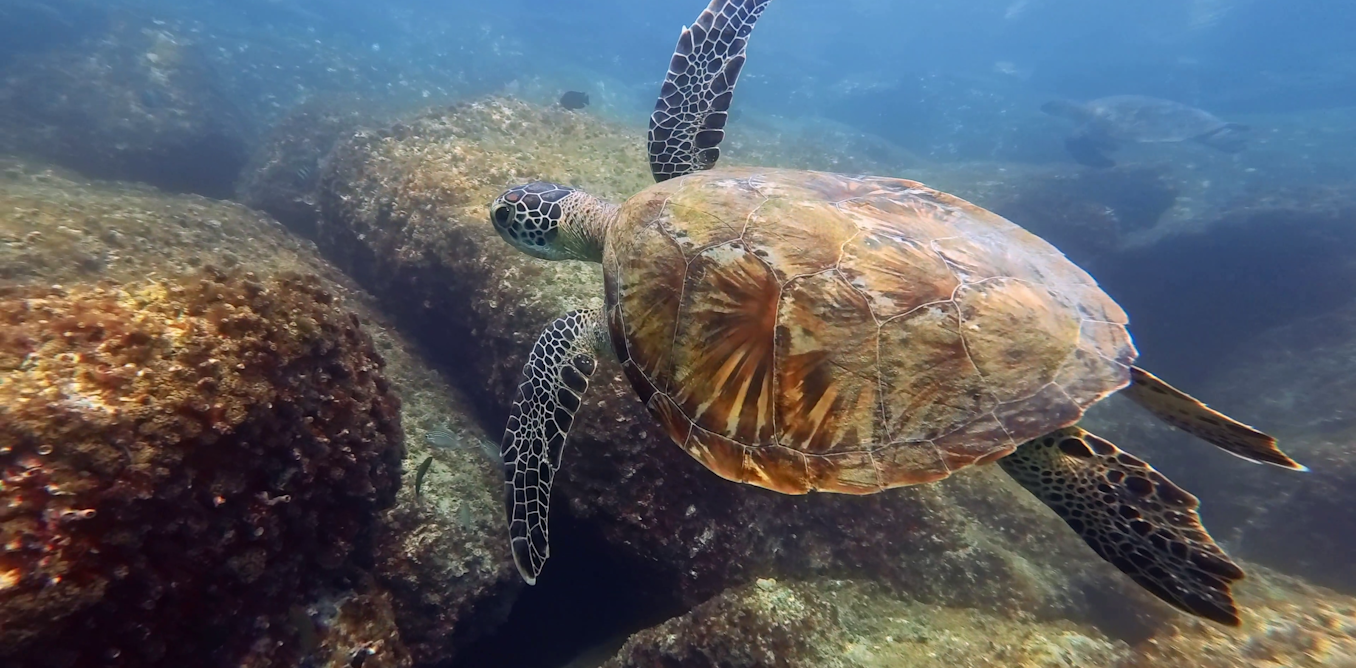
Coastal wetlands, such as mangroves and saltmarshes, are rapidly disappearing yet they are incredibly important for young turtles. In a new study, my colleagues and I used satellite tags to track young green turtles in a protected wetland in Sharjah, UAE. Our results reveal just how important these remaining natural spaces are to young turtles. But we also found that nature can find a way to thrive in unexpected, human-made environments too. So protecting these habitats and the connections between wetlands, artificial environments and the open sea is essential to ensuring wildlife can persist in an increasingly human-shaped world. Coastal wetlands protect our shorelines from storms, store carbon and provide important nursery habitats for marine life. Yet scientists still know surprisingly little about how marine wildlife, including turtles, sharks and rays, use these environments. Knowing where these animals feed, shelter and move helps identify which areas need protection and whether existing protected areas are working. Our study, a collaborative effort between the Environment and Protected Areas Authority (EPAA), a UAE government agency, the University of Exeter and the Sharjah Marine Science Research Centre, focused on Al Qurm Wa Lehhfaiiah, a marine protected area encompassing the last major coastal wetland ecosystem on the UAE’s east coast, which is called Khor Kalba. Arabian collared kingfishers are native to the Khor Kalba region on the east coast of the UAE. John Pereira Its complex wetlands support migratory wading birds, numerous fish species and the Arabian collared kingfisher, a subspecies found only in this region. Young green turtles also swim through its winding mangrove channels. Although the wetland is now protected and recognised as a Ramsar site, a type of conservation designation for any internationally important wetlands, it has not escaped human development. The city of Kalba surrounds much of the site, and a large human-made basin (like a lagoon) was built alongside the natural mangroves in the early 2000s as a proposed recreational and commercial waterfront. The basin was never used for its intended recreational purposes and has since been incorporated into the protected area. To understand how young turtles use this unusual landscape alongside the natural mangrove channels, EPAA staff carefully captured nine juvenile green turtles in 2019 and attached satellite tags to their shells using a specialist, harmless resin. After the turtles were released, the tags allowed us to follow their movements. After seven months and over 2,800 satellite locations the results were clear. We found Kalba’s wetlands were a critical habitat for all nine turtles. They generally stayed within just 2 miles of the wetland entrance and spent more than 80% of their tracked time inside the marine protected area’s boundary. The manmade basin extends from the mangroves and is now an unlikely home to young green turtles. Owen Exeter Basin benefits One of the more surprising findings was the popularity of the human-made basin (similar to a saltwater lagoon extending from the mangroves). The turtles were around five times more likely to be found there than elsewhere in the wetland, and 77% of their core-use areas were concentrated within it. We cannot say for certain why the turtles favoured the basin. One possibility is that algae growing on its floor provides food, while its enclosed layout may offer shelter from larger predators. Whatever the explanation, the findings suggest that wildlife can make use of human-modified environments. However, this is no substitute for protecting natural habitats. Where coastal environments are modified or restored, designs that retain natural habitats, maintain connections between them and preserve the ecological processes they depend on may offer the greatest benefits for wildlife. The mangrove channels. Brendan Whittington-Jones One turtle eventually embarked on a very different journey. After remaining in the wetland for 93 days, it travelled over 500 miles to Masirah Island in neighbouring Oman. This remarkable journey highlights how a small coastal wetland can be important to young turtles before they move into wider waters. But the study also revealed a gap in protection. The main natural channel connecting the ocean to the mangroves and basin currently lies outside the marine protected area. Although the turtles used this channel less frequently overall, they gathered there at low tide, possibly waiting for rising water to allow them to move back into the wetland. Extending protection to include this connecting channel could therefore strengthen the conservation value of the entire system. Our findings underline the importance of protecting natural coastal wetlands. The human-made basin may offer unexpected benefits, but the natural mangrove channels and their connection to the sea remain essential parts of the wider ecosystem. As coastal development continues around the world, understanding how wildlife uses both natural and modified environments can help us make better conservation decisions. Protecting the remaining wetlands at Kalba, including the connections between them and the ocean, is an important step towards securing a future for the young turtles that depend on them.
Young turtles find refuge in both natural and artificial wetlands in UAE – new study
Full Article
Original Source
Read the full article at Theconversation →KhanList aggregates and links to publicly available news content. We do not host full articles from third-party sources. Always verify important information with original sources.