
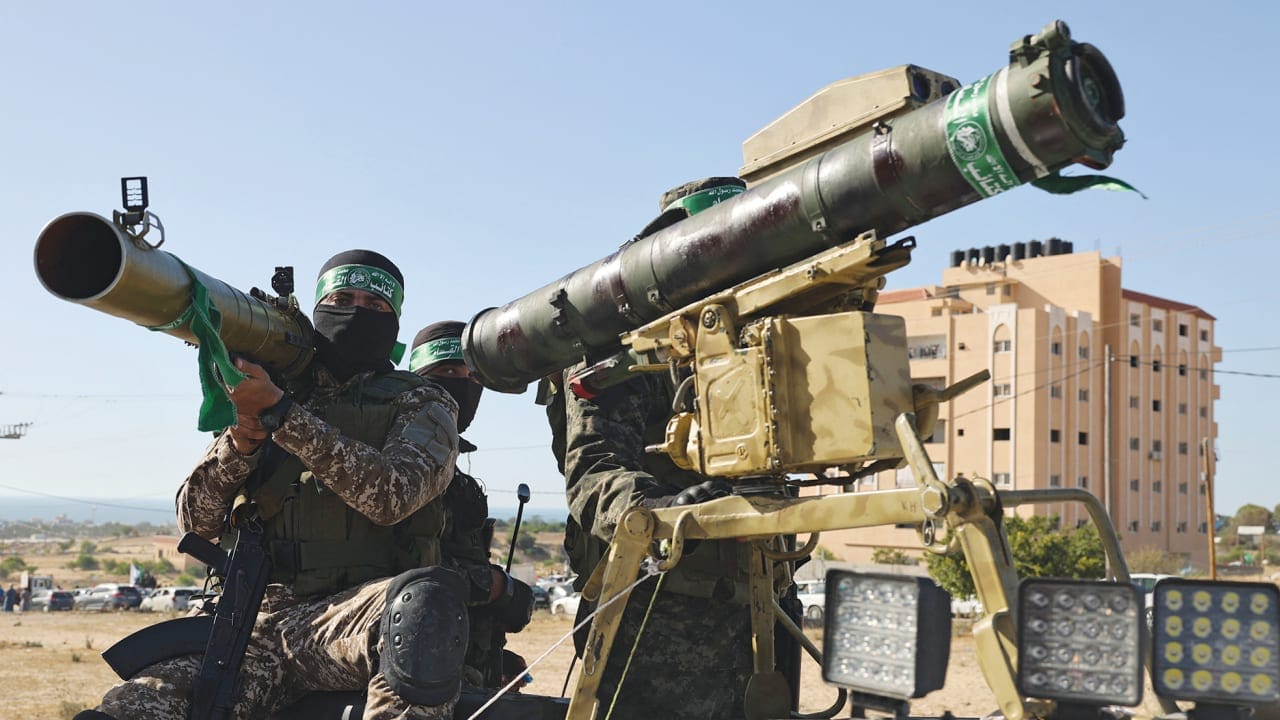
NOVEMBER 13, 2026 12:53Terrorism has morphed in myriad ways, making it more challenging than ever to analyze and defend against, Assaf Moghadam, the new head of the International Institute of Counterterrorism (ICT) at Reichman University, recently told The Jerusalem Post in an exclusive first interview since taking the job.Moghadam joined ICT in 2011, served as ICT’s director of academic affairs, and led the Lauder School of Government, Diplomacy and Strategy as dean from 2019 to 2024.He heads the university’s MA Program in Counterterrorism and Intelligence and its BA track in Security Studies and Counter-Terrorism.The new ICT director came from the US Military Academy at West Point, where he directed terrorism studies, and has held fellowships at Harvard and taught at Columbia, West Point, and UMass Lowell.Replacing Boaz Ganor, who is now the university's president but founded ICT in 1996, Moghadam’s research and multiple books have covered terrorism, global jihad, insurgency, relations between militant organizations, and proxy wars.Assaf Moghadam. (credit: ELLA FAUST)In his interview with the Post, Moghadam traced the recent evolution of terrorism in its broader context along four trajectories, each of which involved the erosion of a former boundary of what constituted terrorism.How AI is lowering the barrier to terrorismThe first trajectory is how artificial intelligence and technology are changing terror and eroding an age boundary.“Regarding the impact of AI and technology, technology has always had an impact on terror. Since time immemorial, terrorists have availed themselves of the latest technology to try to overcome their enemies,” said Moghadam.Next, he said, “It becomes a cat-and-mouse game. AI affects terrorists, but also counter-terrorists. For terrorists, it lowers the barrier of entry into terror.“Social media started this to some extent. With the advent of AI, the barriers were reduced even more. Various tendencies lead to persons becoming radicalized to terror. Terrorists are also getting younger,” he warned.Further, he stated, “Take suicide bombers in the Israeli-Palestinian conflict. ‘Young’ used to be 18- to 19-year-olds. Now radicalized 12- to 13-year-olds are involved in terror. In Europe, there is radicalization involving even younger children. It is no longer surprising to see 12- to 13-year-old-focused plots.”Far-right, far-left and jihadist ideologies convergeThe second new trajectory is the change in what kind of people become terrorists and the erosion of the lines between what their ideologies tend to be, also known as “the diversification of terrorism.”He told the Post, “Terrorism is becoming increasingly diverse.… Perpetrators traditionally were classic terror organizations like al-Qaeda or ISIS. Now, there is a much broader spectrum. There are lone actors. There is obviously greater involvement of states. There are informal networks.“The spectrum of people who could join terror groups is much broader. There are not merely formal terror organizations, but a multitude of organizations with all kinds of different forms and groupings and different motivations for their terrorism,” cautioned Moghadam.Moreover, he stated, “There have always been different motivations and ideologies. But there were periods in the world where one ideology was dominant. There have been different waves of terror in the past.“Anarchist terror was the dominant form. Then religious terror was the dominant form after the [Iranian] Islamic Revolution of 1979. Then [mostly Sunni] jihadism was the most dominant. A religious extremist assassinated [former prime minister Yitzhak] Rabin. In previous periods, one always could tell that one ideology was dominant,” said the new ICT director.In addition, he stated, “Now there is an anachronism. There is left-wing extremism, which is hard to identify with one dominant single ideology. Now terror has to deal with a variety of ideologies at the same time.“Jihadism is still very potent. There is a threat from the far Right and from far-left terror, like in the Paris and Milan [recent riots], which can all take place at the same time. We cannot ignore any of them,” Moghadam told the Post.Next, he said, “There is all cross-pollination between the ideologies. What we are dealing with in Europe with radical [left] protests seems to be motivated by different ideologies all at once. New ideologies are forming.”With some exasperation, he noted, “Anti-Zionism has really evolved into the new and most popular militant ideology of today. There is a more diverse spectrum of motivations for it.“There is a horseshoe theory. Every element of the extreme Right and Left comes together: the Right and jihad-militant extremists on the far Right start to use narratives and symbols which resemble those of jihadism. In the past, they were in separate boxes. Now there is a more complex threat picture,” he contended.Asserting that “antisemitism is one of those social forces which really provides glue that ties and binds together these different ideologies,” he added, “they also have some other things in common, like a common disdain for government.”Further, he highlighted, “Airline hijackings are back after a recent incident,” referring to the UAE flydubai airline incident from September 30.Moreover, he warned, “There is the wanton violence of Hamas on October 7. There is an attempt to enter the mainstream and become normalized, entering the public debate and speaking about terror in a way that is much more socially acceptable, or even celebrated in some quarters.”The Post and Moghadam discussed the incident on April 30, 2024, in which rioters took over Hamilton Hall at Columbia University, including breaking property and barricading themselves within the building, with a parallel incident also involving rioters roughing up two security guards.“This is a broadening of tactics, going from ultra-violence to mainstreaming,” he warned.When terror groups fight like state militariesHoming in on the third trajectory of change for terrorism, Moghadam said terrorists have expanded their arsenal of violence beyond just a single hijacking, ramming, or bus-bombing. This has eroded the boundary of terror, trending from a limited scale and time frame to broadening to widespread, ongoing guerrilla violence, insurgency, and even combined-arms, state military-style attacks.He stated that, “The boundaries between different forms of political violence, including terror, are gradually eroding. Hamas, ISIS, al-Qaeda do not [neatly] separate one from the other, but sometimes do both [multiple kinds of violence] at the same time.“Islamic State could attack a marketplace of innocent civilians, and five minutes later could be fighting Iraqi army forces” in a classic-style military conflict – “and this is the same organization,” he asserted.“For Hezbollah and Hamas, the same applies. The attacks these organizations carry out are now more sophisticated and harder to define.“The October 7 attacks were a terror attack, but they also included guerrilla attacks on IDF bases. They were a military invasion with acts of terrorism,” which could confuse counter-terror researchers trying to approach terror and state-style violence as separate phenomena.Noting that “September 11 was a clear terror attack, though the attack on the Pentagon [had broader implications],” he also asked, “But what is terror versus guerrilla warfare? The boundaries are eroding, and this has implications for counter-terrorism.”In another example, he said, “Iran has engaged in direct and indirect fighting, sometimes using proxy wars, (citing his book published by Routledge).What does it mean for a terror group to not only carry out guerrilla warfare, but to go even farther to act like a national military?He described how the “conventional view of state warfare versus non-state warfare is increasingly problematic.... Non-state actors and state actors are fighting increasingly in similar wars. Non-state actor-terror groups fight in certain ways that states fight, using combined arms organized warfare.”Even if there were some non-state actors who used guerrilla warfare before, they limited themselves to “hit-and-run " and sabotage operations. They could not take the enemy on headfirst. They did not hold territory, but they had the element of surprise.“This does not apply anymore. You can see non-state actors like Hamas and Hezbollah fighting increasingly in ways like states fight.... Most state arsenals pale in comparison to [Hezbollah’s 2023 arsenal of] 150,000 rockets,” as well as having the vast infrastructure of “tunnels and command and control centers which have been used as a state-style capacity. And it is not just about the arsenal. These actors fight in ways that resemble states.”Moghadam described how Hezbollah and Hamas have used multiple kinds of armed warfare in tandem, such as “drone warfare at the same time as infantry attacks. They also use complex engineering to dig tunnels underground and advance planning,” which terror groups lacked in the past.How local conflicts become international proxy wars Finally, the fourth trajectory of change is the erosion of the “difference between local and international conflicts. Localized conflicts are increasingly converging with international conflicts. The entire Middle East has local components, but outside parties are involved.“Proxy wars also now often have local and international conflicts merging in many cases. Middle East civil wars in Syria, in Yemen, in Libya – all are partial proxy wars. The Iranians sent Hezbollah to support the Assad regime. The Americans and Turkey are involved,” said Moghadam.“The same is true in Yemen, where there is Saudi involvement, UAE involvement,” and Iranian involvement.Another case would be the “wars spawned by October 7. The October 7 war was a localized conflict. But it quickly took on an international character,” since many of the organizations involved were partly also Iranian proxies.For example, Moghadam discussed how “on October 8, one day later, Hezbollah launches missiles, as Iran’s ultimate proxy. Then there are the Houthis. Very quickly, the post-October 7 wars became partly also proxy wars and an internationalized conflict. [Hamas chief Yahya] Sinwar engineered this by design.“These are overarching trends that you can see all over the place. They are backed up by data,” he noted.He said the best data sets on the issue come from UCDP – the Uppsala Conflict Data Program, which charts most conflicts in the world for the last 20 years. “They describe in their terms: civil wars with international dimensions, such as proxy wars,” he added.Follow us on Google
The morphing terror threat: How AI, younger recruits, and evolving warfare are reshaping terrorism
Full Article
Original Source
Read the full article at Jpost →KhanList aggregates and links to publicly available news content. We do not host full articles from third-party sources. Always verify important information with original sources.