
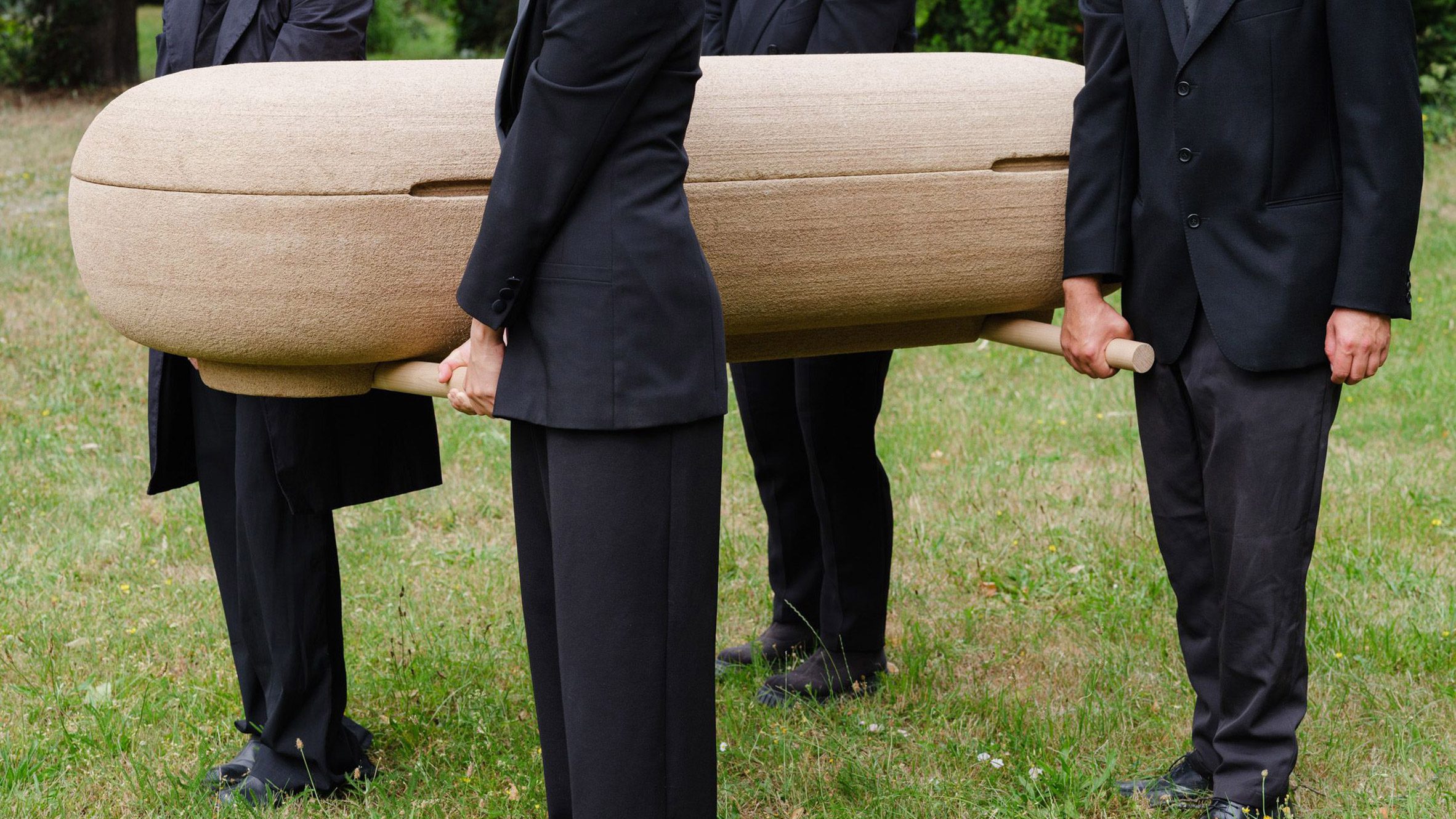
A folding sink and a room divider that provides natural air conditioning feature in Berlin's inaugural Find Attached exhibition, showcasing an arsenal of products from 14 emerging designers that make the most of limited resources. The emerging design show, founded by Jonas Paul Spieker, Mia Pahl and Jul Gross, took over part of a former 1900s shutter factory during the city's newly minted Currents festival. Find Attached includes projects by Lukas Henneberger (above) and Esmée Willemsen (top image) For the trio, who met while studying at Berlin's University of the Arts (UdK), the aim was to give a platform to young local designers, who are mostly left out of international design weeks. "We wanted to take the chance and just show people with a Berlin design connection," Spieker told Dezeen. "Because we thought: there's Milan, there's Copenhagen. But the Berlin design scene is not really shown anywhere in the spotlight." Garance Pröbsting created a natural air conditioner that works without electricity All of the projects in the show examine, in one way or another, how design can contribute to societal change. For many of the participating designers, this question was a cause to explore how we can learn to survive and thrive within the boundaries of our planet's limited resources. Mia Pahl's sponge-bath wash station was designed to conserve water Garance Pröbsting created a natural air conditioner that works completely without electricity, simply by wetting a textile divider via an integrated reservoir and allowing air to blow through the slash in the centre. "This is the oldest air conditioning in the world," Spieker explained during a tour of the exhibition. This Vloow Design Lab sink was designed to be folded away Find Attached's own Pahl focused instead on conserving water through the ritual of Katzenwäsche – a German term for a quick sponge bath that literally translates as "cat's wash". Instead of having seemingly endless water available on tap, her reimagined wash station requires users to fill a two-litre reservoir themselves and collects the wastewater at the end. It's a drastic improvement on the average shower, which consumes 176 litres of water and 6.1 kilowatt-hours of energy. "You can really save a lot of water if you skip showering," Spieker said. "And you have to collect the water so you can use it, so you are really involved in this process." Hygiene was also on the agenda for Vloow Design Lab. The studio, run by another trio of UdK students, used scrap truck tarp to create a fold-away sink for small spaces, while Marie Kurstjens designed a reusable menstrual kit for displaced people who lack access to clean water and hygiene products. Spieker himself looked to challenge the energy consumption and material wastage in the furniture industry with ImPerfekt – a series of CNC-milled wooden furniture, for which he skipped the final perfecting step. Jonas Paul Spieker's ImPerfekt series is CNC-milled What's left behind are roughly-hewn edges designed to irritate and prompt questions about how much imperfection we're able to tolerate in the pursuit of sustainability. "Normally you have two steps: so the rough milling and the perfecting step," he said. "And the step to perfect this surface is normally the same amount of time – or even more – and so the same amount of energy again." "It really asks the question: How acceptable can imperfection be?" he continued. An ice cube scarf is among a series of satirical objects by Paul Rees Traditional manufacturing processes were similarly under the magnifying glass with Esmée Willemsen, who created a customisable coffin using a 3D-printed wood replacement made from sawdust (top image). Nearby, Julia Huhnholz used the same material to create a modular shelving system. Paul Rees took a more tongue-in-cheek approach and created a series of satirical products for surviving a warming world, including a scarf formed from rubber ice-cube moulds. Emil Löber and Daniel Sauter exposed MDF to water to create purposely bloated furniture Also featured in the exhibition were a compact three-legged chair by Jul Gross, objects made from e-waste by Anna-Maria Argmann, a reimagined smoke detector by Emily Lechaux, experimental lights by Lion Sanguinette, purposefully waterlogged MDF furniture by Emil Löber and Daniel Sauter, and a satirical AI surveillance system by Lukas Henneberger. The exhibition formed part of the inaugural edition of Currents, founded by local design journalists Laura Ewert and Jasmin Jouhar in the hopes of finally giving Berlin the design festival it deserves. Other highlights from this year's event included the 20th anniversary exhibition of institutional Berlin design studio Llot Llov and an exhibition by Design Academy Eindhoven graduates together with Kaldewei. All imagery courtesy of Find Attached. Currents 2026 took place from 10 to 12 September 2026 at various locations across Berlin, Germany. For other design events around the world, visit Dezeen Events Guide. Read more: Sustainable design Product design Germany Berlin Student projects Graduates Climate change Sustainability Currents Furniture Products Design Subscribe to our newsletters Your email address New! Dezeen Agenda US Sent on alternate Fridays, this US edition of Dezeen Agenda is a fortnightly newsletter rounding up everything you need to know from America, featuring news, projects and interviews with industry figures. Plus occasional updates and invitations to Dezeen events. New! Dezeen Showroom New Releases A quarterly newsletter rounding up a selection of recently launched products by designers and studios, published on Dezeen Showroom. Dezeen Debate Our most popular newsletter, formerly known as Dezeen Weekly, is sent every Tuesday and features a selection of the best reader comments and most talked-about stories. Plus occasional updates on Dezeen’s services and breaking news. Dezeen Agenda Sent every Thursday and containing a selection of the most important news highlights. Plus occasional updates on Dezeen’s services and invitations to Dezeen events. Dezeen Daily A daily newsletter containing the latest stories from Dezeen. Dezeen In Depth Sent on the last Friday of every month, Dezeen in Depth features original feature articles, interviews and opinion pieces that delve deeper into the major stories shaping architecture and design. Dezeen Jobs Daily updates on the latest design and architecture vacancies advertised on Dezeen Jobs. Plus occasional news. Dezeen Jobs Weekly Weekly updates on the latest design and architecture vacancies advertised on Dezeen Jobs. Plus occasional news. Dezeen Awards News about our Dezeen Awards programme, including entry deadlines and announcements. Plus occasional updates. Dezeen Events Guide News from Dezeen Events Guide, a listings guide covering the leading design-related events taking place around the world. Plus occasional updates and invitations to Dezeen events. Dezeen Awards China News about our Dezeen Awards China programme, including entry deadlines and announcements. Plus occasional updates. We will only use your email address to send you the newsletters you have requested. We will never give your details to anyone else without your consent. You can unsubscribe at any time by clicking on the unsubscribe link at the bottom of every email, or by emailing us at [email protected]. For more details, please see our privacy notice. Thank you! You will shortly receive a welcome email so please check your inbox. You can unsubscribe at any time by clicking the link at the bottom of every newsletter.
Young Berlin designers do more with less at Find Attached exhibition
Full Article
Original Source
Read the full article at Dezeen →KhanList aggregates and links to publicly available news content. We do not host full articles from third-party sources. Always verify important information with original sources.