
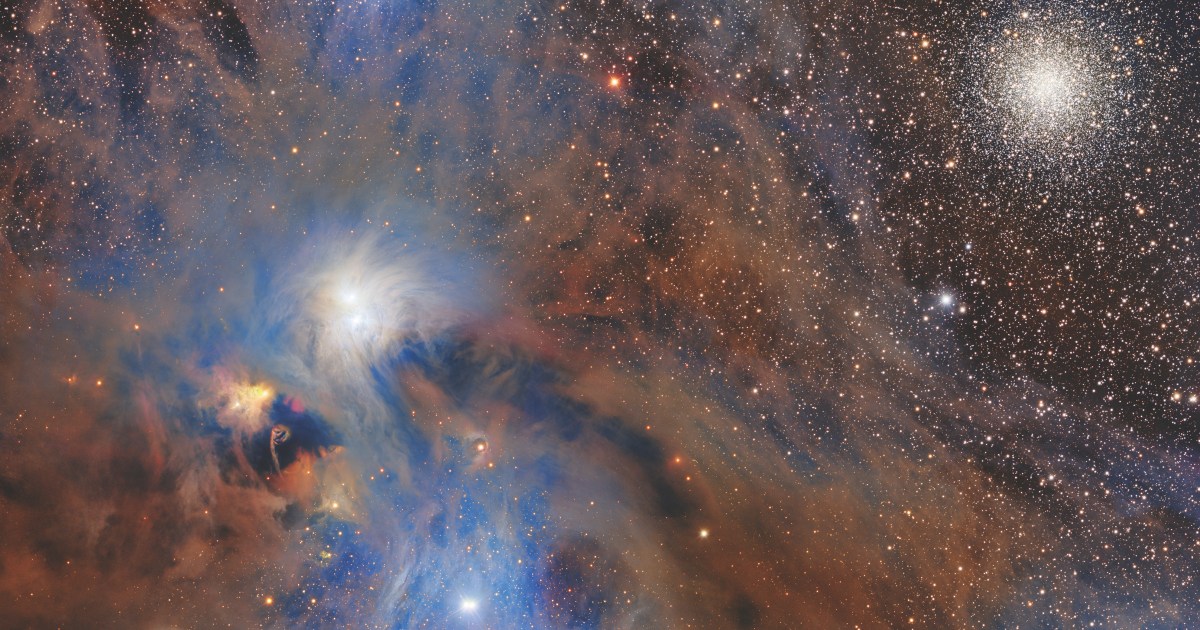
The young, star-forming Corona Australis Molecular Cloud shares this scene with the aged Chandelier globular cluster. | Published: November 22, 2026 Credit: Dark Energy Survey/DOE/FNAL/DECam/CTIO/NOIRLab/NSF/AURA Credit: Dark Energy Survey/DOE/FNAL/DECam/CTIO/NOIRLab/NSF/AURA A stunning stellar nursery lurks at the northern border of Corona Australis. The Corona Australis Molecular Cloud fills the left side of this image with glowing gas and dark dust. Although most of the newly forming stars remain hidden within this web, the variable R Coronae Australis just shines through. It dwells in the orange cloud to the lower left of the bright emission nebula that dominates just left of center. Several bluish reflection nebulae also populate this area. The molecular cloud lies 430 light-years away, among the closest star-forming regions to Earth, and holds enough material to create thousands of stars. Contrast that with the Chandelier Cluster (NGC 6723) at upper right. This globular contains hundreds of thousands of stars and resides about 28,000 light-years from us. It inhabits far southern Sagittarius. Richard Talcott is a former senior editor and current contributing editor of Astronomy.
Young and old stars share the southern sky
Full Article
Original Source
Read the full article at Astronomy →KhanList aggregates and links to publicly available news content. We do not host full articles from third-party sources. Always verify important information with original sources.