
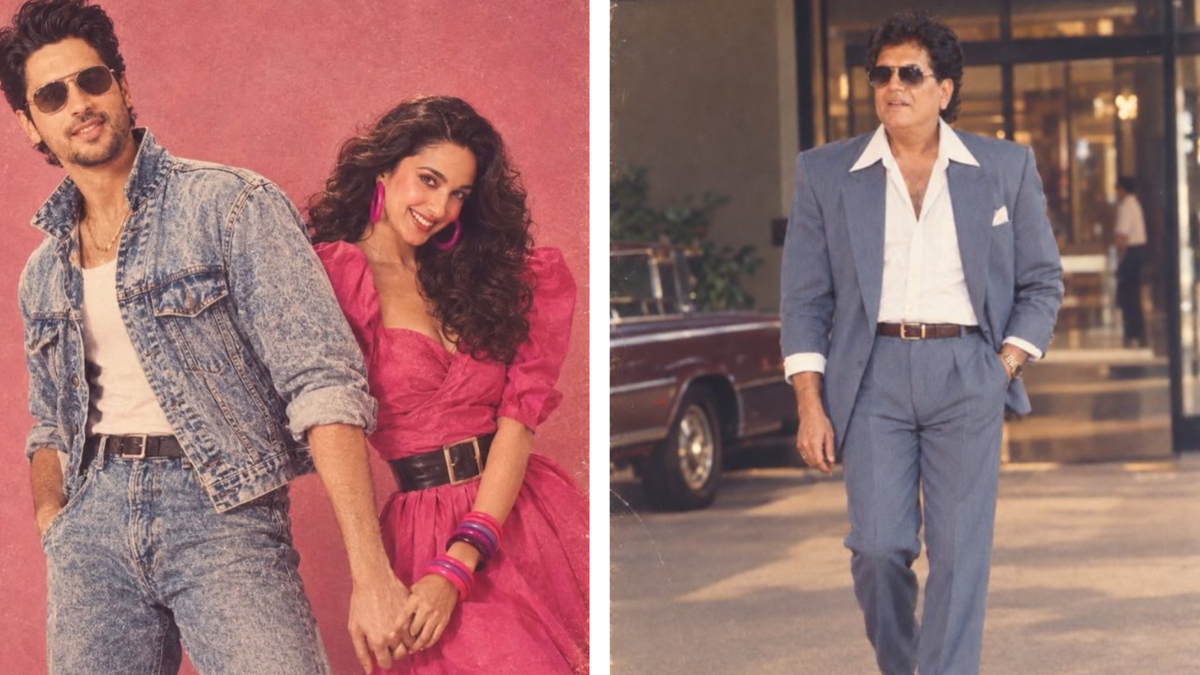
Every few weeks or months, Instagram finds a new way to make us all look the same while allowing each of us to feel individually “seen”. Before the 1980s trend, there was Studio Ghibli. Before that, some Disney character. And at some point, we were future, older versions of ourselves. I can’t keep track.Perhaps the next trend can show us what we would look like during a climate disaster. But only if it removes my pores and gives me a snatched waist. Too dark?Anyway, they say: “It’s just a bit of fun.” “One photo won’t kill the planet.” “#HadToTryThis.” Did you, though? Actor Sonakshi Sinha and husband Zaheer Iqbal hop on the ‘80s trend Social media has turned our desire to be seen into a daily fight for views, reach and proof that we exist. And with a prompt that makes us look “great”? Well, the attraction is almost irresistible.It feels urgent because what if we do it three days later and Instagram might forget to “push” it to “our audience”. The trend also allows us to ask for attention without having to admit that we would like attention. The template provides plausible deniability for vanity.“Please look at me” becomes “Look what AI did!” Piyush Goyal, Minister of Commerce and Industry Kiren Rijiju, Union Minister of Parliamentary Affairs Instagram has spent years training us in this behaviour, like lab mice in an experiment whose evil is matched only by its genius.Step 1. “Try this filter.”Step 2. “Add this hashtag.”Step 3. “Use this trending audio.”Step 4. “Check your insights.”Generative AI trends are simply better cheese: the promise of “creativity” without the inconvenience of imagination. Actor-singer Shruti Haasan For photographers (like me), illustrators and designers, there is additional absurdity and frustration. These systems are only able to produce these “imitations” because they have been trained on enormous collections of existing images, which include creative work taken without consent, credit or compensation. An artist spends decades developing a visual language and style. And now the rest of us can summon something resembling it while waiting at a traffic signal. The extraction is so convenient that it feels innocent. We see only the “fun” output.‘Not an actual cloud’Speaking of fun, India has just experienced its hottest August since temperature records began in 1901. Here in Chennai, this September, the heat feels like a guest that’s overstayed their welcome.By now, we all know that Generative AI images arrive from “the cloud”. Regrettably, the cloud, where we store our emails and pet photographs, is not an actual cloud. It is a building. A very, very large building, filled with machines demanding electricity, water and air-conditioning — so that I can find out whether I would have had better hair in 1987 (the answer is yes and I was 5).And of course, each individual image that we generate represents only a teeny-tiny fraction of that voracious demand. But a trend is never one image. Congress Seva Dal added Rahul Gandhi to the trend, generating an AI image of the leader of the Opposition sipping chaiIn the first week after OpenAI released its new image generator in March 2025, 130 million users generated more than 700 million images. OpenAI did not disclose how many were Ghibli imitations, how many reached Instagram or how many almost-identical versions each person rejected before choosing one. But 700 million images in a week tells us something important: what feels like one person having a little fun has the potential to become an industrial-scale activity — at a time when we are living through record heat, water stress, floods, fires, and increasingly violent weather.Monetising the trendOne AI portrait does not increase the planet’s temperature. And perhaps that is another trick of the system: while we argue about whether your AI selfie or my plastic straw is personally destroying the planet, the corporations building and monetising this infrastructure continue expanding it at extraordinary speed. Actor Parineeti Chopra and husband Raghav Chadha While we audit one another’s individual virtue and supply the photographs, prompts, attention and creative work, Meta gets the engagement, OpenAI gets the users, technology companies get the market value and their billionaire owners get even richer. And the climate conversation becomes a fight between ordinary people about who used a filter.Individual choices are not meaningless, but they do not all carry equal power. I can decide not to generate an AI portrait. I cannot decide where a company builds its next AI data centre, how much water it draws, what powers it, what material it trains on or whether any of those decisions are disclosed to the public. Cricketer Irfan Pathan The forgotten tagsIn all of this, the desire for these ridiculous images exposes something else. We want to play, belong, feel beautiful and imagine ourselves differently. We want to be seen. But the irony is that the machine does not see the “real us”. It only processes us, flatters us and returns us to ourselves neatly as content, ready to be “posted”.We forget to tag the artists whose work made the imitation possible. We forget to tag the workers and physical infrastructure behind the “cloud”. And we forget the communities elsewhere that will bear the costs.The writer is a photographer, an arts manager, and an educator.
You forgot to tag climate in your AI-slop ’80s selfie
Full Article
Original Source
Read the full article at Thehindu →KhanList aggregates and links to publicly available news content. We do not host full articles from third-party sources. Always verify important information with original sources.