
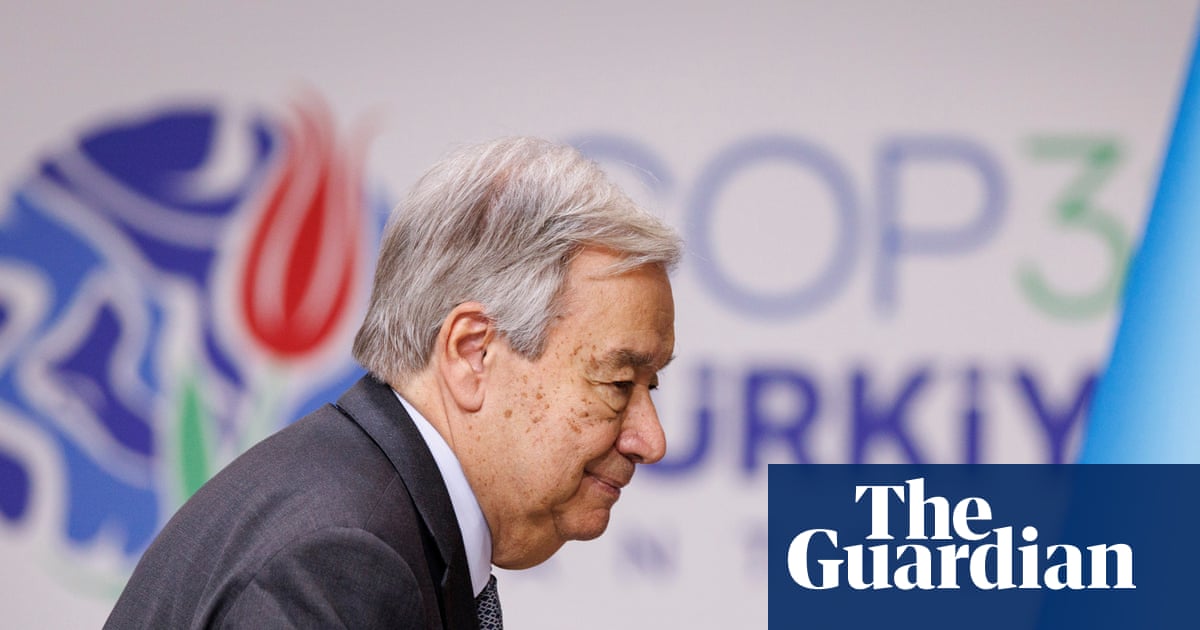
Tackling the climate crisis is central to all of human life and must be at the forefront of global governance, the outgoing UN secretary general has said in an emotional farewell address at the Cop31 climate summit.“You cannot build peace on a burning planet,” António Guterres said at his final climate press conference as secretary general on Friday. “You cannot eradicate poverty when climate disasters keep throwing people back into it. You cannot promise young people a better future while destroying the natural systems on which that future depends.”Guterres has been the most forthright secretary general yet on the subject of the climate, returning to it again and again to castigate fossil fuel companies and recalcitrant governments.He leaves office at the end of December and his successor is still unknown after Donald Trump tried to interject his preferred choices into the process. There are widespread fears that the next incumbent will downplay the climate crisis in favour of other issues.In a clear message to his successor, Guterres spelled out why the UN must continue to place the climate at the top of the global agenda. “Climate change does not stay in its lane,” he said. “It drives anger and displacement around the world. It wipes out development gains built over decades. It pushes countries deeper into deficit. It aggravates competition for land and water.“It fuels instability. And increasingly, it threatens the very existence of communities and countries. For all these reasons, I have never viewed climate action as just one of many other issues. Climate action is central to every aspect of the work of the UN.”Guterres was one of the few world leaders left at Cop by Friday afternoon as most of the more than 90 who had attended returned to their capitals, leaving negotiators to get down to tackling issues such as the electrification of the global economy and a just transition out of fossil fuel industries for workers.Guterres was one of the few world leaders left at Cop by Friday afternoon. Photograph: Mehmet Ali Ozcan/Anadolu/Getty ImagesThe Australian prime minister, Anthony Albanese, flew out after hosting a meeting between major international investors and Australian renewable energy companies, followed by a meeting with Taneti Maamau, the president of the low-lying Pacific nation of Kiribati. Albanese made raising the plight of his country’s Pacific neighbours a major part of his two and a half-days at the talks.The Australian co-presidency of the 31st “conference of the parties” to the UN framework convention on climate change issued a list of “reflections” that encapsulated the proposals countries had expressed since the talks began on Monday. This will form a loose basis for a first draft of the “cover decision”, the final negotiated document gavelled through at the end of the summit, which is likely to be the central outcome of Cop31.Recent cover decisions have produced significant progress: at Cop28, in Dubai in 2023, the cover decision included a global pledge to “transition away from fossil fuels”, and at Cop26, in Glasgow in 2021, a cover decision produced a requirement to “phase down” coal.This year, hoped-for resolutions include a target of deriving 35% of final energy worldwide from electricity by 2035, seen as one of the most important ways of decarbonising the global economy, and pledges to cut methane emissions, make progress on the phase-out of fossil fuels, and ensure adequate finance for developing countries hit by climate disaster.skip past newsletter promotionafter newsletter promotionThe “reflections” document gave a clear sense of how difficult it will be for Australia – which, in an unusual sharing arrangement, is presiding over the negotiations while Turkey hosts the talks – to forge an agreement before the scheduled end next Friday night.Chris Bowen, Australia’s climate and energy minister and the president of the negotiations, said: “We are making sure parties are being listened to as we progress negotiations. The reflection text is not a negotiating text. Nothing in it is prejudged, locked in or necessarily to be included in the final decision.”Countries will have until late on Saturday to respond, with an official draft cover decision text not expected until early next week.More than 100 companies and groups linked to fossil fuels were present at the talks, research revealed on Friday, despite efforts to clamp down on the presence of lobbyists in recent years.Prakash Dalal, of Pro Public/Friends of the Earth Nepal, criticised their presence. “Big polluters have caused loss of livelihood, emotional damage, trauma and survival challenges for our people,” he said. “We cannot tolerate the disproportionate space given to them compared to civil society and our country delegations.”
‘You cannot build peace on a burning planet,’ UN chief tells Cop31 in farewell speech
Full Article
Original Source
Read the full article at Theguardian →KhanList aggregates and links to publicly available news content. We do not host full articles from third-party sources. Always verify important information with original sources.